


Planning is advancing to create the world’s first solar energy station in space, capturing the sun’s rays 24 hours a day and providing the planet with a clean power source.
The futuristic project, which if successful could have a major impact on combating climate change, is being developed by British firm Space Solar, with financial support from Saudi Arabia.
Within six years, Space Solar aims to have a trial project providing six megawatts of power from low Earth orbit, eventually leading to a two-gigawatt power station in high geostationary orbit by 2035.
Sam Adlen, joint chief executive of Space Solar, welcomed the collaboration.
“There’s a real partnership to be developed that can have a huge impact on the future of net zero, energy security and help create an era-defining, new energy source,” he said. "Space-based solar power is the ultimate form of clean, dependable energy and our vision is for clean, affordable energy from space."
With the race for cosmic energy potentially highly lucrative, UK Business Secretary Grant Shapps suggested that “collaboration in space” could “unlock significant commercial opportunities”.
He travelled to Saudi Arabia last week to meet Abdullah Al Swaha, Minister of Communications and chairman of the Saudi Space Commission.
Science fact
For almost a century, the idea of using sonar panels in space to beam electricity down to Earth has largely been in the imagination, with Isaac Asimov writing a short story on the idea in 1941 before a more serious proposal in the 1960s.
Fantasy is now turning into reality.
“This has been science fiction for decades,” space systems architect Matt O’Donnell told The National.
“The calculations around the physics involved with the distances does require very, very large structures in space, building something that's truly enormous, the largest structure ever built by mankind.”
Viable space
Once the technology is developed and tested with smaller models, the power stations in space would cost the equivalent of a nuclear plant to build — about $10 billion — with a similar output of two gigawatts, enough to power more than 1.5 million homes.
With 5km-wide solar panels and at several times the size of the International Space Station, the structure would have to be assembled in space, with parts sent up via numerous rocket launches.
But that is becoming more financially viable, with the returnable rockets of SpaceX missions bringing down the costs.

A British government study has already concluded that space-based solar energy is viable. Another report from Nasa on the subject will be released later this year.
“That makes it look like a believable concept to the energy people who have got massive contracts to build and run enormous terrestrial power stations safe and well,” said Mr O’Donnell, of the global aerospace firm Airbus.
“With the gradual reduction in launch prices and hardware costs and improvements in putting robotics into space, the feeling is that with those three things we're on the cusp, where it could become technologically and economically viable within the next decade, but in order to get to that point we need to start now.”
Space Solar, based near Oxford, also argued that the government studies confirmed that the space energy is now technically viable and economically competitive with other renewables.
“It has low environmental impact, in land usage, carbon footprint and mineral resources,” its website stated. “The technology is highly flexible and can export energy to other co-operating nations without expensive fixed infrastructure such as underwater power cables. It can be switched rapidly to power hydrogen generation or water desalination plants, as well as providing electricity into the grid.”
How it works
Space Solar says the system comprises a kilometre-scale satellite in a high Earth orbit. It features lightweight solar panels and a system of mirrors to concentrate sunlight on to the panels.
The electricity generated is converted into high-frequency radio waves and the power is beamed to a receiving antenna at a fixed point on the ground below.
A ground receiver would likely be the North Sea, but it could also be in the futuristic city of Neom, the metropolis in north-west Saudi Arabia that will be entirely powered by carbon-free electricity.
The spacecraft’s solar array could easily be redirected from the North Sea to Neom.

Doubling demand
With the Earth’s population expected to exceed 10 billion by 2050 — the date set for net zero in global carbon emissions — the demands for clean energy are going to be immense.
One calculation suggests that Britain alone will need a 2km-wide belt of wind farms around its entire coastline to supply clean energy for its 68 million population.
With at least three billion people in the developing world requiring clean energy rather than fossil fuels — and that population is set to grow — the demand for energy globally will be extremely high.
“They could double especially with increased movement of population into cities and with the rest of the world needing access to good, clean energy,” said Mr O’Donnell.
“We can't do this with the existing technologies at sufficient scale, so all the ideas need to be on the table, including nuclear, more battery storage and the potential for space-based solar power.”
Airbus interest
Airbus, which manufactures nearly all the world’s aircraft wings as well as commercial and military satellites, has a keen interest in the project.
“We think it's important for building sustainable societies and the use of space to support the climate,” said its space expert Mr O’Donnell.
“Delivering power from space to replace fossil fuels is a novel way of making a direct contribution. Also, Airbus, as a system-of-systems integrator, understands how supply chains and management of complex things work that have safety of life implications.”
He added that with continued development in the wider world, billions of people “are going to want more energy and they should be given clean energy from the start”.
SaxaVord spaceport — in pictures
-
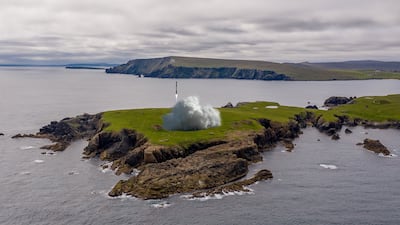
An illustration of a mock rocket taking off from Lamba Ness in Unst, one of Scotland's Shetland Islands. PA -
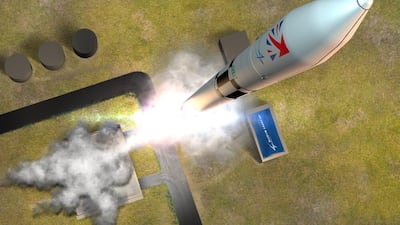
An illustration of the UK Pathfinder Rocket launch. Photo: Lockheed Martin -
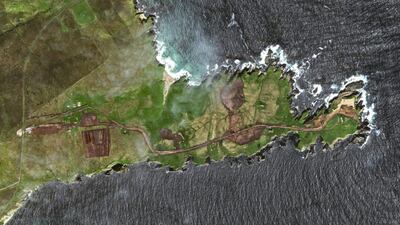
An aerial view of the SaxaVord site in the Shetland Islands. Photo: SaxaVord -
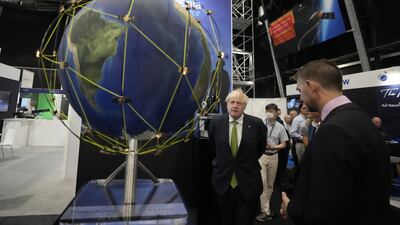
Former British prime minister Boris Johnson walks around the stall for SaxaVord during a visit to the Farnborough International Airshow in July. PA -
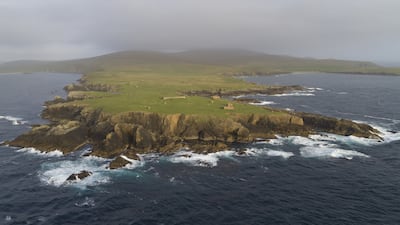
Lamba Ness in Unst. PA



