


Britain cannot afford to underestimate the threat Islamist terrorism continues to pose to its security, an expert has warned, amid growing emphasis on the rise of far-right ideology among prisoners.
Dr Paul Stott, head of security and extremism at Policy Exchange, said officials were shining a light on the threat of far-right terrorism while playing down that of Islamist extremism, which he argued was greater.
Dr Stott also warned of a possible resurgence of ISIS and what he considered a lack of focus by the UK on the Middle East.
In the year to September, 239 people were in custody for terrorism-related offences in Britain, Home Office figures showed. The number of extreme right-wing prisoners hit its highest level on record while the proportion classified as Islamist extremists fell to its lowest.
In an interview with The National, Dr Stott cautioned against using the data to misjudge the make-up of the UK’s terrorism landscape.
He highlighted the same set of statistics, which showed 155 (65 per cent) were Islamist extremists while 66 (28 per cent) were far-right extremists.
“It’s a great paradox,” Dr Stott said. “In my view, the British far-right is weaker than it has been at any point in my lifetime.
“I think it’s important that we see it in context.
“I don’t think it’s that difficult; it should be perfectly simple. There are two significant threats in terms of terrorism and one is bigger than the other.”
The Prevent strategy, the government's counter-terrorism programme, has in the past failed to acknowledge the severity of the threat posed by Islamist extremism, Dr Stott said. Instead, he said the government channelled more energy towards highlighting far-right risks or unclassified cases which are linked to mental health concerns.
The publication of a review of the strategy — which exists to prevent radicalisation and thwart terrorist attacks — has reportedly been delayed due to a row among ministers.
The policy came under renewed scrutiny after it was revealed that the home-grown terrorist who murdered Sir David Amess, a Conservative MP, had continued to plot his attack in secret after being referred to the programme.
There are high hopes that the review, led by William Shawcross, will lead to closed loopholes in the Prevent strategy.
Mr Shawcross, an experienced writer and commentator, was appointed to conduct the review in 2021. He was previously responsible for regulating aid groups across England and Wales in his role as chairman of the Charity Commission.
A shake-up of the policy is well overdue, Dr Stott said, adding that clarification on non-ideological terrorism is urgently needed.
Only 18 terrorist inmates (8 per cent) as of September were classified as having no specific ideology. Yet huge amounts of resources are being used by Prevent officials in trying to deal with cases in this bracket.
“I think what we’re looking for is a greater degree of focus,” Dr Stott said. “An enormous amount of Prevent referrals are being made for those showing mixed, unclear or unstable ideologies.
“It’s a catch-all category. I hope the Shawcross review will give some clarity to that because it does not appear to have the same logic or the same basis as Islamist or far-right extremism.
“It’s just not clear what these individuals are suffering from.
“The suspicion is that it is mental health support that is needed and it will be fast-tracked.”

Age a factor in radicalisation
The former researcher at the Henry Jackson Society and tutor at SOAS University of London said his years of experience in counter-terrorism suggested there were huge differences between how people came to be radicalised by different ideologies.
Dr Stott said it was common for groups of young men to be drawn to Islamist ideology, a trend the West saw in the huge numbers who moved to Syria to join ISIS, while the far-right is attractive to loners.
“If you look at the age profiles of far-right terrorists it often involves significantly older people,” he said, citing the killer of Labour MP Jo Cox and a Dover migrant centre fire-bomber as examples.
“They are people who are sometimes quite isolated and seek what will give them a degree of comfort.
“Lockdown may have influenced radicalisation. It would not be surprising because we’ve been through an extraordinary period.”
A government representative said. “The terrorist threat in the UK is complex and constantly evolving, which is why the government takes all forms of terrorism seriously — including the extreme right-wing. We are committed to tackling all those who spread views that promote violence and hatred against individuals and communities, and that radicalise others.
“Prevent remains a vital tool against radicalisation and has already changed and saved the lives of individuals from all walks of life, with over 3,000 people offered early interventions through the Channel programme."
Militias in fight against ISIS - in pictures
-
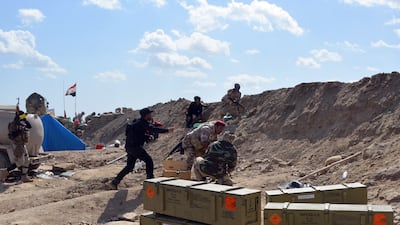
Iraqi government forces and allied militias take a position in the northern part of Diyala province as part of an assault to retake the city of Tikrit from ISIS, on March 2, 2015. All photos: AFP -
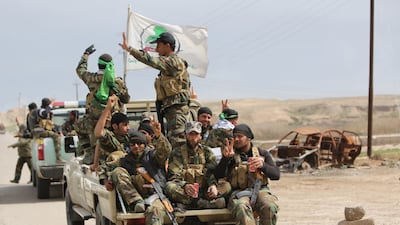
Members of the Iraqi paramilitary Popular Mobilisation units flash the 'V' for victory sign after regaining control of the village of Albu Ajil, near Tikrit, on March 9, 2015. -
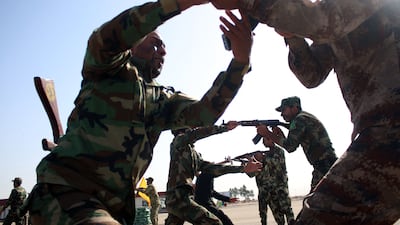
Fighters from a Popular Mobilisation unit take part in an exercise during their graduation ceremony in the southern Iraqi city of Basra, on April 9, 2015. -
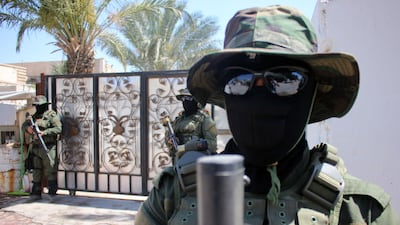
Iraqi fighters of the Shiite group Asaib Ahl Al Haq (The League of the Righteous) stand guard outside their headquarters on May 18, 2015, in the mainly Shiite southern city of Basra, as Shiite militias converged on Ramadi in a bid to recapture it from ISIS. -
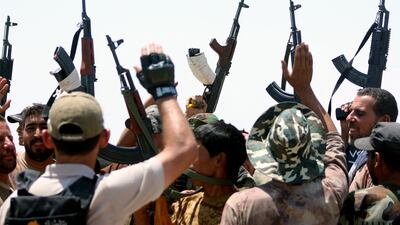
Iraqi government forces and members of the Popular Mobilisation units raise their weapons on the front line during battles with ISIS on the road leading to Saqlawiya, in Iraq's Anbar province, on August 4, 2015. -
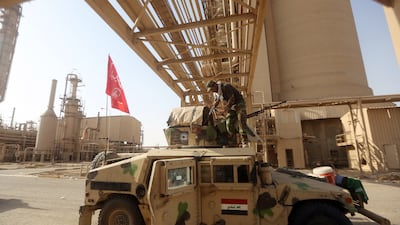
An Iraqi Shiite fighter cleans his weapon on his vehicle at the petrochemical plant in the town of Baiji, north of Tikrit, on October 16, 2015. -
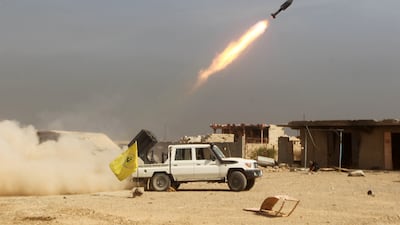
Iraqi Shiite fighters fire a rocket during a military operation against ISIS as they advance towards the centre of Baiji, about 200 kilometres north of Baghdad, on October 19, 2015. -
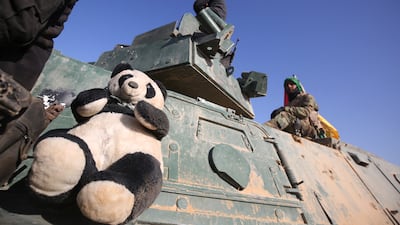
Iraqi Shiite fighters from the Hashed Al Shaabi paramilitaries advance in a desert area near the village of Tall Abtah, south-west of Mosul, on November 28, 2016, during a broad offensive by Iraq forces to retake Mosul from ISIS. -
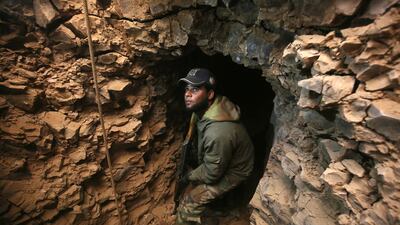
An Iraqi Shiite fighter from the Hashed Al Shaabi paramilitary forces inspects an underground tunnel in the town of Tal Abtah, south of Tal Afar, on December 10, 2016. -
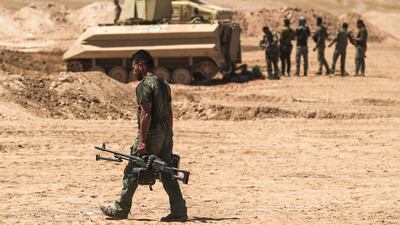
Iraqi pro-government forces advance towards the Unesco-listed ancient city of Hatra, south-west of Mosul, during an offensive to retake the area from ISIS fighters, on April 26, 2017. -
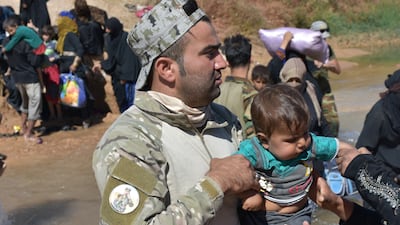
A fighter from the Hashed Al Sahaabi units helps displaced people who fled from battles to oust ISIS from Hawija cross a river in the area of Zarga, about 35km south-east of Kirkuk, on October 4, 2017. -
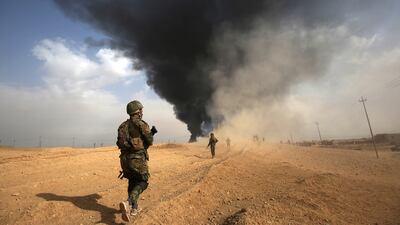
Iraqi forces advance towards the city of al-Qaim, in Iraq's western Anbar province near the Syrian border, as they fight against remnant pockets of ISIS forces, on November 3, 2017. -
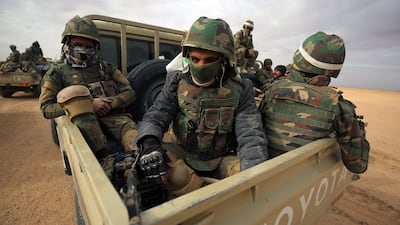
Iraqi forces ride in the back of pick-up trucks during the advance through Anbar province in the western desert bordering Syria, on November 25, 2017, to flush out remaining ISIS fighters in the region. -
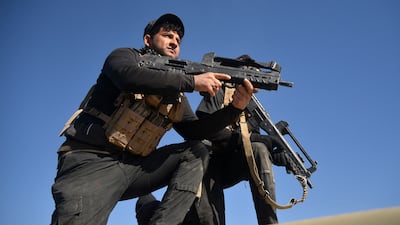
Members of the Iraqi forces and the Hashed Al Shaabi carry their firearms as they stand on an infanty-fighting vehicle near the Iraqi-Syrian border, about 80km west of the border town of al-Qaim, on December 9, 2017. -
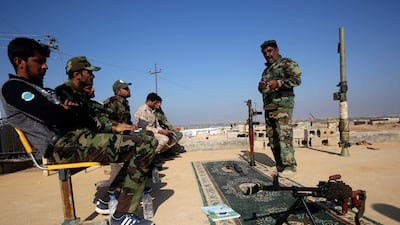
Abbas Hamza Hassan, a 56-year-old Iraqi fighter, is pictured on November 13, 2018 while training fellow Hashed members how to use weapons in the western Iraqi province of Anbar.


Lack of focus on Middle East is 'dangerous'
Security experts recently warned Britain and its allies should be braced for a possible resurgence of ISIS in Syria as early as this year.
They said the terrorists might try to liberate 10,000 of its fighters from Syrian prisons and detention camps as a way to rebuild its caliphate.
At the height of its rule, ISIS held a third of Syrian territory and 40 per cent of Iraq.
The Kurdish-led Syrian Democratic Forces are responsible for running prisons and camps housing ISIS fighters, and their wives and children.
Dr Stott said the possible return of ISIS should sound alarm bells in Britain and jolt the government into taking preventive action. He suggested the SDF needed more support to contain the threat before it is too late.
“There's very little focus in the UK on the Middle East at the moment,” he said. “That's potentially quite dangerous.
“It's the Kurds who are holding the line against ISIS. They were badly led down by [former US president Donald] Trump but support for the Kurds is important.
“What may well [happen] is they are not going to be able to do this indefinitely. If we don't have a resolution to this [ISIS fighters] may break out from prisons.
“There's also the issue that some of the young people who are coming of age in these camps are of fighting age and are ideal recruits for ISIS.”
In late 2019, Mr Trump astonished foreign policy experts and politicians in his own party by pulling support from the Kurds.
He did so by announcing a decision not to interfere with a planned Turkish military campaign into northern Syria, which left the US-allied forces at the mercy of a regime that considers them to be a terrorist group.

