


Britain’s first space mission failed due to a “premature shutdown” of the rocket’s second engine, Virgin Orbit has said.
After taking off from Cornwall on Monday night, the Virgin Orbit plane flew to an altitude of 10,600km over the Atlantic, where it launched a rocket containing nine small satellites towards space.
However, the rocket only achieved an altitude of 180km, rather than the required 555km, before it experienced a malfunction in its second engine.
Virgin Orbit called the cause of the failure an anomaly that “prematurely ended the first burn of the upper stage”.
The rocket’s first-stage engine performed smoothly, it said.
The second engine reportedly ignited for its first burn at an altitude of 105km as planned, but cut off after about one minute — several minutes early.
That ended the mission, resulting in the rocket components and payload falling back to Earth.
The company said on Thursday: “Later in the mission, at an altitude of approximately 180km, the upper stage experienced an anomaly.
“This anomaly prematurely ended the first burn of the upper stage. This event ended the mission, with the rocket components and payload falling back to Earth within the approved safety corridor without ever achieving orbit.”
The company said it had collected “an enormous quantity of data” which would allow its engineers to investigate the anomaly.
UK's Virgin Orbit space launch ends in failure — in pictures
-

Cosmic Girl, carrying the LauncherOne rocket under its left wing, on the runway in Cornwall. Getty -

The modified Boeing plane takes off from Spaceport Cornwall. PA -
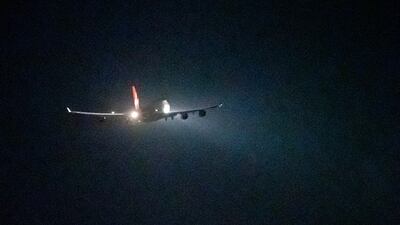
It flew to an altitude of 10,600km over the Atlantic, where it jettisoned the rocket containing nine small satellites. PA -
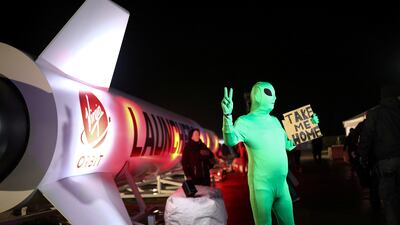
A model of Virgin Orbit's LauncherOne at Spaceport Cornwall. Reuters -

Spectators gather in Cornwall to watch the launch. Reuters -

Spaceport Cornwall merchandise for sale prior. Reuters -

The team hopes to try again within the next 12 months. Getty


It added: “Virgin Orbit has initiated a formal investigation into the source of the second-stage failure.”
The company has said it will try to launch the mission again before the end of the year.
LauncherOne was aimed at marking the start of a new development in the UK’s space ambitions, with the goal of sending scores of satellites into low-Earth orbit every year.
The launch was the culmination of an eight-year programme that has been driven by Spaceport Cornwall and the government to give Britain a sovereign space capability and allow it to become a player in the international race to harness the potential of the cosmos for life on Earth.
The programme has attracted international customers from the Middle East, Europe and the US and could lead to further engagement, particularly with the UAE’s space programme.
The plane, called Cosmic Girl, took off on Monday night from Cornwall Airport with hundreds of members of the public watching and more than 75,000 viewing a live stream of the event.
Named after the Rolling Stones’ 1981 hit, the mission involved a repurposed Virgin Atlantic Boeing 747 aircraft and Virgin Orbit’s LauncherOne rocket.
It was originally hoped the launch would take place before Christmas, but owing to technical and regulatory issues, it had to be pushed into 2023.
Virgin Orbit Cosmic Girl — in pictures
-
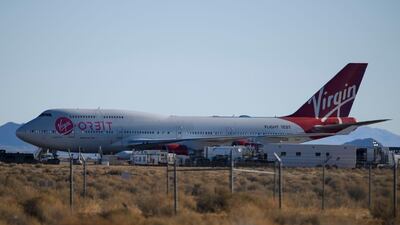
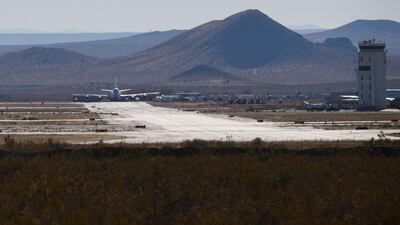
The Virgin Orbit Cosmic Girl – a modified Boeing plane carrying a LauncherOne rocket under its wing – is prepared for launch at Mojave Air and Space Port, California in 2021. All photos: AFP -
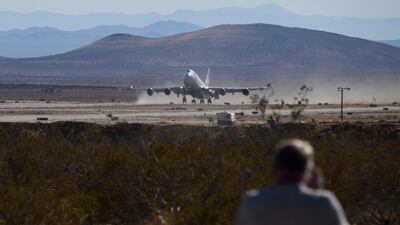
A photographer takes pictures of Cosmic Girl as it takes off from Mojave -
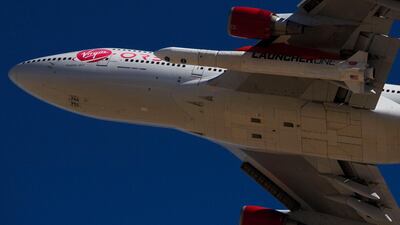
The LauncherOne rocket, which will release from the wing of the Boeing 747 before ignition, contains small research satellites for Nasa's Educational Launch of Nanosatellites 20 mission -
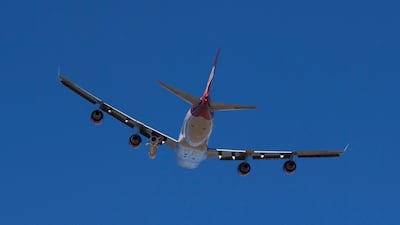
A shot of the Virgin Orbit Cosmic Girl from below -
Cosmic Girl releases a rocket in mid-air when the plane reaches a target altitude -

The aircraft returns to the runway and the rocket carries the satellite payloads into low-Earth orbit



