


The Parthenon sculptures known as the Elgin Marbles should not be returned to Greece because they "belong here in the UK", Culture Secretary Michelle Donelan said on Wednesday.
The artefacts are housed in the British Museum.
Britain and Greece recently began new talks over a possible deal to end the long-running dispute.
Athens wants a permanent return from the British Museum of the 2,500-year-old sculptures, which were removed from the Parthenon temple in the early 19th century by British diplomat Lord Elgin, then ambassador to the Ottoman Empire.
The Parthenon, which is on the Acropolis in Athens, was completed in the 5th century BC as a temple to the goddess Athena, and its decorative friezes contain some of the greatest examples of ancient Greek sculpture.
The British Museum has always ruled out returning the parts in its collection, which include about half of the 160-metre frieze that adorned the Parthenon. It insists that they were acquired legally.
Britain's Daily Telegraph newspaper reported last week that the marbles could soon be returned as part of a "cultural exchange" being negotiated with Athens.
The deal, effectively a loan agreement, could see the 2,500-year-old antiquities returned "sooner rather than later", it reported.
Such an arrangement could circumvent a legal ban on the museum breaking up its vast collection.
The Elgin Marbles - in pictures
-
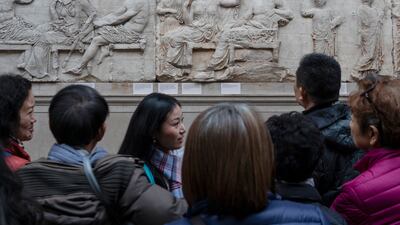
Sections of the Elgin Marbles, also known as the Parthenon Marbles, are displayed at The British Museum in London. Getty Images -

Greece has repeatedly called for the permanent return from the British Museum of the 2,500-year-old sculptures. AP -
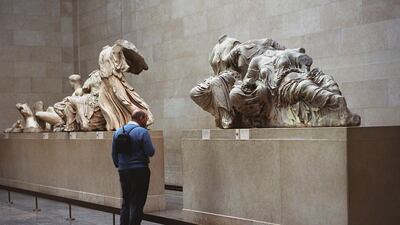
The British Museum has ruled out returning the marbles, which include about half of the 160-metre frieze that adorned the Parthenon, insisting that they were legally acquired. Getty Images -
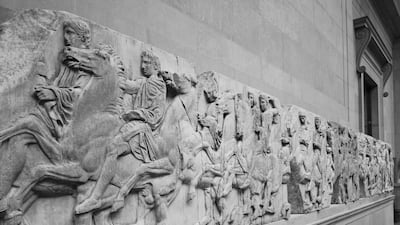
The Elgin Marbles on display in the Duveen Gallery at the British Museum in 1971. Getty Images -

Archaeologist Sir Mortimer Wheeler listens to the newly available audio guide in the Duveen Gallery of the British Museum in 1964. Getty Images -
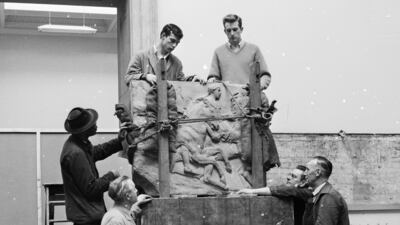
Workmen unload a portion of the Parthenon frieze before affixing it to the wall in the new Elgin Marbles room of the British Museum in 1961. Getty Images


It would probably involve some objects being sent by London on a long-term loan basis and Athens reciprocating with some ancient Greek treasures.
But any loan deal not expected to end the long-running dispute over the 17 sculptures and part of a frieze.
Ms Donelan told BBC Radio 4 that George Osborne, the chairman of the British Museum, did not intend to permanently return the marbles.
She said sending the sculptures to Greece would "open a can of worms" and be a "dangerous road to go down".
It would "open the gateway to the question of the entire contents of our museums", Ms Donelan said.
Greek newspaper Ta Nea reported in December that talks between Mr Osborne and the government in Athens were at "an advanced stage".
Law prevents the British Museum from permanently returning the artworks to Greece.
Greece has been pushing for years to get the artworks back and accuses Lord Elgin of theft. It does not recognise the British Museum as owner of the sculptures.
Today’s announcement that the law will not be changed will be met with anger in Athens and beyond.
The artefacts' return remains a highly sensitive subject as the British Museum's vast collection includes many items now considered by other countries to be loot taken by builders of the British Empire, and the government is wary of setting a precedent.

Ms Donelan said she had "several conversations" with Mr Osborne, the former chancellor.
"I think his view on this has been misinterpreted and certainly portrayed wrongly," she said. "He's not about to send them back, basically. That's not his intention. He has no desire to do that.
"There's also been this concept of a 100-year loan mooted as well, which is certainly not what he's planning either.
"He would agree with me that we shouldn't be sending them back, and actually they do belong here in the UK, where we've cared for them for a great deal of time, where we've allowed access to them."
Meanwhile, Greek Prime Minister Kyriakos Mitsotakis on Wednesday dismissed reports of the Elgin Marbles' an imminent return.
In a televised meeting with President Katerina Sakellaropoulou, conservative premier Mr Mitsotakis, whose term ends in July, said he hoped to have the sculptures returned if he won a second term.
"I don't expect immediate results, but I believe that we have already moved very systematically," he said.
"If the Greek people trust us again, I believe we could achieve this target after the elections."
Mr Mitsotakis said Greece wanted the antiquities returned so that "not only we, Greeks, but everyone, including our visitors, see and enjoy this universal monument in its entirety, in its natural space, which is none other than the Acropolis Museum".

Everything you need to know about the controversial Elgin Marbles
The sculptures are remnants of a 160 metre frieze that ran around the outer walls of the Parthenon temple on the Acropolis, dedicated to Athena, goddess of wisdom.
The Parthenon was built between 447-432 BC and is considered the crowning work of classical architecture.
Much was lost in a 17th-century bombardment, and about half of the remaining works were removed in the early 19th century by British diplomat Lord Elgin, and given to the British Museum.
Return of Parthenon fragment to Greece reignites campaign for UK to hand over marbles - video
Why is there a controversy?
The sculptures' presence in Britain has been the subject of continuing controversy and debate that has raged for decades.
Greece maintains they were taken illegally during the country's Turkish occupation and should be returned for display in Athens, which the British Museum and the government have previously rejected.
In December, Pope Francis decided to send back to Greece the three fragments of Parthenon sculptures that the Vatican museums have held for centuries.
Where are they housed?
Of the 50 per cent of the original sculptures that survived, about half are in the British Museum and half in Athens, the museum says.
The 17 sculptures have been in the British Museum since 1816, apart from spending the war years safely stashed in a Tube station.
The sculpture of the river god Ilissos was temporarily lent to St Petersburg State Hermitage Museum in Russia.
Neil MacGregor, a former director of the British Museum, resigned after he backed the the move to lend a section of the display to Russia.
In 2009, the Acropolis Museum was built to house the sculptures that remain in Greece alongside other treasures.
What has the Greek government previously said?
A formal request for the permanent return of all of the Parthenon sculptures in the Museum's collection to Greece was first made in 1983, and discussions have been continuing since.
Mr Mitsotakis has on many occasions called for the marbles to be returned, even offering to lend some of his country's other treasures to the British Museum in exchange.
In recent years, a team of London lawyers including Amal Clooney, wife of Hollywood film star George Clooney, were involved in talks with the Greek government about a possible legal bid for the works.
Successive Greek governments have "refused to acknowledge" the Trustees' title to the Parthenon sculptures, the British Museum said.

