A plane over the southern runway at London Heathrow Airport. PA

UK government funds green-energy projects that could fuel guilt-free flights


Soraya Ebrahimi
  • English
  • Arabic

A share of a £165 million ($199 million) fund has been pledged to projects that turn household rubbish into fuel for “guilt-free flying” on jets.

Sustainable aviation fuel (SAF) plants in Teesside, Immingham and Ellesmere Port that will convert domestic and commercial waste are some of the projects to benefit from the fund.

A project in Port Talbot, southern Wales, will convert steel mill emissions into fuel and another scheme will develop a plant creating fuel using carbon captured from a gas-fired power station, and hydrogen made from renewable electricity.

“Using waste or by-products to refuel airliners sounds like a flight of fancy, but thanks to £165 million of government funding it’s going to help us make guilt-free flying a reality," said Transport Secretary Mark Harper.

“It’s exactly this kind of innovation that will help us create thousands of green jobs across the country and slash our carbon emissions.”

The Department for Transport said the five projects would produce more than 300,000 tonnes of SAF a year, enough to fly to the Moon and back an estimated 60 times.

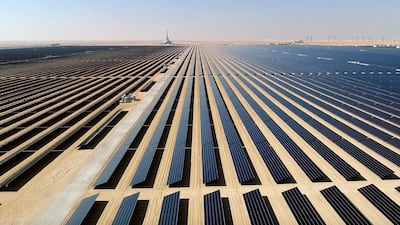
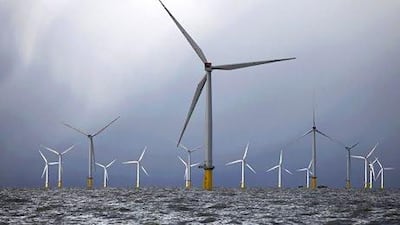
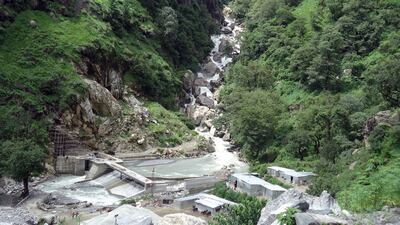
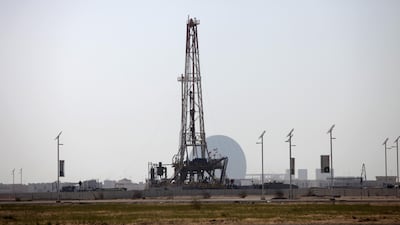
Green energy sources - in pictures

The successful projects will also cut carbon dioxide emissions by an average of 200,000 tonnes a year when fully operational.

The latest allocation of cash from the advanced fuels fund came after the announcement that Virgin Atlantic will operate the world’s first “net zero” transatlantic flight next year.

The airline secured £1 million of government funding to fly a Boeing 787 jet from London Heathrow to New York JFK using SAF instead of kerosene.


UAE currency: the story behind the money in your pockets
How Voiss turns words to speech

The device has a screen reader or software that monitors what happens on the screen

The screen reader sends the text to the speech synthesiser

This converts to audio whatever it receives from screen reader, so the person can hear what is happening on the screen

A VOISS computer costs between $200 and $250 depending on memory card capacity that ranges from 32GB to 128GB

The speech synthesisers VOISS develops are free

Subsequent computer versions will include improvements such as wireless keyboards

Arabic voice in affordable talking computer to be added next year to English, Portuguese, and Spanish synthesiser

Partnerships planned during Expo 2020 Dubai to add more languages

At least 2.2 billion people globally have a vision impairment or blindness

More than 90 per cent live in developing countries

The Long-term aim of VOISS to reach the technology to people in poor countries with workshops that teach them to build their own device

Mercer, the investment consulting arm of US services company Marsh & McLennan, expects its wealth division to at least double its assets under management (AUM) in the Middle East as wealth in the region continues to grow despite economic headwinds, a company official said.

Mercer Wealth, which globally has $160 billion in AUM, plans to boost its AUM in the region to $2-$3bn in the next 2-3 years from the present $1bn, said Yasir AbuShaban, a Dubai-based principal with Mercer Wealth.

Within the next two to three years, we are looking at reaching $2 to $3 billion as a conservative estimate and we do see an opportunity to do so,” said Mr AbuShaban.

Mercer does not directly make investments, but allocates clients’ money they have discretion to, to professional asset managers. They also provide advice to clients.

“We have buying power. We can negotiate on their (client’s) behalf with asset managers to provide them lower fees than they otherwise would have to get on their own,” he added.

Mercer Wealth’s clients include sovereign wealth funds, family offices, and insurance companies among others.

From its office in Dubai, Mercer also looks after Africa, India and Turkey, where they also see opportunity for growth.

Wealth creation in Middle East and Africa (MEA) grew 8.5 per cent to $8.1 trillion last year from $7.5tn in 2015, higher than last year’s global average of 6 per cent and the second-highest growth in a region after Asia-Pacific which grew 9.9 per cent, according to consultancy Boston Consulting Group (BCG). In the region, where wealth grew just 1.9 per cent in 2015 compared with 2014, a pickup in oil prices has helped in wealth generation.

BCG is forecasting MEA wealth will rise to $12tn by 2021, growing at an annual average of 8 per cent.

Drivers of wealth generation in the region will be split evenly between new wealth creation and growth of performance of existing assets, according to BCG.

Another general trend in the region is clients’ looking for a comprehensive approach to investing, according to Mr AbuShaban.

“Institutional investors or some of the families are seeing a slowdown in the available capital they have to invest and in that sense they are looking at optimizing the way they manage their portfolios and making sure they are not investing haphazardly and different parts of their investment are working together,” said Mr AbuShaban.

Some clients also have a higher appetite for risk, given the low interest-rate environment that does not provide enough yield for some institutional investors. These clients are keen to invest in illiquid assets, such as private equity and infrastructure.

“What we have seen is a desire for higher returns in what has been a low-return environment specifically in various fixed income or bonds,” he said.

“In this environment, we have seen a de facto increase in the risk that clients are taking in things like illiquid investments, private equity investments, infrastructure and private debt, those kind of investments were higher illiquidity results in incrementally higher returns.”

The Abu Dhabi Investment Authority, one of the largest sovereign wealth funds, said in its 2016 report that has gradually increased its exposure in direct private equity and private credit transactions, mainly in Asian markets and especially in China and India. The authority’s private equity department focused on structured equities owing to “their defensive characteristics.”

Who's who in Yemen conflict

Houthis: Iran-backed rebels who occupy Sanaa and run unrecognised government

Yemeni government: Exiled government in Aden led by eight-member Presidential Leadership Council

Southern Transitional Council: Faction in Yemeni government that seeks autonomy for the south

Habrish 'rebels': Tribal-backed forces feuding with STC over control of oil in government territory

Updated: December 22, 2022, 1:00 AM