Alistair Burt, a former Middle East minister, has said Iraq's leaders must take on the country's challenges and not simply hope that partners like the UK can play a greater role in the reconstruction of the state.
Almost 20 years after British troops took part in a coalition invasion of Iraq, Mr Burt said he is routinely asked why the UK government chooses to take a backseat role in the rebuilding of the nation and establishment of a post-Saddam democratic system. “I think it's perfectly clear now that the issue of the determination of the future of governance in Iraq will be quite properly in the hands of the Iraqi people and those who are elected and guiding them,” he said.
“It won't be in the hands of anyone from outside.”
The British Army maintains a presence in the country but this is solely in training capacity aimed at equipping local forces with the skills needed to prevent a resurgence of Isis.
In recent years and months Iraq has been blighted by a litany of issues including systemic corruption, high unemployment, poverty, mass protests and political crises.
Iraq’s parliament last month approved a new government set up by Prime Minister Mohammed Shia Al Sudani, ending more than a year of deadlock. But challenges remain and despite Baghdad earning record oil income due to high crude prices, the country’s 42 million citizens live with many unknowns.
Mr Burt, who served as Middle East minister in the UK’s Foreign Office and international development minister from 2017 to 2019, pushed back against voices urging Britain to do more to alleviate Iraq's social and political problems.
Speaking at the Iraq Initiative conference at Chatham House, a London-based think tank, he argued against the theme of “it’s all our fault” and said it would not be Britain’s place to play a more central role.
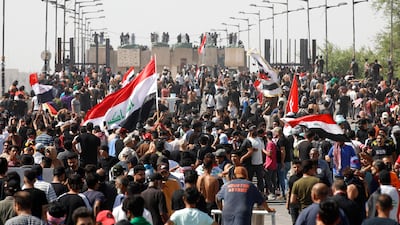
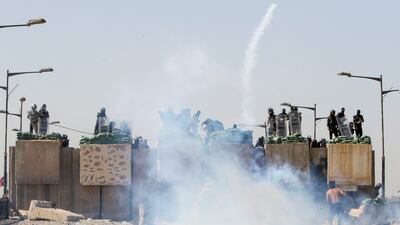
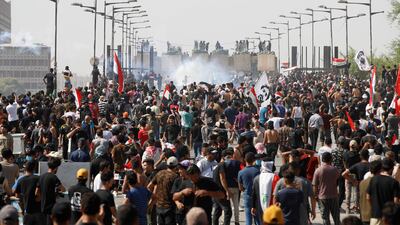
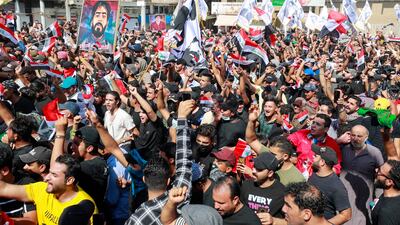
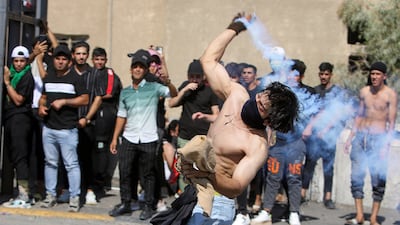
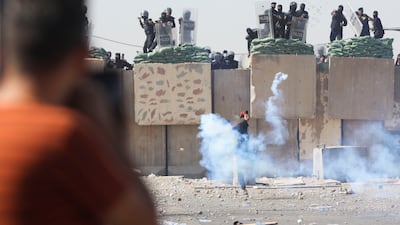
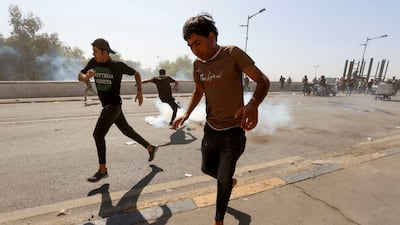
He pointed to the series of demonstrations and civil disobedience that sprung up in 2019 in protest against corruption, political sectarianism, interventionism and lack of jobs. Mr Burt said the voices of the Iraqi people must be heard by the elite in Baghdad if the country is to move towards a promising future.
He suggested the UK’s role in Iraq today consists largely of encouraging elected officials to engage with Iraqis and listen to their concerns.
“Unless those voices are listened to, then the direction of governments will not be where Iraq needs to be and not be where Iraq will be secure,” he said. “[They are] the voices that need to be heard by government and that's what we’re doing.”
Jennifer Gavito, deputy assistant secretary of state for Near East Affairs at the US Department of State, struck a similar tone to Mr Burt. She told the audience that although the US intends to play a role in the reconstruction of post-war Iraq for years to come, it cannot provide the political will for change so many Iraqis are crying out for.
The US mission in Iraq formally concluded in December 2021.
On the question of how Iraq’s problems can be addressed, she said “the answer lies with the Iraqis not with a imposed solution”.
“We have invested heavily in providing the Iraqi security forces with the training needed in order to take on the mantle of security for its own country,” she said. “Political will is something that as Alistair notes, we can't provide.”
Anti-government demonstrations in Iraq - in pictures
Britain's travel restrictions
- A negative test 2 days before flying
- Complete passenger locator form
- Book a post-arrival PCR test
- Double-vaccinated must self-isolate
- 11 countries on red list quarantine
The specs
Engine: 2.5-litre, turbocharged 5-cylinder
Transmission: seven-speed auto
Power: 400hp
Torque: 500Nm
Price: Dh300,000 (estimate)
On sale: 2022
FIGHT%20CARD
%3Cp%3EAnthony%20Joshua%20v%20Otto%20Wallin%2C%2012%20rounds%2C%20heavyweight%3C%2Fp%3E%0A%3Cp%3EDeontay%20Wilder%20v%20Joseph%20Parker%2C%2012%20rounds%2C%20heavyweight%3C%2Fp%3E%0A%3Cp%3EDmitry%20Bivol%20v%20Lyndon%20Arthur%2C%2012%20rounds%2C%20light%20heavyweight%3C%2Fp%3E%0A%3Cp%3EDaniel%20Dubois%20v%20Jarrell%20Miller%2C%2012%20rounds%2C%20heavyweight%3C%2Fp%3E%0A%3Cp%3EFilip%20Hrgovic%20v%20Mark%20de%20Mori%2C%2012%20rounds%2C%20heavyweight%C2%A0%3C%2Fp%3E%0A%3Cp%3EArslanbek%20Makhmudov%20v%20Agit%20Kabayel%2C%2012%20rounds%2C%20heavyweight%C2%A0%3C%2Fp%3E%0A%3Cp%3EFrank%20Sanchez%20v%20Junior%20Fa%2C%2012%20rounds%2C%20heavyweight%C2%A0%3C%2Fp%3E%0A%3Cp%3EJai%20Opetaia%20v%20Ellis%20Zorro%2C%2012%20rounds%2C%20cruiserweight%3C%2Fp%3E%0A
BUNDESLIGA FIXTURES
Saturday, May 16 (kick-offs UAE time)
Borussia Dortmund v Schalke (4.30pm)
RB Leipzig v Freiburg (4.30pm)
Hoffenheim v Hertha Berlin (4.30pm)
Fortuna Dusseldorf v Paderborn (4.30pm)
Augsburg v Wolfsburg (4.30pm)
Eintracht Frankfurt v Borussia Monchengladbach (7.30pm)
Sunday, May 17
Cologne v Mainz (4.30pm),
Union Berlin v Bayern Munich (7pm)
Monday, May 18
Werder Bremen v Bayer Leverkusen (9.30pm)
THE DETAILS
Kaala
Dir: Pa. Ranjith
Starring: Rajinikanth, Huma Qureshi, Easwari Rao, Nana Patekar
Rating: 1.5/5
The specs
Engine: 2.0-litre four-cylinder turbo
Power: 178hp at 5,500rpm
Torque: 280Nm at 1,350-4,200rpm
Transmission: seven-speed dual-clutch auto
Price: from Dh209,000
On sale: now
TO%20CATCH%20A%20KILLER
%3Cp%3E%3Cstrong%3EDirector%3A%20%3C%2Fstrong%3EDamian%20Szifron%3C%2Fp%3E%0A%3Cp%3E%3Cstrong%3EStars%3A%3C%2Fstrong%3E%20Shailene%20Woodley%2C%20Ben%20Mendelsohn%2C%20Ralph%20Ineson%3C%2Fp%3E%0A%3Cp%3E%3Cstrong%3ERating%3A%3C%2Fstrong%3E%202%2F5%3C%2Fp%3E%0A
Mercer, the investment consulting arm of US services company Marsh & McLennan, expects its wealth division to at least double its assets under management (AUM) in the Middle East as wealth in the region continues to grow despite economic headwinds, a company official said.
Mercer Wealth, which globally has $160 billion in AUM, plans to boost its AUM in the region to $2-$3bn in the next 2-3 years from the present $1bn, said Yasir AbuShaban, a Dubai-based principal with Mercer Wealth.
“Within the next two to three years, we are looking at reaching $2 to $3 billion as a conservative estimate and we do see an opportunity to do so,” said Mr AbuShaban.
Mercer does not directly make investments, but allocates clients’ money they have discretion to, to professional asset managers. They also provide advice to clients.
“We have buying power. We can negotiate on their (client’s) behalf with asset managers to provide them lower fees than they otherwise would have to get on their own,” he added.
Mercer Wealth’s clients include sovereign wealth funds, family offices, and insurance companies among others.
From its office in Dubai, Mercer also looks after Africa, India and Turkey, where they also see opportunity for growth.
Wealth creation in Middle East and Africa (MEA) grew 8.5 per cent to $8.1 trillion last year from $7.5tn in 2015, higher than last year’s global average of 6 per cent and the second-highest growth in a region after Asia-Pacific which grew 9.9 per cent, according to consultancy Boston Consulting Group (BCG). In the region, where wealth grew just 1.9 per cent in 2015 compared with 2014, a pickup in oil prices has helped in wealth generation.
BCG is forecasting MEA wealth will rise to $12tn by 2021, growing at an annual average of 8 per cent.
Drivers of wealth generation in the region will be split evenly between new wealth creation and growth of performance of existing assets, according to BCG.
Another general trend in the region is clients’ looking for a comprehensive approach to investing, according to Mr AbuShaban.
“Institutional investors or some of the families are seeing a slowdown in the available capital they have to invest and in that sense they are looking at optimizing the way they manage their portfolios and making sure they are not investing haphazardly and different parts of their investment are working together,” said Mr AbuShaban.
Some clients also have a higher appetite for risk, given the low interest-rate environment that does not provide enough yield for some institutional investors. These clients are keen to invest in illiquid assets, such as private equity and infrastructure.
“What we have seen is a desire for higher returns in what has been a low-return environment specifically in various fixed income or bonds,” he said.
“In this environment, we have seen a de facto increase in the risk that clients are taking in things like illiquid investments, private equity investments, infrastructure and private debt, those kind of investments were higher illiquidity results in incrementally higher returns.”
The Abu Dhabi Investment Authority, one of the largest sovereign wealth funds, said in its 2016 report that has gradually increased its exposure in direct private equity and private credit transactions, mainly in Asian markets and especially in China and India. The authority’s private equity department focused on structured equities owing to “their defensive characteristics.”