


The Zayed Centre for Research into Rare Disease in Children is celebrating another year of achievements, including a key role in an investigation into the cause of a global spate of paediatric hepatitis cases.
Experts at the centre, which is based at Great Ormond Street Hospital for Children (Gosh), were called on by the UK government to help explain what was behind the unusual rise in liver inflammation in children.
Hundreds of cases have been recorded across the globe in 35 countries this year.
The UK Health Security Agency (UKHSA) first called on the Zayed Centre’s expertise in April.
By July, experts based there were able to report that co-infection with two viruses may have caused the onset of severe liver disease in the affected children.
A separate study in Scotland later corroborated the results.
The findings provide the world's first example of adeno-associated viruses being implicated in disease, according to the centre, which was named in honour of Sheikh Zayed by his wife Sheikha Fatima bint Mubarak, Chairwoman of the General Women's Union, President of the Supreme Council for Motherhood and Childhood, and Supreme Chairwoman of the Family Development Foundation.
The centre, which has just celebrated its third anniversary, is also working on cell therapies to treat childhood cancers, among other areas.
Louise Parkes, chief executive at Gosh Charity, said: “The Zayed Centre for Research is a powerful example of how proximity of researchers, clinicians and patients can propel research and collaboration to help the lives of seriously ill children around the world.
-
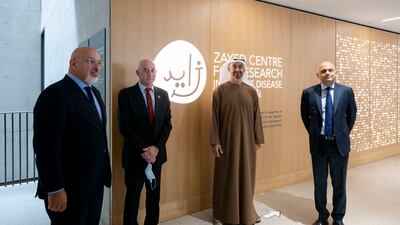
Sheikh Mohamed at the Zayed Centre in 2021 with the former UK health minister Sajid Javid, right, and former UK education minister Nadhim Zahawi, left. All photos: Ministry of Presidential Affairs -

Sheikh Mohamed and Sheikh Hamdan bin Mohamed bin Zayed during the visit to the Zayed Centre for Research into Rare Disease in Children. -
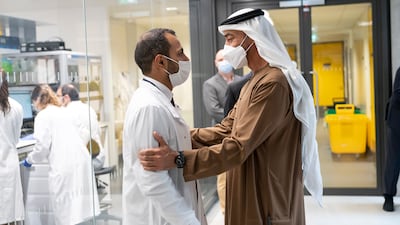
Sheikh Mohamed speaks with Mohamed Al Ameri, researcher and PhD candidate. -
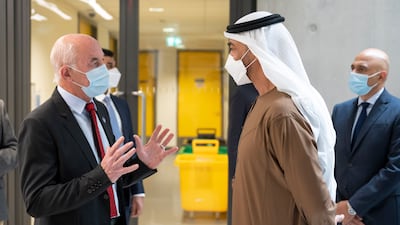
Sheikh Mohamed visits the Zayed Centre for Research into Rare Disease in Children, located in London. -
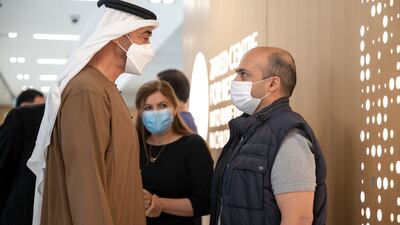
Sheikh Mohamed speaks with a family member of a patient at the centre. -
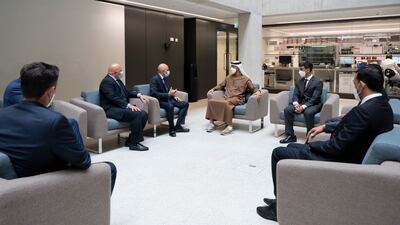
Sheikh Mohamed and Sheikh Hamdan hold a meeting with Mr Javid, the former UK health secretary, at the centre. -

Sheikh Hamdan attends a meeting with the former UK health secretary at the centre. -
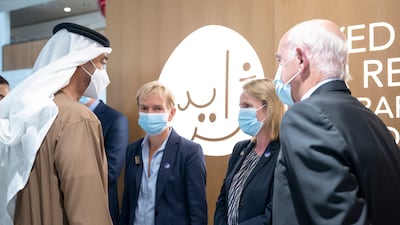
Sheikh Mohamed toured the centre, meeting researchers, professors and doctors working on pioneering research and life-saving treatments. -
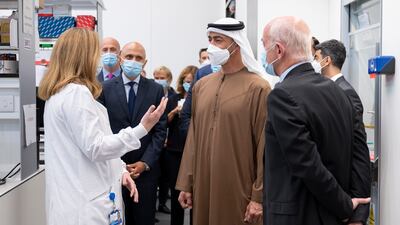
Sheikh Mohamed visiting the centre in 2021, which will celebrate its fourth anniversary in October. -

Sheikh Mohamed was briefed on the centre’s specialist facilities that have enabled it to play a vital role in the global response to Covid-19. -
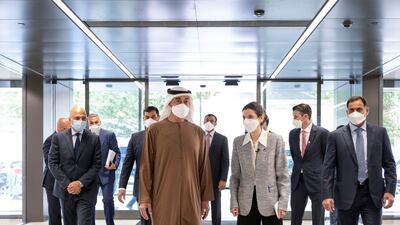
Sheikh Mohamed tours the centre. -

Sheikh Mohamed speaks with family members of a patient at the centre.


“As the centre turns three, we’re extremely proud of all its accomplishments and very grateful to the donors who have helped to make them a reality.”
The Zayed Centre for Research is a partnership between Gosh, University College London and Great Ormond Street Hospital Children’s Charity (Gosh Charity).
It was made possible thanks to a £60 million ($69m) gift in 2014 from Sheikha Fatima.
It welcomed its first patients five years later, on October 24, 2019.
UAE President Sheikh Mohamed, who was then the Crown Prince of Abu Dhabi and Deputy Supreme Commander of the Armed Forces, visited the centre in 2021.
Prof Maha Barakat, Director General of the Frontline Heroes Office, said: “The global research contributions generated by the Zayed Centre for Research over just three short years is a testament to the scientists and clinicians who have dedicated themselves to saving young lives, as well as the cutting-edge facilities that make their work possible.”
Much work at the Zayed Centre relates to conditions with a genetic basis.
It treats about 50,000 patients a year. The majority of children who were treated by the centre when it first opened in 2019 were UK-based, but it also welcomed a number of international patients, including from the UAE.
The centre hosts trials and manufactures gene and cell therapies, for conditions including Severe Combined Immunodeficiency.
The top five specialities at the centre in 2019/2020, according to its first annual report, which has just been released, were cardiology (62 per cent), respiratory medicine (9 per cent), dermatology (8 per cent), cystic fibrosis (3 per cent), immunology (3 per cent).

