


UK scientists say they have identified the origin of one of the rarest meteorites to ever fall on Earth.
The Ivuna meteorite landed in Tanzania in December 1938 and was split into samples, one of which is housed at the Natural History Museum in London.
Experts believe the Ivuna rock may have originated from the edge of the solar system after an analysis of an asteroid known as Ryugu.
The museum team said its findings, published in the journal Science Advances, could unlock more answers about the early history of the solar system and shed more light on how life came to exist on Earth.
“It is a really exciting discovery for me because it shows that meteorites in our museum and in collections around the world might actually sample most of the solid solar system, from the innermost rocky part to its furthest outer reaches," Prof Sara Russell, a senior researcher at the museum and co-author of the paper, told PA.
“We can use them to learn more about our origins and about all our companion planets.”
The Ivuna falls into a category of extremely rare meteorites known as CI chondrites.
Largest image by James Webb space telescopes shows glittering galaxies - in pictures
-
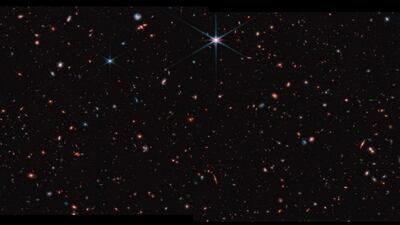
An enormous colour mosaic made up of images captured by the James Webb Space Telescope has been released. This image shows only a small part of the mosiac. All photos: Nasa -
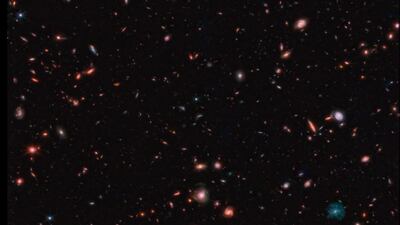
The mosaic is made up 690 individual frames taken with the telescope’s near infrared camera – an instrument that captures radiant energy from objects invisible to the human eye. -

Collectively known as Epoch 1, the image is the largest one yet made using data from the world’s largest space observatory. -
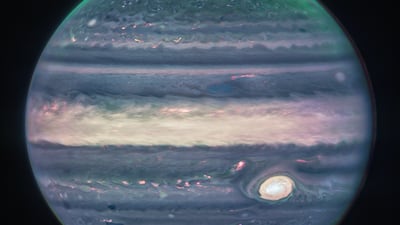
Jupiter as seen by the James Webb telescope. -
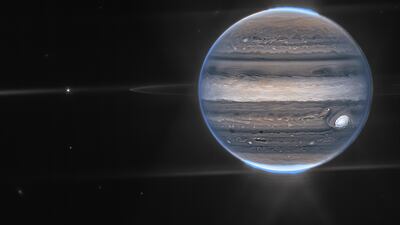
The James Webb telescope captures Jupiter.


These are stony, carbon-containing meteorites that retain the original primitive chemistry from the formation of the solar system more than four billion years ago.
They have been known to contain water – one of the key ingredients to life.
Prof Russell said that apart from Ivuna, only four known CI-type meteorites exist on Earth: Orgueil and Alais, which both fell in France; Tonk which fell in India; and the tiny Revelstoke meteorite that hit Canada.
“It’s only within the last decade we’ve begun to appreciate just how far objects in the solar system can move towards and away from the sun,” she said.
James Webb telescope captures Jupiter - in pictures
-

The James Webb telescope captured stunning images of Jupiter. Photo: NASA -
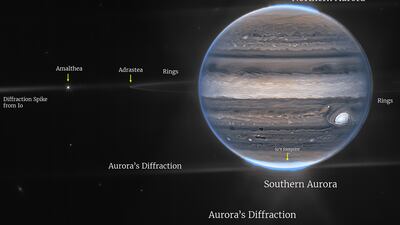
Jupiter is the largest planet in the solar system. Photo: NASA -
Experts were impressed by the quality of the images gathered by the state-of-the-art telescope. Photo: NASA -
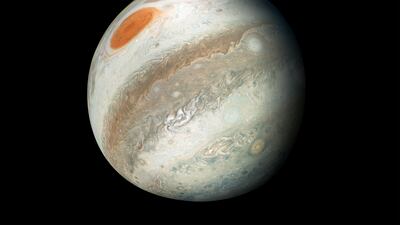
The view shows Jupiter including its Great red Spot captured by Nasa's Juno spacecraft on April 1, 2018. Photo: Nasa -
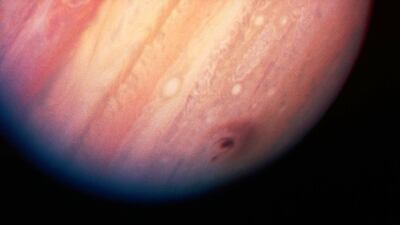
The temporary "crater" and debris left behind by the impact of a fragment of the Shoemaker-Levy 9 comet in 1994. Some of the impacts created fireballs the size of Earth. Photo: Nasa


For the study, the team examined Ryugu samples, which were remotely brought back to Earth in 2020 by Japanese spacecraft Hayabusa2.
It is thought that Ryugu, which is classed as a near-Earth object, was born in the outer solar system more than four billion years ago and broke away from a larger body, migrating towards Earth.
It is now located between the Earth and Mars and orbits the Sun.
Ryugu belongs to a class of asteroids called carbonaceous, or C-type, asteroids.
C-type asteroids are rich in water, carbon and organic compounds from when the solar system formed.
The researchers said Ryugu and the CI chondrites originate from the same region of space and cannot rule out the possibility that they could even share the same parent body.
“By comparing the forms of iron in both the asteroids and meteorites, we learnt that Ryugu is a remarkably close match to CI chondrites,” Prof Russell said.

