


Asylum seekers who arrived in the UK by crossing the English Channel can claim compensation after immigration officials unlawfully confiscated their mobile phones, the High Court ruled.
Judges said a “failure of governance” at the Home Office led to “robust denials” being wrongly made in High Court proceedings about the existence of an unlawful blanket policy of taking mobile phones.
Lord Justice Edis said: “We are concerned with a failure of governance which allowed an unlawful policy to operate for an unknown period of time before November 2020.”
Anyone whose mobile phone was seized between April and November 2020 after crossing the English Channel may be eligible for compensation. That is believed to be about 1,300 people.
Three people, who cannot be identified, won a legal challenge against the home secretary in March after it was admitted their mobile phones were unlawfully taken from them and other people crossing in small boats.
After the three issued their claims at the High Court in London, lawyers acting for the Home Office repeatedly denied there was a blanket policy and asserted that it was lawful to seize mobile phones from some asylum claimants.
-
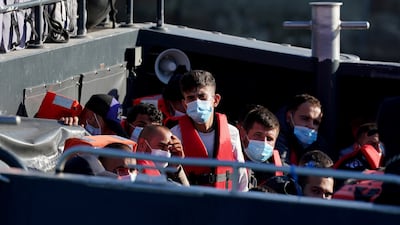
The number of migrants crossing the English Channel from northern Europe has reached record-breaking figures as people in Britain are experiencing an exceptionally hot summer. PA -

A lady carries a toddler to a bus after a group of people thought to be migrants were brought in to Dover, Kent, on the south-east English coast. PA -
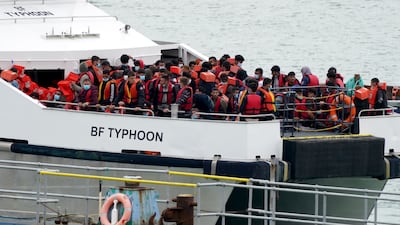
A group of migrants are brought in to Ramsgate, Kent, on August 1 - the day on which almost 700 migrants crossed the Channel to the UK in a single day, a record for the year so far. PA -
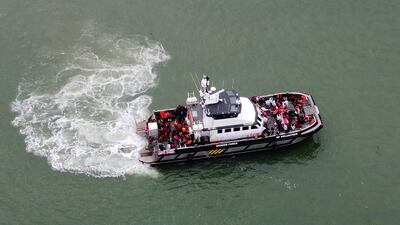
It was only the second time in 2022 that the daily figure has topped 600. PA -

A woman carries a newborn baby in a life cradle as she is brought in to Dover on a Border Force vessel in July. PA -

About 3,683 migrants made the crossing on 90 boats in July, the highest monthly total this year. PA -

A warehouse in Dover for boats used by people trying to cross the Channel. PA -
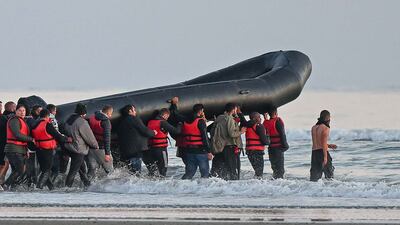
Migrants hold up an inflatable boat before attempting to cross the Channel to Britain, near the northern French city of Gravelines, in July. AFP -
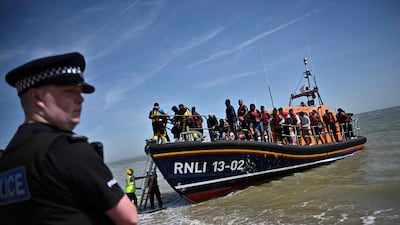
A police officer stands guard on the beach at Dungeness, England, as migrants get off a lifeboat after they were picked up at sea in June. AFP -
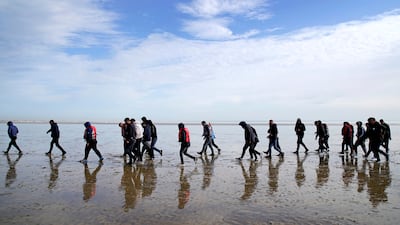
A group of people thought to be migrants walk up the beach after being brought in to Dungeness in May. AP -

Migrants on the beach at Dungeness, after crossing the English Channel in an inflatable dinghy in January. Reuters


The Home Office later realised such a blanket policy had been in operation during the relevant period and, after “very significant concessions” were made on behalf of the department, Lord Justice Edis and Justice Lane ruled in favour of the three.
They were separately arrested after being intercepted at sea on small boats between April and September 2020. Officials confiscated their property at Tug Haven in Dover, Kent.
In their March ruling, judges said there was an “apparent failure” by the then home secretary Priti Patel — for which she had apologised “to comply with her duty of candour” when responding to the claims.
Lord Justice Edis said the factors that led to the error being made included the great pressure staff were under dealing with small boat crossings, media scrutiny, legal process and the consequences of the coronavirus pandemic.
He said documents seen by the court showed that those at the Home Office who were dealing with the High Court claims, as well as those responsible for applying the policy, “failed to prioritise the need to ensure that everything that was done was lawful”.
This meant, he said, that the policies being applied at the time were “ad hoc” and were not clearly understood by those applying them, nor clearly recorded, which made it “more difficult than it should have been to communicate accurately and quickly what those policies were”.
The judge said it was “very surprising” that the mistake was not reported because some of those working on the legal challenges were also, at around the same time, drawing up a change in the policy — to ensure it was not applied indiscriminately to every migrant — which took effect in November 2020.

