Alain Aspect, John Clauser and Anton Zeilinger have won the Nobel Prize for Physics 2022. Wikimedia Commons/Reuters

Nobel Prize for Physics awarded to trio for work in quantum mechanics


Gillian Duncan
  • English
  • Arabic

The Nobel Prize for Physics 2022 has been awarded to three scientists for their work in quantum mechanics.

Alain Aspect, John Clauser and Anton Zeilinger won the prize for “experiments with entangled photons, establishing the violation of Bell inequalities and pioneering quantum information science”.

The trio, from institutions in France, the US and Austria, worked independently. They were cited for discovering the way particles known as photons can be linked, or “entangled,” sharing information with each other, even when they are separated by large distances.

That effectively means what happens to one particle in an entangled pair determines what happens to the other, even if they are too far apart to affect each other.

“Quantum information science is a vibrant and rapidly developing field,” said Eva Olsson, a member of the Nobel committee.

“It has broad and potential implications in areas such as secure information transfer, quantum computing and sensing technology.”

She said the trio's work has “opened doors to another world, and it has shaken the very foundation of how we interpret measurements.”

Speaking live at the prize ceremony, professor Zeilinger, said he was “very surprised” to get the call from the committee.

“I’m still kind of shocked, but it’s a positive shock,” said the Austrian, who is a professor of physics at the University of Vienna and senior scientist at the Institute for Quantum Optics and Quantum Information at the Austrian Academy of Sciences.

He said his work demonstrated quantum teleportation was possible.

“Quantum teleportation uses the features of entanglement,” Prof Zeilinger said.

“It is not like in the Star Trek films, or whatever, transporting something, certainly not a person, over some distance.

“But the point is using entanglement you can transfer all the information which is carried by an object over to some other place, where the object is.

“You can transfer the information without knowing the information.”

So far this has been done only with very small particles, he said.

But he dismissed the possibility teleportation will be used by people to travel one day.

“The teleportation of people is the same kind of science fiction as it always was,” he said.

'Spooky action at a distance'

Entanglement, once described by Albert Einstein as “spooky action at a distance,” is integral to the operation and power of quantum computing.

Abu Dhabi is currently building its own quantum computer, which will be able to process information at much faster speeds than classic technology.

Experts say the technology offers huge potential.

Today’s computers function using something called bits, which are arranged in a combination of ones and zeroes. A zero represents “off,” while “on” is a one.

Everything we see on a computer screen is made from a combination of these ones and zeroes.

But this binary system can be very limiting.

While the combinations can be used to reflect basic information and calculations, they cannot solve complicated problems.

Even the world’s largest supercomputer would eventually run out of space trying to choose the best solution to a problem with many options.

Quantum computers do not.

Instead of bits, they use quantum bits, or “qubits”.

By applying the principles of a branch of physics called quantum mechanics, qubits can be in two states at the same time.

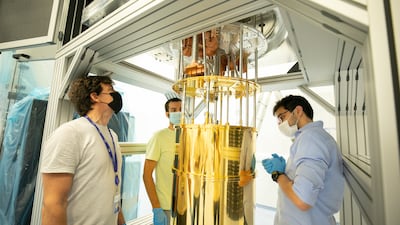
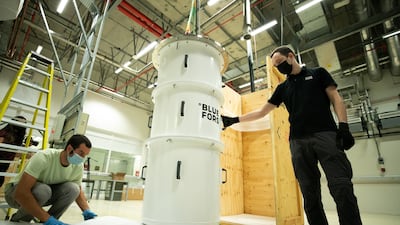
  • A quantum computer has arrived at the Technology Innovation Institute in Abu Dhabi.
    A quantum computer has arrived at the Technology Innovation Institute in Abu Dhabi.
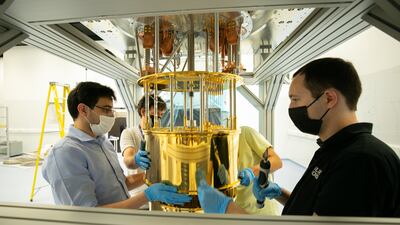
  • The institute’s Quantum Research Centre team opens the outer shields of the refrigerator housing the machine to reveal the chandelier. The device enables the temperature to be lowered in stages.
    The institute’s Quantum Research Centre team opens the outer shields of the refrigerator housing the machine to reveal the chandelier. The device enables the temperature to be lowered in stages.
  • The team prepares to open the box.
    The team prepares to open the box.
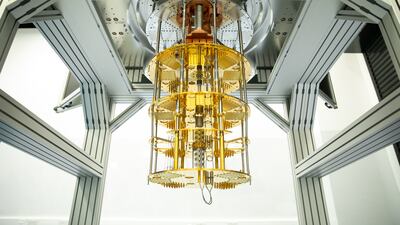
  • The quantum chandelier, so-called for its resemblance to the light fixture, has looping microwave communication cables that enable other computers to interact with the quantum chip within.
    The quantum chandelier, so-called for its resemblance to the light fixture, has looping microwave communication cables that enable other computers to interact with the quantum chip within.
  • Two helium isotopes are mixed, cooling the chandelier to 10 millikelvin. The looping microwave communication cables enable other computers to interact with the quantum chip.
    Two helium isotopes are mixed, cooling the chandelier to 10 millikelvin. The looping microwave communication cables enable other computers to interact with the quantum chip.
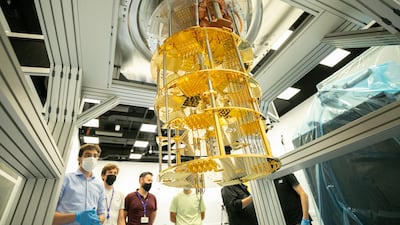
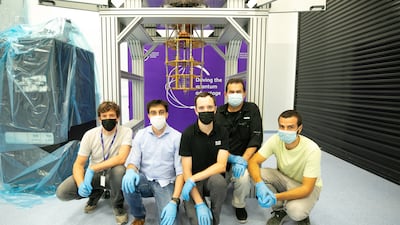
  • Members of the Quantum Research Centre team. From left to right, Alvaro Orgaz, senior project manager; Boulos Alfakes, postdoctoral researcher; Andrii Torgovkin, technical engineer; Carsten Andrew Lutken, executive director – quantum computing, and David Fuentes, engineer.
    Members of the Quantum Research Centre team. From left to right, Alvaro Orgaz, senior project manager; Boulos Alfakes, postdoctoral researcher; Andrii Torgovkin, technical engineer; Carsten Andrew Lutken, executive director – quantum computing, and David Fuentes, engineer.
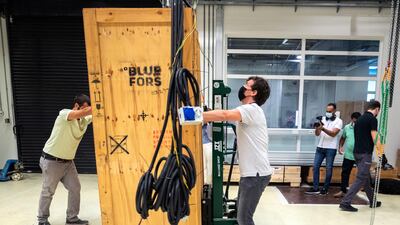
  • The quantum computer unboxing at Masdar City, Abu Dhabi.
    The quantum computer unboxing at Masdar City, Abu Dhabi.
  • The quantum computer unboxing.
    The quantum computer unboxing.
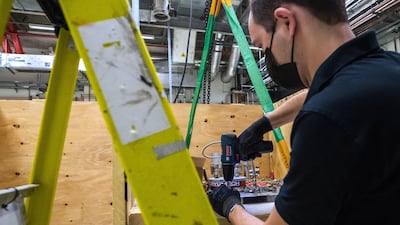
  • Andrii Torgovkin uses a drill to gain access to quantum computer components.
    Andrii Torgovkin uses a drill to gain access to quantum computer components.
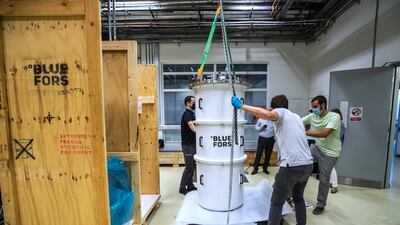
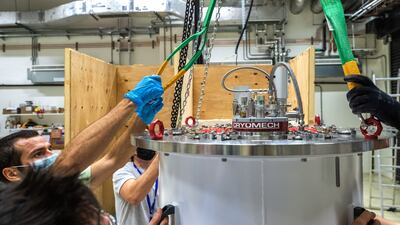
  • The cryostat is lifted off the shipping crate. This device plays an important role in achieving the extremely low temperature of 10 millikelvin in which the quantum chip must operate.
    The cryostat is lifted off the shipping crate. This device plays an important role in achieving the extremely low temperature of 10 millikelvin in which the quantum chip must operate.
  • The cryostat being hoisted from its crate.
    The cryostat being hoisted from its crate.
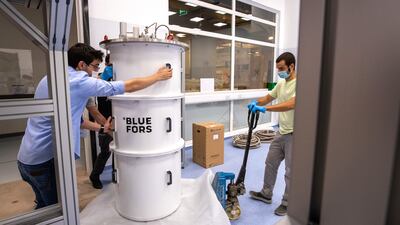
  • The cryostat is pushed into position.
    The cryostat is pushed into position.
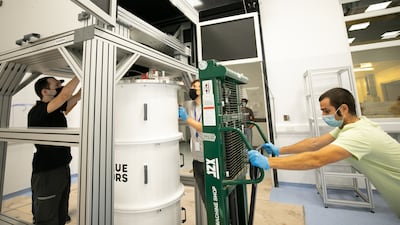
  • The cryostat is positioned and hung from a frame, enabling it to be opened and closed. The frame contains the helium dilution refrigerator that helps maintain an extremely low temperature using helium isotopes.
    The cryostat is positioned and hung from a frame, enabling it to be opened and closed. The frame contains the helium dilution refrigerator that helps maintain an extremely low temperature using helium isotopes.

So instead of being either “on” or “off”, the qubits can be on and off simultaneously. This is known as “superposition”.

This helps allow quantum computers to process multiple possibilities at once, solving problems at a much faster rate.

Faced with a choice of thousands of routes, traditional computers would try each in turn, ruling them out one by one.

But a quantum computer can test them all at once, reducing a calculation that would ordinarily take years to minutes.

The “magic” of quantum computing occurs when the qubits become entangled, thereby able to share information.

Earlier this month, it was announced scientists had entangled three qubits on silicon for the first time. Silicon is the material used in computers’ electronics today, so experts said it represented an important step in “bridging” the quantum and classical computer realms.

“Two-qubit operation is good enough to perform fundamental logical calculations,” quantum physicist Seigo Tarucha, from the Riken research institute in Japan told ScienceAlert.

“But a three-qubit system is the minimum unit for scaling up and implementing error correction.”

But quantum computers are as fragile as they are complex.

They require an ultra-cold environment to operate of just above zero Kelvin — a unit of temperature which is minus 273.15°C, the lowest physically possible temperature in the universe. That is colder than deep space.

On Monday, it was announced Svante Paabo had been awarded the 2022 Nobel Prize in Physiology or Medicine “for his discoveries concerning the genomes of extinct hominins and human evolution”.

The Swedish geneticist, 67, has worked extensively on the Neanderthal genome and is known as a founder of paleogenetics.


The specs: 2019 Aston Martin DBS Superleggera

Price, base: Dh1.2 million

Engine: 5.2-litre twin-turbo V12

Transmission: Eight-speed automatic

Power: 725hp @ 6,500pm

Torque: 900Nm @ 1,800rpm

Fuel economy, combined:  12.3L / 100km (estimate)

Take Me Apart

Kelela

(Warp)

Fast%20X
%3Cp%3E%3Cstrong%3EDirector%3A%3C%2Fstrong%3E%20Louis%20Leterrier%3C%2Fp%3E%0A%3Cp%3E%3Cstrong%3EStars%3A%3C%2Fstrong%3E%20Vin%20Diesel%2C%20Michelle%20Rodriguez%2C%20Jason%20Statham%2C%20Tyrese%20Gibson%2C%20Ludacris%2C%20Jason%20Momoa%2C%20John%20Cena%2C%20Jordana%20Brewster%2C%20Nathalie%20Emmanuel%2C%20Sung%20Kang%2C%20Brie%20Larson%2C%20Helen%20Mirren%20and%20Charlize%20Theron%3C%2Fp%3E%0A%3Cp%3E%3Cstrong%3ERating%3A%3C%2Fstrong%3E%203%2F5%3C%2Fp%3E%0A
MO
%3Cp%3E%3Cstrong%3ECreators%3A%20%3C%2Fstrong%3EMohammed%20Amer%2C%20Ramy%20Youssef%3C%2Fp%3E%0A%3Cp%3E%3Cstrong%3EStars%3A%20%3C%2Fstrong%3EMohammed%20Amer%2C%20Teresa%20Ruiz%2C%20Omar%20Elba%3C%2Fp%3E%0A%3Cp%3E%3Cstrong%3ERating%3A%3C%2Fstrong%3E%204%2F5%3C%2Fp%3E%0A
GIANT REVIEW

Starring: Amir El-Masry, Pierce Brosnan

Director: Athale

Rating: 4/5

Messi at the Copa America

2007 – lost 3-0 to Brazil in the final

2011 – lost to Uruguay on penalties in the quarter-finals

2015 – lost to Chile on penalties in the final

2016 – lost to Chile on penalties in the final

Super Saturday results

4pm: Mahab Al Shimaal Group 3 | US$350,000 | (Dirt) | 1,200m
Winner: Drafted, Pat Dobbs (jockey), Doug Watson (trainer).

4.35pm: Al Bastakiya Listed | $300,000 | (D) | 1,900m
Winner: Divine Image, Brett Doyle, Charlie Appleby.

5.10pm: Nad Al Sheba Turf Group 3 | $350,000 | (Turf) | 1,200m
Winner: Blue Point, William Buick, Charlie Appleby.

5.45pm: Burj Nahaar Group 3 | $350,000 | (D) | 1,600m
Winner: Muntazah, Jim Crowley, Doug Watson.

6.20pm: Dubai City of Gold Group 2 | $300,000 | (T) | 2,410m
Winner: Old Persian, William Buick, Charlie Appleby.

6.55pm: Al Maktoum Challenge Round 3 Group 1 | $600,000 | (D) | 2,000m
Winner: Capezzano, Mickael Barzalona, Salem bin Ghadayer.

7.30pm: Jebel Hatta Group 1 | $400,000 | (T) | 1,800m
Winner: Dream Castle, Christophe Soumillon, Saeed bin Suroor.

The National's picks

4.35pm: Tilal Al Khalediah
5.10pm: Continous
5.45pm: Raging Torrent
6.20pm: West Acre
7pm: Flood Zone
7.40pm: Straight No Chaser
8.15pm: Romantic Warrior
8.50pm: Calandogan
9.30pm: Forever Young

The%20specs
%3Cp%3E%3Cstrong%3EEngine%3A%3C%2Fstrong%3E%20Twin-turbocharged%204-litre%20V8%0D%3Cbr%3E%3Cstrong%3EPower%3A%20%3C%2Fstrong%3E542bhp%0D%3Cbr%3E%3Cstrong%3ETorque%3A%20%3C%2Fstrong%3E770Nm%0D%3Cbr%3E%3Cstrong%3ETransmission%3A%20%3C%2Fstrong%3EEight-speed%20automatic%0D%3Cbr%3E%3Cstrong%3EPrice%3A%20%3C%2Fstrong%3EFrom%20Dh1%2C450%2C000%3Cbr%3E%3Cstrong%3EOn%20sale%3A%20%3C%2Fstrong%3ENow%3C%2Fp%3E%0A
Benefits of first-time home buyers' scheme
  • Priority access to new homes from participating developers
  • Discounts on sales price of off-plan units
  • Flexible payment plans from developers
  • Mortgages with better interest rates, faster approval times and reduced fees
  • DLD registration fee can be paid through banks or credit cards at zero interest rates
Remaining fixtures

Third-place-play-off: Portugal v Mexico, 4pm on Sunday

Final: Chile v Germany, 10pm on Sunday


SPEC%20SHEET%3A%20SAMSUNG%20GALAXY%20Z%20FOLD%204
%3Cp%3E%3Cstrong%3EMain%20display%3A%3C%2Fstrong%3E%207.6%22%20QXGA%2B%20Dynamic%20Amoled%202X%2C%202176%20x%201812%2C%2021.6%3A18%2C%20374ppi%2C%20HDR10%2B%2C%20up%20to%20120Hz%3C%2Fp%3E%0A%3Cp%3E%3Cstrong%3ECover%20display%3A%3C%2Fstrong%3E%206.2%22%20HD%2B%20Dynamic%20Amoled%202X%2C%202316%20x%20904%2C%2023.1%3A9%2C%20402ppi%2C%20up%20to%20120Hz%3C%2Fp%3E%0A%3Cp%3E%3Cstrong%3EProcessor%3A%3C%2Fstrong%3E%20Qualcomm%20Snapdragon%208%2B%20Gen%201%2C%204nm%2C%20octa-core%3B%20Adreno%20730%20GPU%3C%2Fp%3E%0A%3Cp%3E%3Cstrong%3EMemory%3A%3C%2Fstrong%3E%2012GB%3C%2Fp%3E%0A%3Cp%3E%3Cstrong%3ECapacity%3A%3C%2Fstrong%3E%C2%A0256%2F512GB%20%2F%201TB%3C%2Fp%3E%0A%3Cp%3E%3Cstrong%3EPlatform%3A%3C%2Fstrong%3E%20Android%2012%2C%20One%20UI%204.1.1%3C%2Fp%3E%0A%3Cp%3E%3Cstrong%3EMain%20camera%3A%3C%2Fstrong%3E%20Triple%2012MP%20ultra-wide%20(f%2F2.2)%20%2B%2050MP%20wide%20(f%2F1.8)%20%2B%2010MP%20telephoto%20(f%2F2.4)%2C%20dual%20OIS%2C%203x%20optical%20zoom%2C%2030x%20Space%20Zoom%2C%20portrait%2C%20super%20slo-mo%3C%2Fp%3E%0A%3Cp%3E%3Cstrong%3EVideo%3A%3C%2Fstrong%3E%208K%4024fps%2C%204K%4030%2F60fps%2C%20full-HD%4030%2F60fps%2C%20HD%4030fps%3B%20slo-mo%4060%2F240%2F960fps%3B%20HDR10%2B%3C%2Fp%3E%0A%3Cp%3E%3Cstrong%3ECover%20camera%3A%3C%2Fstrong%3E%2010MP%20(f%2F2.2)%3C%2Fp%3E%0A%3Cp%3E%3Cstrong%3EInner%20front%20camera%3A%3C%2Fstrong%3E%20Under-display%204MP%20(f%2F1.8)%3C%2Fp%3E%0A%3Cp%3E%3Cstrong%3EBattery%3A%3C%2Fstrong%3E%204400mAh%2C%2025W%20fast%20charging%2C%2015W%20wireless%20charging%2C%20reverse%20wireless%20charging%2C%20'all-day'%20life%3C%2Fp%3E%0A%3Cp%3E%3Cstrong%3EConnectivity%3A%3C%2Fstrong%3E%205G%3B%20Wi-Fi%2C%20Bluetooth%205.2%2C%20NFC%20(Samsung%20Pay)%3C%2Fp%3E%0A%3Cp%3E%3Cstrong%3EI%2FO%3A%3C%2Fstrong%3E%20USB-C%3C%2Fp%3E%0A%3Cp%3E%3Cstrong%3ECards%3A%3C%2Fstrong%3E%20Nano-SIM%20%2B%20eSIM%3B%202%20nano-SIMs%20%2B%20eSIM%3B%202%20nano-SIMs%3C%2Fp%3E%0A%3Cp%3E%3Cstrong%3EColours%3A%3C%2Fstrong%3E%20Graygreen%2C%20phantom%20black%2C%20beige%2C%20burgundy%20(online%20exclusive)%3C%2Fp%3E%0A%3Cp%3E%3Cstrong%3EIn%20the%20box%3A%3C%2Fstrong%3E%20Fold%204%2C%20USB-C-to-USB-C%20cable%3C%2Fp%3E%0A%3Cp%3E%3Cstrong%3EPrice%3A%3C%2Fstrong%3E%20Dh6%2C799%20%2F%20Dh7%2C249%20%2F%20Dh8%2C149%3C%2Fp%3E%0A
Western Region Asia Cup T20 Qualifier

Sun Feb 23 – Thu Feb 27, Al Amerat, Oman

The two finalists advance to the Asia qualifier in Malaysia in August


Group A

Bahrain, Maldives, Oman, Qatar


Group B

UAE, Iran, Kuwait, Saudi Arabia

Updated: October 04, 2022, 12:18 PM