


UK Defence Secretary Ben Wallace sought to reassure Europe on Sunday, saying Russian President Vladimir Putin was “highly unlikely” to use nuclear weapons in the Ukraine conflict.
But Mr Wallace said Mr Putin was not acting in a “rational” way.
There have been fears he could use tactical nuclear weapons in response to attacks on parts of Ukraine he has annexed after he vowed to use “all the means at our disposal” if his country is threatened.
In a fringe meeting at the Conservative party conference, Mr Wallace said that although the use of nuclear weapons was in the Russian military doctrine, it would be unacceptable to Moscow’s allies, India and China.
He told the event, hosted by the Onward think tank, that Mr Putin “was given a very clear sense what is acceptable and unacceptable” in meetings with the Indian and Chinese leaderships.
But Mr Wallace said the Russian leader’s actions, from the nerve agent attack in Salisbury to the invasion of Ukraine, were “totally irrational”.
In a sign of the latest concerns about Russia’s actions, he3 will join a crisis meeting of northern European nations on Monday to discuss the security of pipelines and undersea cables.
Vladimir Putin annexes four regions of Ukraine - in pictures
-
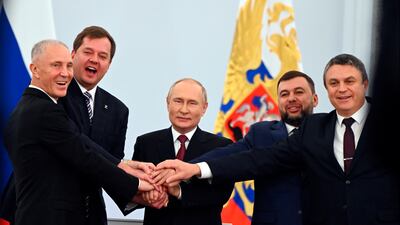
From left, Moscow-appointed head of Kherson region Vladimir Saldo, Moscow-appointed head of Zaporizhzhia region Yevgeny Balitsky, Russian President Vladimir Putin, leader of the Donetsk People's Republic Denis Pushilin, and leader of the Luhansk People's Republic Leonid Pasechnik during a ceremony to sign an annexation agreement with Russia in Moscow. AP -
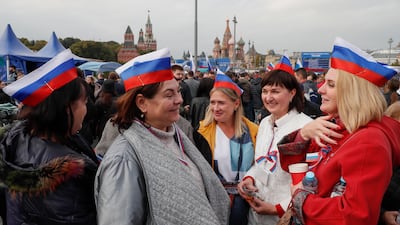
Russians gather for a celebration after the ceremony in central Moscow. EPA -
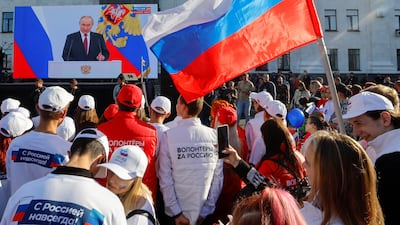
People gather near a screen showing Mr Putin during a broadcast of the ceremony. Reuters -
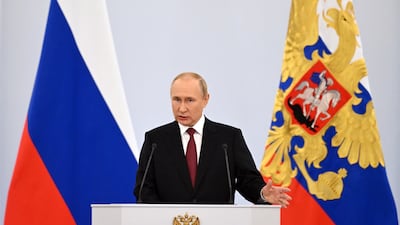
Mr Putin speaks during the ceremony to sign the treaties for the new territories' accession to Russia at the Grand Kremlin Palace in Moscow. EPA -
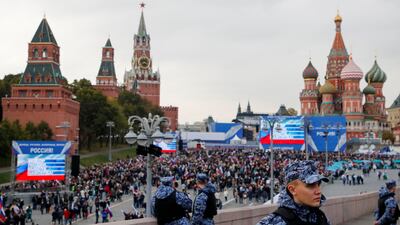
Law enforcement officers stand guard as people walk towards Red Square to attend the ceremony marking the annexation of the Russian-controlled territories. Reuters -

Participants listen to Mr Putin at the ceremony in the Georgievsky Hall of the Great Kremlin Palace in Moscow. Reuters -
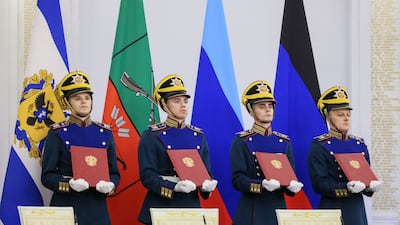
Honour guards attend the ceremony. Reuters -
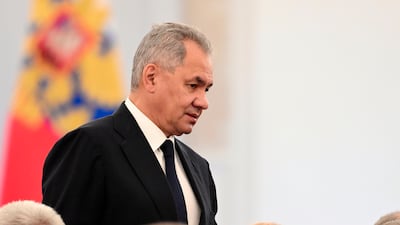
Russian Defence Minister Sergey Shoigu arrives at the ceremony. AP -

People walk towards Red Square in Moscow. Reuters -
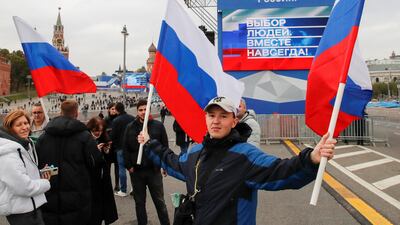
People gather in front of screens located near the Kremlin before the live broadcast of the ceremony. Reuters


British Prime Minister Liz Truss said explosions that caused major damage to Russia’s undersea Nord Stream gas pipelines were “clearly an act of sabotage”.
Mr Wallace said the UK and the Nordic nations were “deeply vulnerable” to acts of sabotage against cables and pipelines.
“I’ll be convening, with the Dutch, a virtual joint expeditionary force meeting on Monday,” he said.
“So I have to break my timetable tomorrow to meet 10 of the Nordic states about what we’re going to do about it because the Nordic states and ourselves are deeply vulnerable to people doing things on our cables and our pipelines.
“So suddenly, that becomes a big issue we have to get to the bottom of.
"We have to think about what assets we can move to give people reassurance or, indeed, investigate what’s going on.”
Mr Wallace said the prolonged war in Ukraine had shown the need to make sure stockpiles of equipment and supply chains were protected, as he admitted some supplies were running “fairly low”.
Defence spending had been “hollowed out” over 30 to 40 years so “unsexy parts” of the budget had been neglected, he said.
Putin's inner circle – in pictures
-
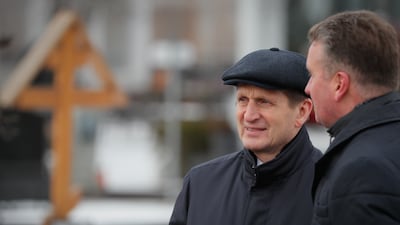
Head of Russia's SVR intelligence service Sergei Naryshkin has seen his status eroded by the strong resistance encountered in Ukraine, which he did not foresee. EPA -
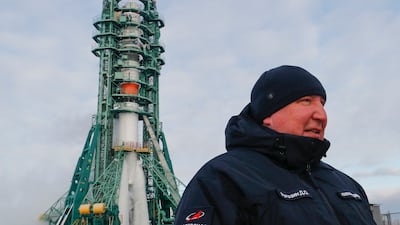
Head of Russia's Roscosmos space agency Dmitry Rogozin has threatened to abandon a Nasa astronaut on the International Space Station. AFP -
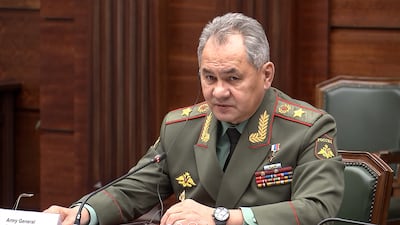
Russian Defence Minister Sergei Shoigu was one of the architects of Moscow's intervention in Syria. AFP -
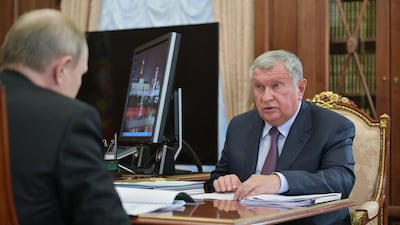
Russian President Vladimir Putin meets with Russia's oil giant Rosneft chief Igor Sechin. He has been described as Mr Putin's right-hand man. AFP -
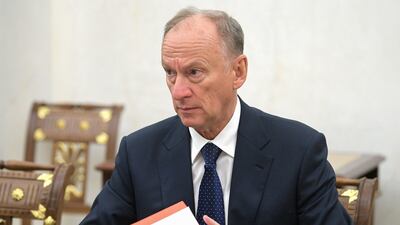
Secretary of Russia's Security Council Nikolai Patrushev attends a meeting in Moscow. He is said to have known Mr Putin for 50 years. AFP -
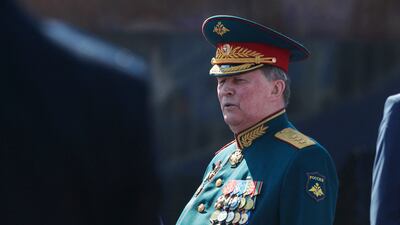
Sergei Ivanov, Russian special representative on questions of ecology and transport, is a close friend of Mr Putin. AFP -
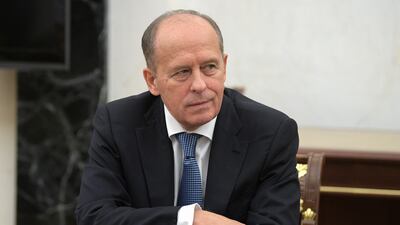
Federal Security Service director Alexander Bortnikov is responsible for a huge network of agents in Russia. AFP -

At 58, president of the Duma Lower House of Parliament Vyacheslav Volodin is one of the younger members of the inner circle. He has been touted as a possible successor to Mr Putin. AFP


Mr Wallace acknowledged that “some of our weapons stockpiles are fairly low and the supply chains switched off 10 years ago, so we have to reinvigorate that”.
He said the Russians were suffering badly, in part because some of their suppliers were in Ukraine and had been bombed — a sign of the “strategic genius that President Putin is clearly proving to be”.
Mr Wallace also said the government had committed to “two specialist ships” that can patrol and protect underwater infrastructure from Russia.
He told members the “mysterious” damage inflicted to the Nord Stream pipelines this week should be a reminder of how fragile the UK economy and infrastructure are in the face of “hybrid attacks”.
Mr Wallace warned that Russia makes “no secret” of its ability to target underwater infrastructure.
He said the UK would acquire the two ships to protect the network as “our internet and energy are highly reliant on pipelines and cables”.
“Our intent is to protect them … Russia makes no secret of its ability to target such infrastructure," Mr Wallace said.
“So for that reason, I can announce we recently committed to two specialist ships with the capability to keep our cables and pipelines safe.
“The first multi-role survey ship for seabed warfare will be purchased by the end of this year, fitted out here in the UK and then be operational before the end of next year.
“The second ship will be built in the UK and we will plan to make sure it covers all our vulnerabilities.”
The Kremlin was accused of attacking the Nord Stream pipelines beneath the Baltic Sea, which led to huge methane leaks.
Mr Wallace also said he has not ruled out a future bid for the Tory leadership and admitted being head of Nato would be a “nice job”.
He did not run in the contest in which Ms Truss was elected, instead insisting he was focused on his departmental responsibilities.
But he remains a popular figure within the party, bolstered by his handling of the Ukraine war.
He said leading the party and becoming prime minister would have meant “sacrificing everything”.
“You have to really, really want it to be a prime minister," Mr Wallace said. "I think you have to really want to sacrifice absolutely everything, and I mean in your private and your personal life.
“It doesn’t mean to say I wasn’t tempted. I was conflicted between a deep sense of duty I have to the country I love, to try and do the very best for it, but also I knew I was in a job I felt fulfilled in.
“So at this time in life, the idea was no. I mean, do I rule it out? No, I don’t rule it out. But will I be here in a few years time? I didn’t know either.”
Asked whether he would like to succeed Jens Stoltenberg as Nato secretary general when his term ends in 2023, Mr Wallace said: “I love doing the defence secretary job, I genuinely do. I don’t know how long the prime minister wants me to do it.
“[Nato] would be a nice job, but I love this. I want to hold the prime minister to account on her pledges to defence.
“It was very important to me, when it came to the leadership election, that people recognised that defence spending is not a discretionary luxury at the bottom of people’s priorities, it’s for real.
“The world is very much more unsafe, more unstable. We all worry about our prices and our security of our supply chains.
"That’s not going to happen on its own. We need to invest in security, we have to invest in keeping our people safe.”
The Ukraine war latest - in pictures
-
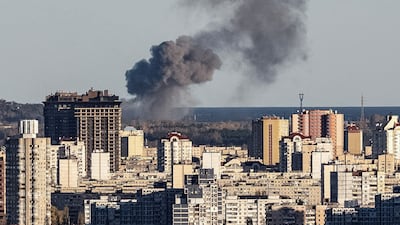
Smoke rises on the outskirts of the city during a Russian missile attack in Kyiv. Reuters -

Workers surround the Monument to the Heroes of the Heavenly Hundred with sandbags against damage from shelling in Mykolaiv. EPA -
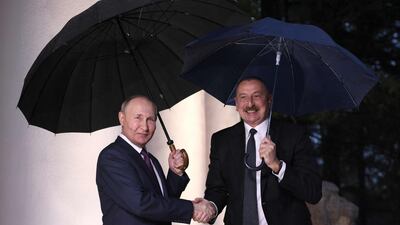
Russian President Vladimir Putin welcomes Azerbaijan President Ilham Aliyev for talks before a meeting between the Russian president and the leaders of Armenia and Azerbaijan in the Black Sea resort city of Sochi, Russia. AFP -
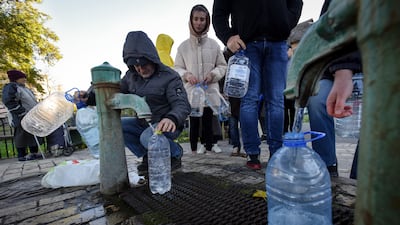
People take water from a water pump in Kyiv. EPA -
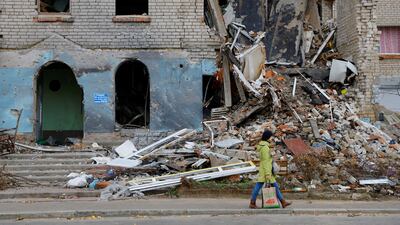
A woman walks past a damaged building in the town of Nova Kakhovka. Reuters -
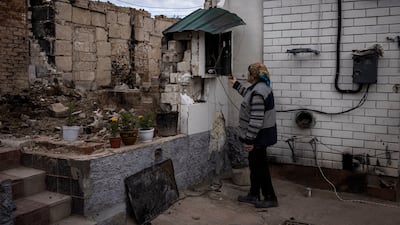
A woman outside her home, which was destroyed during battles at the start of the conflict, in Yahidne, Chernihiv. Getty Images -
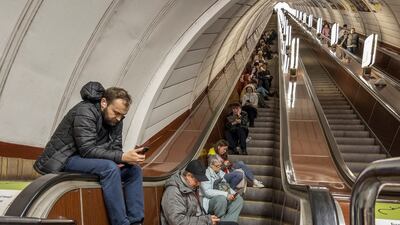
People shelter inside a subway station during a Russian missile attack in Kyiv. Reuters -
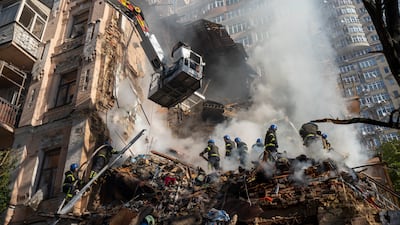
Firefighters at the site of a drone attack in Kyiv, Ukraine. AP -
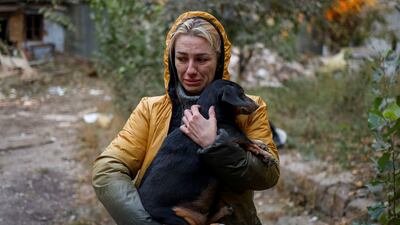
A woman walks past the site of a Russian missile strike in the southern Ukrainian city of Mykolaiv. Reuters -
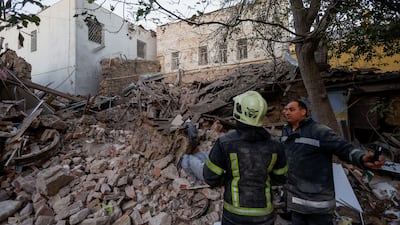
Rescuer workers at a building destroyed in an attack in Mykolaiv. Reuters -
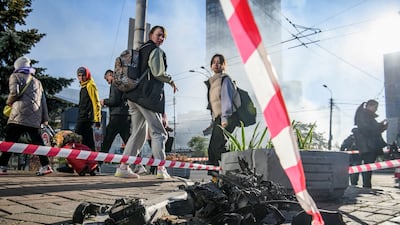
Parts of a drone lie on a street in Kyiv. Reuters -
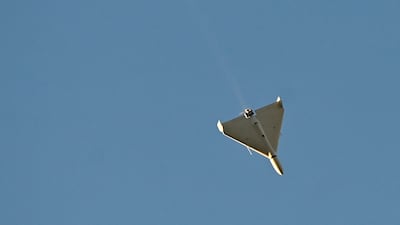
A drone flies over the Ukrainian capital during an attack. AFP -
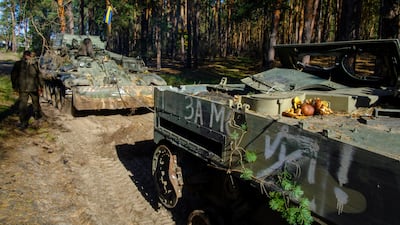
Ukrainian servicemen tow a captured Russian armoured vehicle in Rudneve village, Kharkiv. EPA -
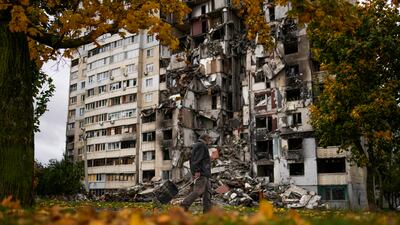
A partially destroyed residential building in Saltivka, in Kharkiv. AP -
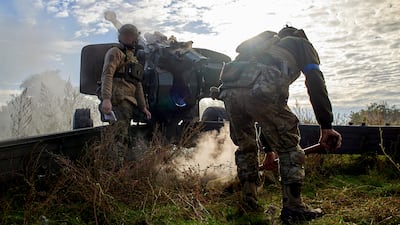
Ukrainian servicemen fire a captured Russian howitzer on a front line near Kupyansk city, Kharkiv. EPA -
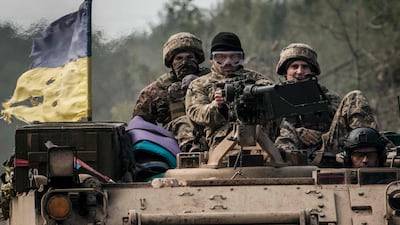
Ukrainian servicemen near the recently retaken town of Lyman in Donetsk region. AFP -
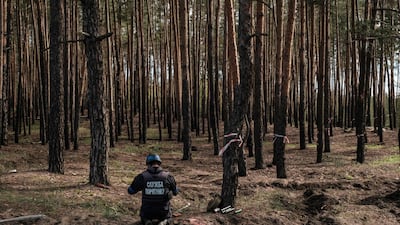
An officer from a Ukrainian national police emergency demining team prepares to detonate collected anti-tank mines and explosives near Lyman, in the Donetsk region. AFP -
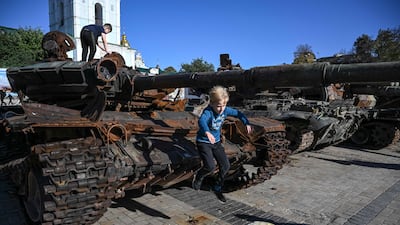
A boy playing on a destroyed Russian tank on display in Kyiv. AFP -
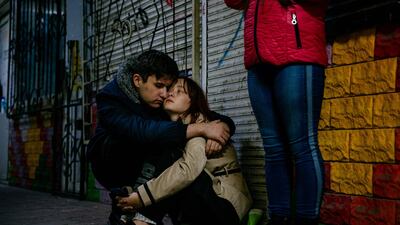
A young couple hiding underground during an air alert in Zaporizhzhia. AFP -
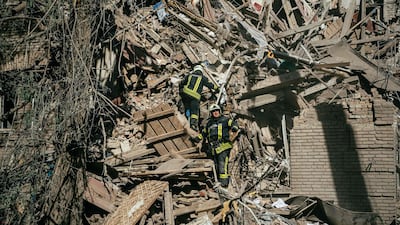
Ukrainian firefighters looking for survivors after a strike in Zaporizhzhia. AFP -
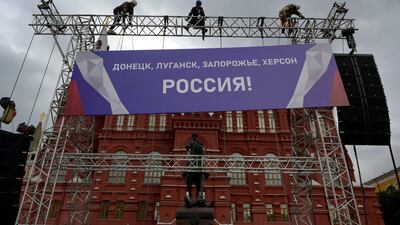
Workers fix a banner reading 'Donetsk, Luhansk, Zaporizhzhia, Kherson - Russia!' to the State Historical Museum near Red Square in Moscow. AFP -

Residents try to cross a destroyed bridge in the Kharkiv region of Ukraine. AFP -
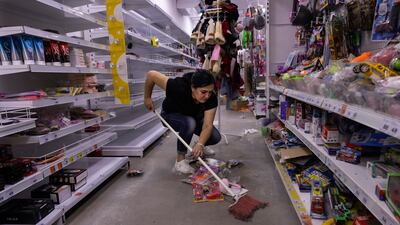
Alyona Kishinskaya helps to clean up a shop as it prepares to reopen in Balakiya, Ukraine, after a six-month Russian occupation. Getty Images -
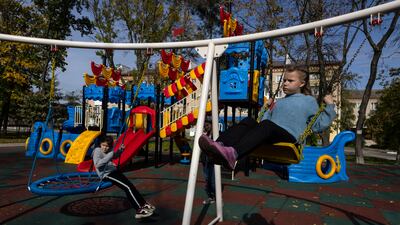
Alla, 12, has a swinging time in Balakiya, Ukraine, as life goes on despite the war. Getty Images -
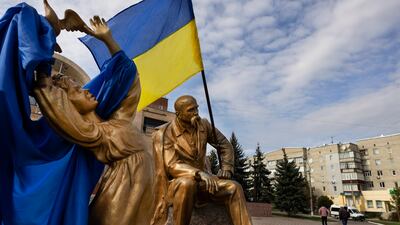
Ukrainian flags in the town square in Balakiya. Getty Images -
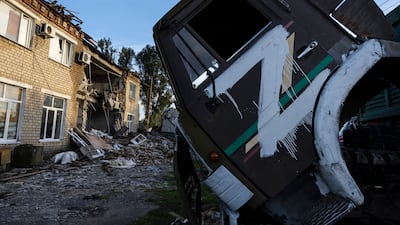
A destroyed Russian command centre in Izium, Ukraine. Getty Images -

In what may be a final farewell, young Russian recruits - escorted by their wives - walk to a train station in Volgograd before being sent to war in Ukraine. AP -
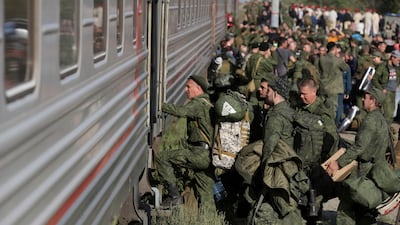
Russian recruits board the train to Ukraine in Volgograd. AP -
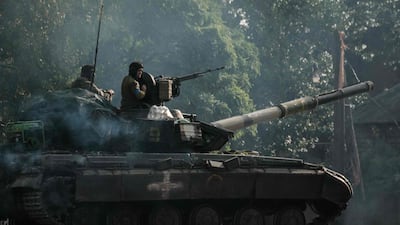
Ukrainian soliders drive a tank at the recently retaken eastern side of the Oskil River in Kharkiv region, Ukraine. AFP -
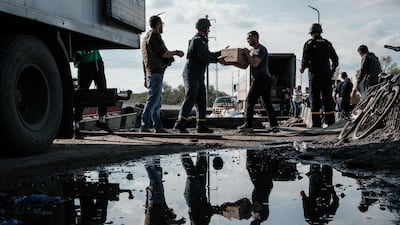
Volunteers pass boxes of food aid on a destroyed bridge over the Oskil River. AFP -
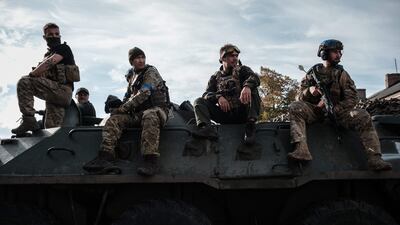
Ukrainian soliders rest on an armoured personnel carrier. AFP -
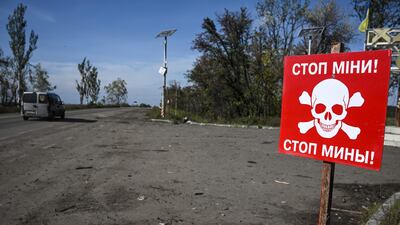
A sign warns of landmines in Izyum, eastern Ukraine. AFP -
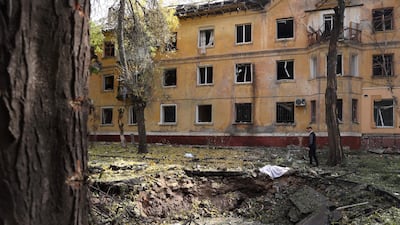
This crater was left after a missile strike in the Donetsk region of Ukraine. AFP


At another fringe event, James Cleverly said Ukraine will succeed in pushing out Russian invaders because Moscow’s “tanks are fearful of Ukrainian tractors”.
“We have seen Ukrainians — both their professional army but also those people volunteering, those people, the students and the musicians and the politicians and the artists and the sports stars — taking up arms and defending their country against this illegal, unprovoked act of aggression by Vladimir Putin," Mr Cleverly said.
“Anyone here who was a member of the armed forces, you’re always told the only thing that a tank fears is another tank.
“Well, Russian tanks are fearful of Ukrainian tractors.
“That’s why Ukrainians will succeed, and when they do and when that fantastic, glorious day comes, then our role evolves, because we have to help them rebuild their country and rebuild their society and rebuild their economy.”
Ukraine’s ambassador to the UK said he was “fascinated” by UK bureaucracy as he criticised the visa process.
At a fringe event at the conference held by the Conservative Friends of Ukraine group, Vadym Prystaiko thanked Britons for opening up their homes to Ukrainians fleeing the war.
With the six-month contract under the government’s sponsorship scheme about to expire, Mr Prystaiko asked for “more hospitality, more generosity, more patience” from those putting up refugees.
“We’ll never forget this, this act, this kindness," he said.
“And please, somebody do something with the visas, finally. Where is Secretary Cleverly? This is just a disgrace, you know, I have to tell you.
“I’m fascinated … by your bureaucracy.”
Vladimir Putin says Russia will use 'all means' to defend its territory - video
He has previously urged MPs to drop visa requirements for fleeing Ukrainians and said his wife faced delays in obtaining one.
Meanwhile, former prime minister Boris Johnson was named as the incoming president of the Conservative Friends of Ukraine group.

