

British Prime Minister Liz Truss is refusing to back down on her tax-cutting mini-budget despite economic turmoil, saying on Thursday it was the “right plan”.
In her first public comments since Chancellor Kwasi Kwarteng unveiled the proposals last Friday, which have led to almost a week of financial chaos, Ms Truss dismissed concerns.
After remaining silent this week, on Thursday she undertook a media blitz which included 15 quick-fire interviews with BBC local radio stations across the country.
Ms Truss told BBC Radio Leeds “we were here” because of Russia’s war against Ukraine, which pushed up energy prices.
“Currencies are under pressure around the world,” she said. “And that’s why it’s so important that this government took urgent action."
The mini-budget, or so-called “fiscal event” on Friday, represented the biggest tax cuts in 50 years.
Its announcement unleashed turmoil in the markets, with the pound sinking to its lowest level against the dollar to only $1.03 on Monday.
-
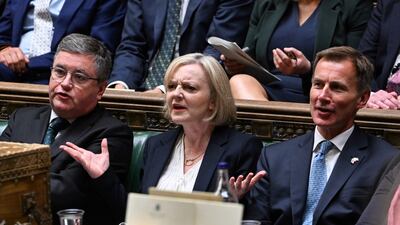
Britain's Prime Minister Liz Truss during Prime Minister's Questions in the House of Commons in London, addressing Parliament for the first time since abandoning her disastrous tax-slashing economic policies. Here, 'The National' looks at her time in power so far. AFP -
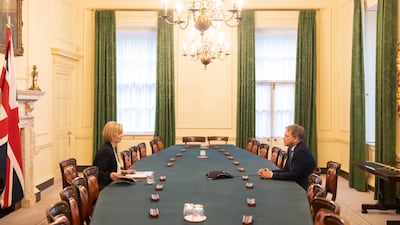
Liz Truss speaks to Grant Shapps at Downing Street as he is appointed Home Secretary, after the resignation of Suella Braverman. Photo: Simon Dawson / No 10 Downing Street -
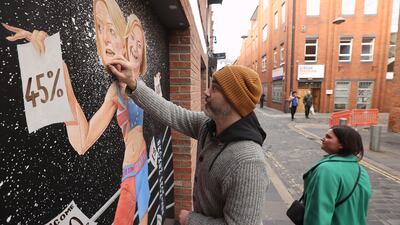
A mural by artist Ciaran Gallagher in Belfast is updated to reflect Liz Truss's current political troubles. PA -
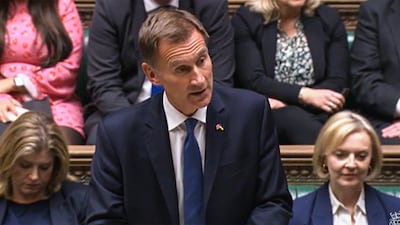
Britain's new Chancellor of the Exchequer Jeremy Hunt announcing tax and spending measures at the House of Commons in London, with Liz Truss sitting on the bench behind him. AFP -
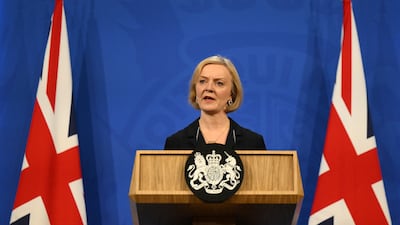
Liz Truss gives a speech after sacking Kwasi Kwarteng as chancellor of the exchequer. Reuters -
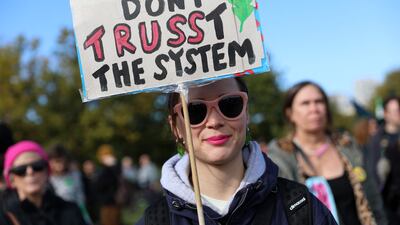
A protest by climate change group Extinction Rebellion in central London. Ms Truss has said the group is part of an 'anti-growth coalition' with trade unions and the main opposition Labour Party. AFP -
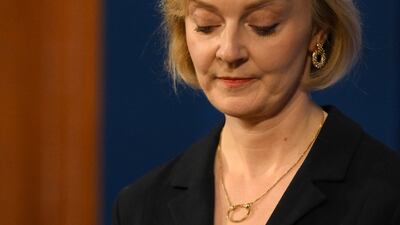
Ms Truss has come under increasing pressure during her short time as prime minister. AFP -
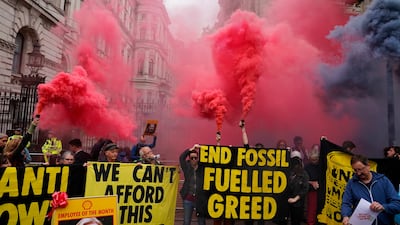
An Extinction Rebellion protest outside Downing Street on the day Mr Kwarteng was removed from the government. AP -
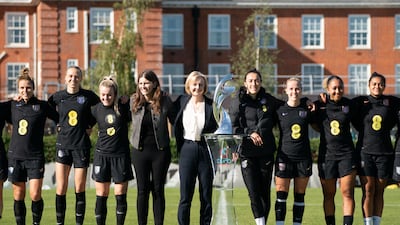
Ms Truss with members of the England women's football team and the European Championship trophy in Teddington, south-west London. Getty -

Ms Truss arrives for a meeting of the European Political Community at Prague Castle in the Czech Republic. AP -
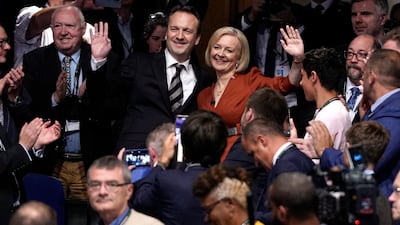
Ms Truss and her husband Hugh O'Leary wave after her keynote speech at the Conservative Party conference in Birmingham. AP -
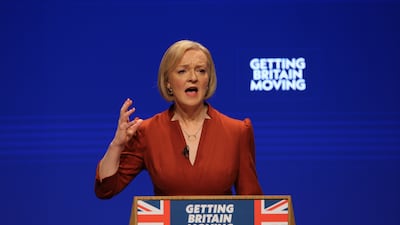
Liz Truss gives a speech at the Conservative Party Conference. EPA -
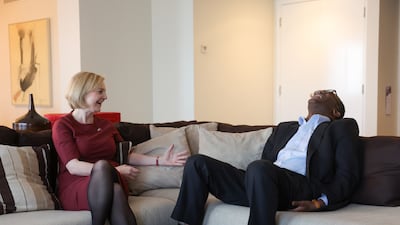
Ms Truss meets with Mr Kwarteng, chancellor of the exchequer at the time. Photo: Andrew Parsons / CCHQ -
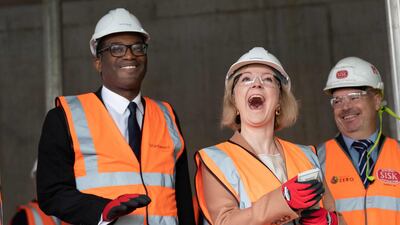
Ms Truss and Mr Kwarteng visit a construction site for a medical innovation campus in Birmingham. AFP -
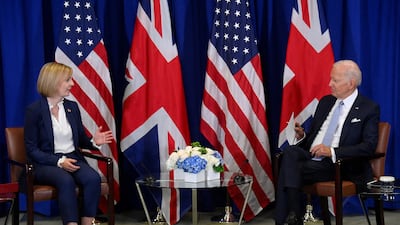
Ms Truss meets US President Joe Biden for talks at the UN headquarters in New York. PA -
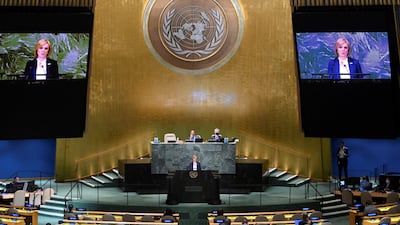
Ms Truss delivers a speech at the 77th session of the General Assembly at the UN headquarters in New York. AP -
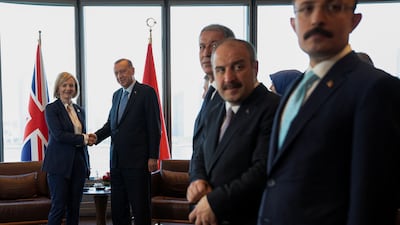
The British prime minister holds a bilateral meeting with Turkish President Recep Tayyip Erdogan in New York. Reuters -
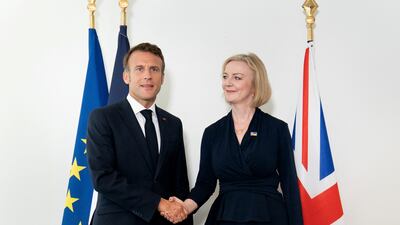
Ms Truss meets French President Emmanuel Macron at the UN headquarters in New York. Reuters -
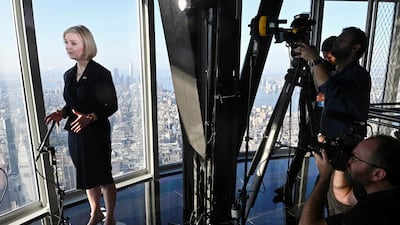
Ms Truss speaks to the media during her visit to the Empire State building in New York. AP -
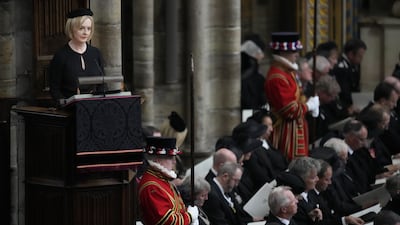
Britain's new leader speaks during the state funeral of Queen Elizabeth at Westminster Abbey, London. PA -
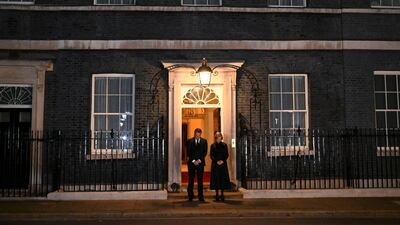
Ms Truss and her husband Hugh O'Leary observe a minute's silence at Number 10 Downing Street following the death of the queen. Reuters -
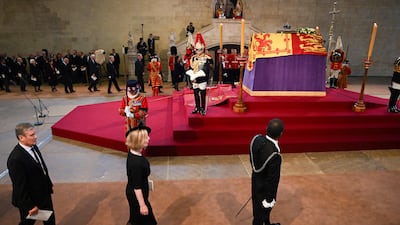
Britain's Labour Party leader Sir Keir Starmer and Ms Truss leave after a service for the reception of Queen Elizabeth's coffin at Westminster Hall in the Palace of Westminster. AFP -

Ms Truss joins the Speaker Lindsay Hoyle and selected MPs to take the oath and swear allegiance to King Charles III in the House of Commons chamber. PA -
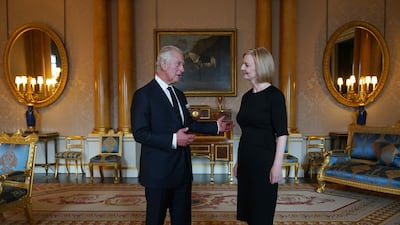
King Charles during his first audience with Ms Truss at Buckingham Palace, London, following the death of Queen Elizabeth. Getty Images -

Ms Truss gives a reading during a service of prayer and reflection, following the passing of Queen Elizabeth, at St Paul's Cathedral in London. Getty Images -

The British prime minister makes a statement outside 10 Downing Street in London following the queen's death. Bloomberg -
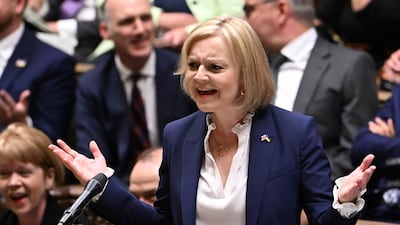
Ms Truss speaking during her first weekly Prime Minister's Questions session at the House of Commons in London. AFP -

Front pages of a selection of British national newspapers, each leading with a story about Ms Truss becoming Britain's new prime minister. AFP -
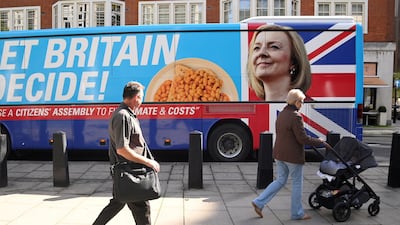
People walk past an image in central London of Ms Truss on the side of a protest bus calling for a citizens' assembly. Reuters -
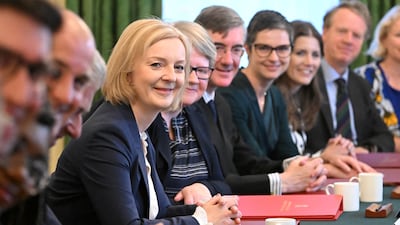
Ms Truss holds her first Cabinet meeting at 10 Downing Street. Reuters -
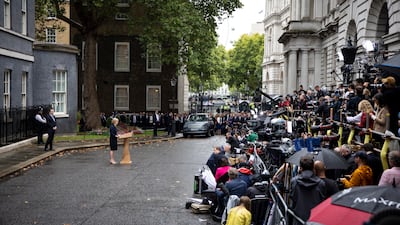
Ms Truss speaks at Downing Street on the day she took over as prime minister from Boris Johnson. EPA -
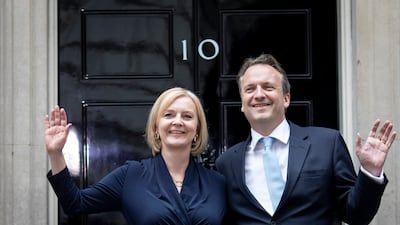
Ms Truss poses with her husband Hugh O'Leary at Downing Street before entering as prime minister for the first time. EPA -
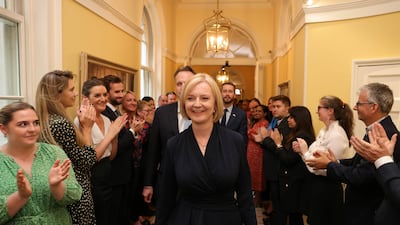
Ms Truss is welcomed by staff in Downing Street as she enters the famous prime ministerial offices for the first time. Andrew Parsons / No 10 Downing Street -
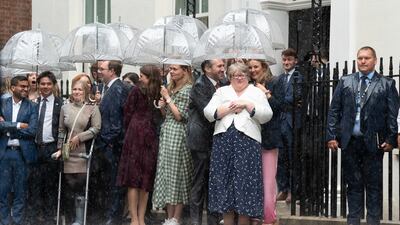
New Health Secretary Therese Coffey and Number 10 staff shelter from a downpour as they wait for Ms Truss to arrive in Downing Street. PA -

Liz Truss makes a speech outside 10 Downing Street, London, after meeting Queen Elizabeth II and accepting her invitation to become prime minister and form a new government. PA -
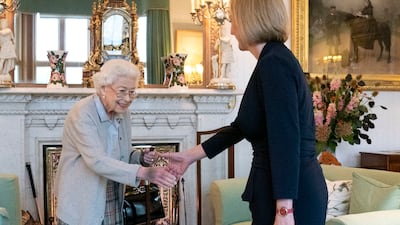
Queen Elizabeth II greets the newly elected leader of the Conservative Party, Ms Truss, at Balmoral Castle in Scotland. The queen invited Ms Truss to become prime minister and form a new government. Getty Images


Two days later, the Bank of England was forced to intervene to buy up gilts — UK government debt in sterling ― after it “warned of a material risk to UK financial stability”.
The bank was forced to act after plunging markets for UK debt sent borrowing costs soaring and forced pension funds to dump their assets because they did not have enough short-term cash to honour some contracts.
The turbulence continued into Thursday, with sterling sliding again in early deals to as low as $1.0763. It later recovered some ground, rising to $1.0857 by 1.30pm UK time.
The prime minister said the government was working “very closely” with the Bank of England, but that it was important the central bank was independent.
“We are facing very, very difficult economic times," she said. "We are facing that on a global level. I talked to a lot of my overseas counterparts, about issues like energy, about making sure we are dealing with the global economy.
“But the important thing is the British government acted to make sure people were protected from these high energy costs, to make sure we are getting the economy going."
The growth will not come through “overnight”, she said. “But what’s important is we are putting this country on a better trajectory for the long term.”
Ms Truss, who will face Tory members next week at the Conservative Party conference, also received questions from members of the public during the round of radio interviews.
She was asked questions such as: "What on earth were you thinking?", "How can we ever trust the Conservatives with our economy again?" and "Are you ashamed of what you've done?".
Ms Truss replied: "I think we have to remember what situation this country was facing.
"We were going into the winter with people expected to face fuel bills of up to £6,000 ($6,522), huge rates of inflation, slowing economic growth.
"And what we've done is we've taken action to make sure that from this weekend, people won't be paying a typical fuel bill of more than £2,500."
She told another presenter the government “had to take urgent action to get our economy growing, get Britain moving and also deal with inflation”.
“And, of course, that means taking controversial and difficult decisions,” she said.
“But I am prepared to do that as prime minister, because what is important to me is that we get our economy moving and we make sure people are able to get through this winter. We are prepared to do what it takes to make that happen.”
She said it was "simply not true" when asked by BBC Radio Nottingham whether her mini-budget was a "reverse Robin Hood" that disproportionately benefited the most wealthy.
She said: "People were facing unaffordable energy bills and the package we presented in the energy statement, but also on the mini-budget last week - the biggest part of that is the help on energy."
She was also questioned about local issues, including fracking, which she said would only take place where a community has consented.
Asked about the replacement of the dilapidated Queen Elizabeth Hospital in King's Lynn, in her own constituency, she said: "I hope the new Health Secretary, Therese Coffey, will visit soon to see the situation and make sure that action is taken," she said.
"She will be the one that delivers but I'm not making promises on her behalf."
At one point she was rendered speechless by a question about the impact of her tax-cutting agenda on people's mortgages across the UK.
BBC Radio Stoke's presenter John Acres pointed out that homeowners' mortgages fees were rising by more than the amount they would save from the energy support.
"I don't think anybody is arguing that we shouldn't have acted on energy," the prime minister replied after a silence.
Meanwhile, former Bank of England governor Sir Mark Carney warned the government on Thursday against undermining the country’s economic institutions. He said it was “working at cross purposes with the bank” with its mini-budget.
Sir Mark said the government also made the mistake of leaving out the “real measures”. He said these would drive the acceleration of growth in the economy, which was necessary for the numbers to add up.
“And so that leads to one last uncertainty and concern, which is maybe the way the numbers are going to add up is through spending cuts, as yet unspecified,” he said. “What would those be and how are those going to be put in place?”
“Unfortunately, having a partial budget in these circumstances — a tough global economy, tough financial market position, working at cross purposes with the bank — has led to quite dramatic moves in financial markets.”
The International Monetary Fund said earlier this week it was “closely monitoring” developments. It also urged Mr Kwarteng to “re-evaluate” his tax measures, saying, in an extraordinary statement, that the plans would increase inequality.
The mini-budget has also led to infighting among Conservatives, with some calling for Mr Kwarteng to go.
However, Chris Philp, Britain's chief secretary to the Treasury, said he disagreed with concerns raised by the IMF.
“I saw the IMF comments. I respectfully disagree,” he told Sky News.
Mr Philp also said the government would stick to its plan to hold a bigger fiscal announcement on November 23.
Meanwhile, World Bank president David Malpass on Wednesday said that it could take years for global energy production to diversify away from Russia after its invasion of Ukraine. This would prolong the risk of "stagflation" ― a period of low growth and high inflation ― he said.
In a speech at Stanford University in California, Mr Malpass said there was an increased likelihood of a recession in Europe. He said China's growth was slowing sharply and US economic output had contracted in the first half of the year.
Those developments would have grave consequences for developing countries, Mr Malpass said. He cited what he called “consequential” and “worsening” challenges facing development.

