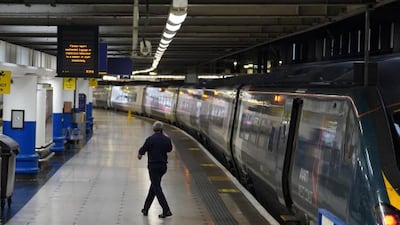
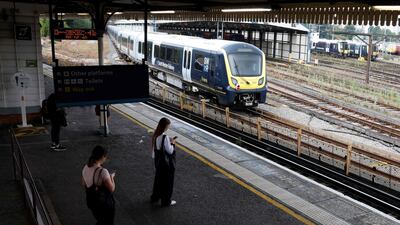
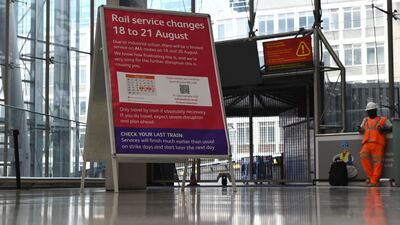
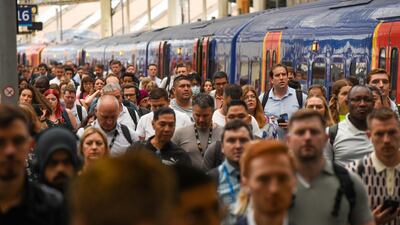
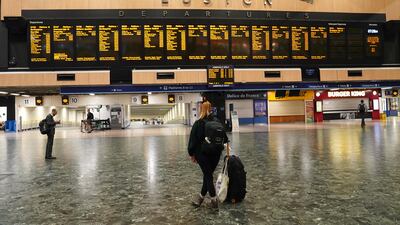
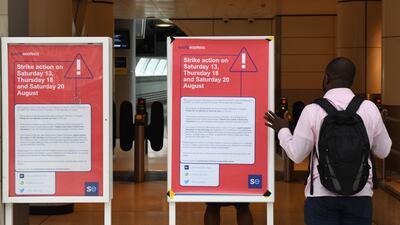
Tens of thousands of railway workers in the UK are set to go on strike in a long-running dispute over pay, jobs and conditions.
Members of the Rail, Maritime and Transport union (RMT) at Network Rail and 14 train operators will walk out on September 15 and 17.
More than 40,000 union members will strike, RMT said, warning it will “effectively shut down” the entire rail network.
A series of strikes have already been held over the course of the bitter, deadlocked row.
Despite lengthy talks between the union and the rail industry, there has been no breakthrough or new offers from either Network Rail or the operators, the union said.
“Our members have no choice but to continue this strike action,” said RMT general secretary Mick Lynch.
“Network Rail and the train operating companies have shown little interest these past few weeks in offering our members anything new in order for us to be able to come to a negotiated settlement.
“[Transport Secretary] Grant Shapps continues his dereliction of duty by staying in his bunker and shackling the rail industry from making a deal with us.
“We will continue to negotiate in good faith, but the employers and government need to understand our industrial campaign will continue for as long as it takes.”
The news follows announcements by Aslef and the Transport Salaried Staffs Association of strikes by their members in the coming weeks.
“Yet again, union leaders are choosing self-defeating, co-ordinated strike action over constructive talks, not only disrupting the lives of millions who rely on these services but jeopardising the future of the railways and their own members’ livelihoods,” said a Department for Transport representative.
“These reforms deliver the modernisations our rail network urgently needs are essential to the future of rail and will happen; strikes will not change this.”
Rail strikes continue to hit commuters in the UK — video
“We want to give our employees a decent pay rise and we’re doing everything we can to find a breakthrough in talks,” said Andrew Haines, Network Rail chief executive.
“It isn’t fair to ask taxpayers or passengers to fund this pay rise, so we must fund it ourselves, which is achievable if the unions will work with us to modernise and run the railway more efficiently.
“Our latest offer of a two-year, 8 per cent pay rise, with heavily discounted travel and a guarantee of no compulsory redundancies is affordable from within our own budgets, but the RMT remains unwilling to give its members the chance to vote on it despite knowing that members at another union overwhelmingly accepted a similar deal.
“Frustratingly, the RMT’s decision to call for further action means we will again have to ask passengers to stay away from the railway on September 15 and 17, at a time when we should be focusing on building a railway fit for a 21st-century, post-pandemic Britain.”
Rail strikes return in Britain — in pictures
“These strikes are cynically timed to cause maximum disruption to the very passengers the industry depends on for its recovery,” said Steve Montgomery, chairman of the Rail Delivery Group.
“From those left out of pocket because they can’t get to work, to people missing vital appointments and thousands of children and young people who depend on the train to get to school, the union leadership’s actions have very real consequences.
“We absolutely want to give our people a pay rise and we know they are facing a squeeze — but the RMT must recognise that with revenue consistently at 20 per cent below pre-Covid levels, the only solution lies in long-overdue reforms that will put the industry on a sustainable footing and improve services for passengers.
“Everybody wants to see the industry and its people thrive. We ask the RMT to do the right thing, call off these damaging strikes and work with us to make that happen.”

Our family matters legal consultant
Name: Dr Hassan Mohsen Elhais
Position: legal consultant with Al Rowaad Advocates and Legal Consultants.
UAE's final round of matches
- Sep 1, 2016 Beat Japan 2-1 (away)
- Sep 6, 2016 Lost to Australia 1-0 (home)
- Oct 6, 2016 Beat Thailand 3-1 (home)
- Oct 11, 2016 Lost to Saudi Arabia 3-0 (away)
- Nov 15, 2016 Beat Iraq 2-0 (home)
- Mar 23, 2017 Lost to Japan 2-0 (home)
- Mar 28, 2017 Lost to Australia 2-0 (away)
- June 13, 2017 Drew 1-1 with Thailand (away)
- Aug 29, 2017 v Saudi Arabia (home)
- Sep 5, 2017 v Iraq (away)
How to donate
Send “thenational” to the following numbers or call the hotline on: 0502955999
2289 – Dh10
2252 – Dh 50
6025 – Dh20
6027 – Dh 100
6026 – Dh 200
The specs
Engine: Four electric motors, one at each wheel
Power: 579hp
Torque: 859Nm
Transmission: Single-speed automatic
Price: From Dh825,900
On sale: Now
Profile of Foodics
Founders: Ahmad AlZaini and Mosab AlOthmani
Based: Riyadh
Sector: Software
Employees: 150
Amount raised: $8m through seed and Series A - Series B raise ongoing
Funders: Raed Advanced Investment Co, Al-Riyadh Al Walid Investment Co, 500 Falcons, SWM Investment, AlShoaibah SPV, Faith Capital, Technology Investments Co, Savour Holding, Future Resources, Derayah Custody Co.
The burning issue
The internal combustion engine is facing a watershed moment – major manufacturer Volvo is to stop producing petroleum-powered vehicles by 2021 and countries in Europe, including the UK, have vowed to ban their sale before 2040. The National takes a look at the story of one of the most successful technologies of the last 100 years and how it has impacted life in the UAE.
Read part four: an affection for classic cars lives on
Read part three: the age of the electric vehicle begins
Read part one: how cars came to the UAE
ESSENTIALS
The flights
Fly Etihad or Emirates from the UAE to Moscow from 2,763 return per person return including taxes.
Where to stay
Trips on the Golden Eagle Trans-Siberian cost from US$16,995 (Dh62,414) per person, based on two sharing.
The specs: 2018 Ford F-150
Price, base / as tested: Dh173,250 / Dh178,500
Engine: 5.0-litre V8
Power: 395hp @ 5,000rpm
Torque: 555Nm @ 2,750rpm
Transmission: 10-speed automatic
Fuel consumption, combined: 12.4L / 100km
LIKELY TEAMS
South Africa
Faf du Plessis (captain), Dean Elgar, Aiden Markram, Hashim Amla, AB de Villiers, Quinton de Kock (wkt), Vernon Philander, Keshav Maharaj, Kagiso Rabada, Morne Morkel, Lungi Ngidi.
India (from)
Virat Kohli (captain), Murali Vijay, Lokesh Rahul, Cheteshwar Pujara, Rohit Sharma, Ajinkya Rahane, Hardik Pandya, Dinesh Karthik (wkt), Ravichandran Ashwin, Bhuvneshwar Kumar, Ishant Sharma, Mohammad Shami, Jasprit Bumrah.
The five pillars of Islam
The%20specs
%3Cp%3E%3Cstrong%3EEngine%3A%3C%2Fstrong%3E%204.0-litre%20twin-turbo%20V8%3Cbr%3E%3Cstrong%3EPower%3A%20%3C%2Fstrong%3E680hp%20at%206%2C000rpm%3Cbr%3E%3Cstrong%3ETorque%3A%20%3C%2Fstrong%3E800Nm%20at%202%2C750-6%2C000rpm%3Cbr%3E%3Cstrong%3ETransmission%3A%20%3C%2Fstrong%3ERear-mounted%20eight-speed%20auto%3Cbr%3E%3Cstrong%3EFuel%20consumption%3A%20%3C%2Fstrong%3E13.6L%2F100km%3Cbr%3E%3Cstrong%3EOn%20sale%3A%3C%2Fstrong%3E%20Orderbook%20open%3B%20deliveries%20start%20end%20of%20year%3Cbr%3E%3Cstrong%3EPrice%3A%20%3C%2Fstrong%3EFrom%20Dh970%2C000%3C%2Fp%3E%0A
Results
5.30pm Maiden (TB) Dh82,500 (Turf) 1,400m
Winner Spirit Of Light, Clement Lecoeuvre (jockey), Erwan Charpy (trainer)
6.05pm Maiden (TB) Dh82,500 (Dirt) 1,900m
Winner Bright Start, Pat Cosgrave, Saeed bin Suroor
6.40pm Handicap (TB) Dh92,500 (D) 2,000m
Winner Twelfthofneverland, Nathan Crosse, Satish Seemar
7.15pm Handicap (TB) Dh85,000 (T) 1,600m
Winner Imperial Empire, Tadhg O’Shea, Satish Seemar
7.50pm Handicap (TB) Dh92,500 (T) 2,000m
Winner Record Man, Tadhg O’Shea, Satish Seemar
8.25pm Handicap (TB) Dh92,500 (D) 1,600m
Winner Celtic Prince, Fabrice Veron, Rashed Bouresly
Graduated from the American University of Sharjah
She is the eldest of three brothers and two sisters
Has helped solve 15 cases of electric shocks
Enjoys travelling, reading and horse riding
Company%20profile
%3Cp%3E%3Cstrong%3EName%3A%3C%2Fstrong%3E%20Belong%3Cbr%3E%3Cstrong%3EBased%3A%3C%2Fstrong%3E%20Dubai%3Cbr%3E%3Cstrong%3EFounders%3A%3C%2Fstrong%3E%20Michael%20Askew%20and%20Matthew%20Gaziano%3Cbr%3E%3Cstrong%3ESector%3A%3C%2Fstrong%3E%20Technology%3Cbr%3E%3Cstrong%3ETotal%20funding%3A%3C%2Fstrong%3E%20%243.5%20million%20from%20crowd%20funding%20and%20angel%20investors%3Cstrong%3E%3Cbr%3ENumber%20of%20employees%3A%3C%2Fstrong%3E%2012%3C%2Fp%3E%0A
Mercer, the investment consulting arm of US services company Marsh & McLennan, expects its wealth division to at least double its assets under management (AUM) in the Middle East as wealth in the region continues to grow despite economic headwinds, a company official said.
Mercer Wealth, which globally has $160 billion in AUM, plans to boost its AUM in the region to $2-$3bn in the next 2-3 years from the present $1bn, said Yasir AbuShaban, a Dubai-based principal with Mercer Wealth.
“Within the next two to three years, we are looking at reaching $2 to $3 billion as a conservative estimate and we do see an opportunity to do so,” said Mr AbuShaban.
Mercer does not directly make investments, but allocates clients’ money they have discretion to, to professional asset managers. They also provide advice to clients.
“We have buying power. We can negotiate on their (client’s) behalf with asset managers to provide them lower fees than they otherwise would have to get on their own,” he added.
Mercer Wealth’s clients include sovereign wealth funds, family offices, and insurance companies among others.
From its office in Dubai, Mercer also looks after Africa, India and Turkey, where they also see opportunity for growth.
Wealth creation in Middle East and Africa (MEA) grew 8.5 per cent to $8.1 trillion last year from $7.5tn in 2015, higher than last year’s global average of 6 per cent and the second-highest growth in a region after Asia-Pacific which grew 9.9 per cent, according to consultancy Boston Consulting Group (BCG). In the region, where wealth grew just 1.9 per cent in 2015 compared with 2014, a pickup in oil prices has helped in wealth generation.
BCG is forecasting MEA wealth will rise to $12tn by 2021, growing at an annual average of 8 per cent.
Drivers of wealth generation in the region will be split evenly between new wealth creation and growth of performance of existing assets, according to BCG.
Another general trend in the region is clients’ looking for a comprehensive approach to investing, according to Mr AbuShaban.
“Institutional investors or some of the families are seeing a slowdown in the available capital they have to invest and in that sense they are looking at optimizing the way they manage their portfolios and making sure they are not investing haphazardly and different parts of their investment are working together,” said Mr AbuShaban.
Some clients also have a higher appetite for risk, given the low interest-rate environment that does not provide enough yield for some institutional investors. These clients are keen to invest in illiquid assets, such as private equity and infrastructure.
“What we have seen is a desire for higher returns in what has been a low-return environment specifically in various fixed income or bonds,” he said.
“In this environment, we have seen a de facto increase in the risk that clients are taking in things like illiquid investments, private equity investments, infrastructure and private debt, those kind of investments were higher illiquidity results in incrementally higher returns.”
The Abu Dhabi Investment Authority, one of the largest sovereign wealth funds, said in its 2016 report that has gradually increased its exposure in direct private equity and private credit transactions, mainly in Asian markets and especially in China and India. The authority’s private equity department focused on structured equities owing to “their defensive characteristics.”