


People earning £45,000 will probably need help to pay their energy bills this winter, the UK Chancellor has said.
Nadhim Zahawi said both low and middle earners will require support, after regulator Ofgem raised the price cap on household bills by 80 per cent.
The average household will be charged £3,549 a year from October.
“If you are a senior nurse or a senior teacher on £45,000 a year, you're having your energy bills go up by 80 per cent and will probably rise even higher in the new year – it’s really hard,” he told The Daily Telegraph.
“If you’re a pensioner, it’s really hard. So Universal Credit is a really effective way of targeting, but I'm looking at what else we can do to make sure we help those who really need the help. We’re looking at all the options.”
His comments came as departing Prime Minister Boris Johnson predicted a “tough” few months ahead — but promised energy prices will eventually come down amid grim predictions about the impact the 80.06 per cent rise in the price cap will have on millions of the poorest households across the UK.
As the vote on who will replace Mr Johnson as the leader of the Conservative Party approaches, Mr Zahawi insisted on Friday that the government is not paralysed by the contest and is focused on preparing options for whomever comes out on top.
The chancellor told broadcasters help from the government is coming, but admitted: “We know that’s not enough. We’ve got to do more.
“We need to make sure that this isn’t a sticking plaster, that for the long term we continue to help the most vulnerable who have no cushion, and that’s what I’m determined to do.
“And we’re working up those options for both households and for business for the incoming prime minister on September 5 to take those decisions.
“So my message today is, we’ll get this £37 billion ($43bn) to people to help them for now, and then more will be coming because we know this will continue in January and, of course, on to April and next year and we have to remain resilient.”
Mr Zahawi emphasised the need for people to pay more attention to how they use energy.
“It is a difficult time. There is war on our continent,” he said.
Cost of living crisis in the UK — in pictures
-
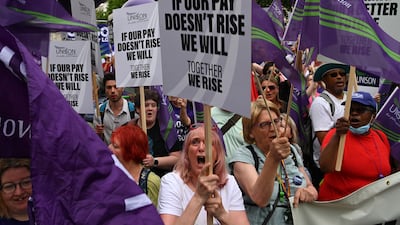
People demonstrate in central London against the rising cost of living. EPA -
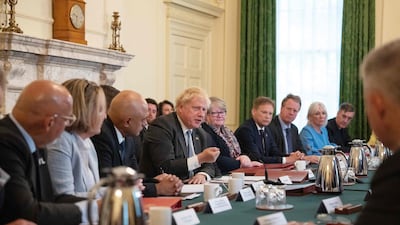
Former British prime minister Boris Johnson said workers should accept a pay cut to avoid spiralling inflation. AFP -
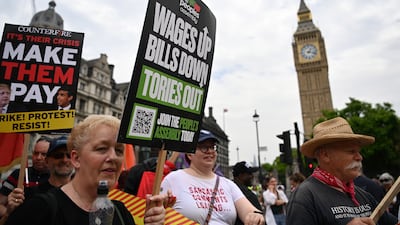
Inflation in the UK hit an annual rate of 9.1 per cent in May. EPA -

The British government told workers they cannot expect pay rises to keep up with the increasing cost of living. EPA -
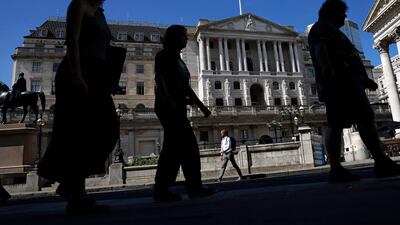
The Bank of England, which says it can do nothing to stop the sharp increase in prices, is raising rates at an unprecedented rate. AFP -

The UK was also brought to standstill by the biggest rail strike in 30 years this week, with 40,000 RMT union members walking out in a row over a below-inflation pay offer. PA -
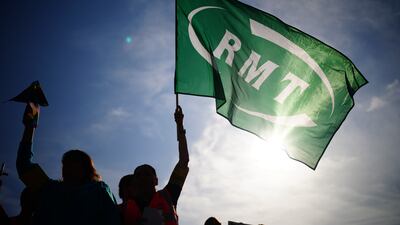
The RMT picket line outside Bristol Temple Meads station. PA -
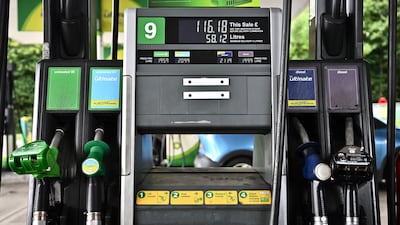
The cost of petrol continues to rise. AFP -
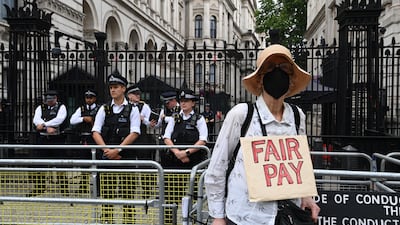
A protester demonstrates outside Downing Street. EPA -

Volunteers in Bradford, northern England, prepare food parcels at the Bradford Central Foodbank. More and more people are visiting the centre. AFP


The i newspaper reported that Conservative Party leadership contender Liz Truss is set to give extra winter fuel payments to pensioners to ease the burden, despite in the past insisting she was focused on tax cuts rather than “handouts”.
Her rival Rishi Sunak has already said he will provide additional support aimed at the most vulnerable.
Mr Zahawi said he was working “flat out” to draw up options for a plan of action for the next PM so they can “hit the ground running” when they take office in September.
In his interview with The Telegraph, he said he is exploring ways to ensure “we help those who really need the help”.
The newspaper said he refused to rule out freezing the energy cap as suggested by Labour, insisting “nothing is off the table”.
But he said: “My concern about it is that it is universal. You’re helping wealthier households, households like mine, where we can withstand the additional pressure of high energy costs, and that takes away from your ability to be resilient over the long term.
“It would be about £100 billion in about 18, 24 months. If I targeted that help, I’d be able to deliver more help to the most vulnerable.”
He also reportedly said he is considering action to help small companies through measures including cuts to VAT and business rates to support the hospitality and leisure sectors.
“If we don’t help those small and medium enterprises, my concern is the scarring effect, the longer-term scarring effect on the economy,” he said.
“So what we did on business rates, what we did on VAT for particular sectors like hospitality. So we’re working up all those options to look at those.
“And, of course, Liz Truss has talked about removing a moratorium on the green levies for a couple of years. We’re looking at that as well, which will help everyone with about £150.”
Another option on the table is granting large loans to energy suppliers to help cut bills by up to £500 a year, the newspaper said.
Mr Zahawi has been meeting heads of generating companies including Ørsted, Newcleo and RWE to discuss what more the industry can do to ensure markets function effectively for consumers.
The Treasury said the chancellor had been “clear” that the companies “need to do more to support their customers”, instead of relying on behaviour changes or expecting the government alone to help people.
The companies acknowledged that the industry “will need to make a contribution to ensure consumers are supported as energy prices rise”, the department said.
Mr Johnson, entering his final few days in office, said the government has a “big package of help and support”.
“There’s a pipeline of cash coming through over the next few months and through the autumn and the winter,” he told broadcasters during a trip to the South West London Elective Orthopaedic Centre in Surrey.
“But that is clearly now going to be augmented, increased, by extra cash that the government is plainly going to be announcing in September.”
Mr Johnson has been accused of presiding over a “zombie government” in recent weeks, with the promise of fresh help on energy bills delayed until a new prime minister takes office next month.
Opposition politicians, industry regulator Ofgem and campaigners were all united on Friday in calling on the government to intervene urgently, as charities said that households across the country could be plunged into poverty by soaring energy bills.
The Institute for Fiscal Studies (IFS) suggested that whoever becomes the next prime minister will be unable to avoid putting together a “substantial package of support”.
It said it is difficult to assess the impact of Ms Truss’s plan to cut green levies.
“Cutting only those levies that still add to bills would be complex as they are linked to various schemes and subsidies and apply to business as well as households, but would save households around £50 on average over the three months from October,” it said.
Everything you need to know about Liz Truss — video
Mr Sunak, plans to cut VAT on household energy bills, which the IFS said would save a typical household £51 between October and December at a cost of £1.4bn.
“Looking beyond this winter, energy prices also look like they will remain very high well into next year, which will put pressure on the government to provide further support in the coming months,” IFS economist Isaac Delestre said.
“Whoever becomes the next prime minister will most likely be announcing a substantial package of support very soon after taking office.”
A spokesman for Ms Truss said on Friday that as prime minister, she would “ensure people get the support needed to get through these tough times”.
Mr Sunak also told broadcasters that protecting people from rising energy bills would be his “immediate priority” as prime minister.
Everything you need to know about Rishi Sunak — video
Jonathan Brearley, Ofgem’s chief executive, on Friday said the problem is beyond what the regulator can address by itself.
Appearing on BBC Radio 4’s Today programme only minutes after the price cap announcement, he said the news would be “devastating” for many families.
“The truth is this is beyond the capacity of the regulator and the industry to address,” he said.
Ofgem boss Jonathan Brearley said the regulator had to make “difficult trade-offs” setting the new price cap.
He gave a warning that costs would come back to customers in the long run if companies were to fail.
“The price cap was designed to do one thing, and that was to make sure that unfair profits aren’t charged by those companies that buy and sell energy. And, right now, those profits in that market are zero per cent," said Mr Brearley speaking to Channel 4 News.
“What it can’t do is it can’t say, given the cost of the energy, that we can force companies to get from customers less than it costs to buy the energy that they need, because otherwise they simply can’t buy the energy for those customers.”
“So, we have had to make some difficult trade-offs and we have had to make some difficult choices,” he said.
A former vice president of BP said the latest cap should be suspended and called for taxes to be increased on oil producers if they are not facing “real costs”.
Nick Butler, who worked for the company for 30 years, said he did not think the Ofgem cap should have been announced with no “modification or mitigation”.
He told BBC Scotland’s The Seven he believed some energy companies were “milking the system” and that those who could not prove they faced real supply costs should face a tax rise.
“[Some] people, I think, are milking the system and that’s why I absolutely believe this has got to be made a transparent market, and the good companies will welcome that transparency because it will restore an element of the trust that has been lost,” Mr Butler said.
After the price cap was announced, about 100 protesters gathered outside Ofgem headquarters in London urging consumers to withhold payment for “astronomical” energy price increases they could not afford.
Members of the crowd shouted “enough is enough” and held banners reading “Freeze profits, not people” on the street in Canary Wharf in London.
The demonstration was promoted by Don’t Pay UK, a grass roots movement describing its aim as “building a mass non-payment strike of energy bills starting on October 1”.
Tracy Baldwin, 52, said deaths caused in part by the price rise were inevitable and would be “nothing short of corporate manslaughter”.
“The price hikes are astronomical. There’s going to be deaths from the vulnerable, the disabled, the elderly," said Ms Baldwin, a carer from Yorkshire.
“Ofgem are not doing anything to tackle the problem. When people start to die it’s going to be nothing short of corporate manslaughter.”
Teacher Jamie Grey, 34, called for “hitting them where it hurts, withdrawing our financial support for a barbaric regime of energy companies that have put profit before people”.
The Tower Hamlets resident said she teaches children who are already living below the poverty line whose families would be unable to stay warm this winter.
She said Ofgem “doesn’t care about us at all” and vulnerable people would die over the coming months as a result of the cost-of-living crisis.
“Ofgem don’t care about us. All we have is each other — historically we know mass non-payment and mass movements do work,” Ms Grey said.
“People are going to be driven into poverty. The people being asked to absorb the price rises are the people at the bottom,” said protester Tony Cisse.

