

A drought was declared for large parts of England on Friday, as the country braced for a sweltering weekend.
Prolonged deprivation of rainfall and record-breaking temperatures prompted the UK's National Drought Group to introduce drought status for parts of the south, south-west, central and eastern parts of the country.
For middle-aged and elderly Britons, the measure has called to mind the summer of 1976, when the country was in the grips of the Great Drought.
Experts say Britain could be in for another nationwide drought if the skies don’t open soon to relieve the parched land.
What is drought status?
The National Drought Group — made up of representatives from the government, water companies, the Environment Agency and others — made the declaration following a meeting on Friday.
It opens the door for possible new measures such as more hosepipe bans.
Water companies will also not need further permission from the government to impose restrictions on water use.
-
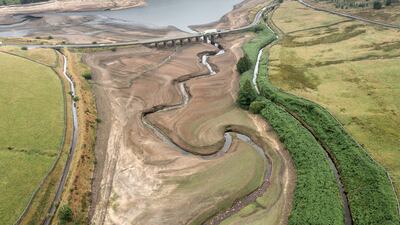
The bed of the Woodhead reservoir as water levels sink in Glossop. There was a record-breaking heatwave in July, which was the driest July in records dating back to 1836 for south-east and central southern England. Getty Images -
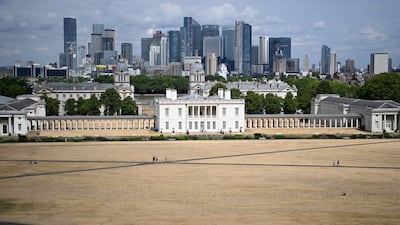
The parched grass lands of Greenwich Park in London. The country is facing its driest summer since 1976. EPA -

Bewl Water Reservoir near Lamberhurst in Kent, which is currently measured at 67 per cent of its capacity as the dry weather continues. PA -

A man walks along a dry bank of a tributary to the Dowry Reservoir close to Oldham. PA -
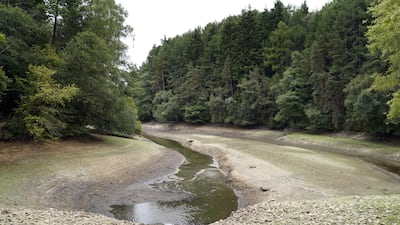
Ardingly reservoir in West Sussex, owned and managed by South East Water, the water supplier for Kent and Sussex, which is restricting the use of hosepipes and sprinklers. PA -
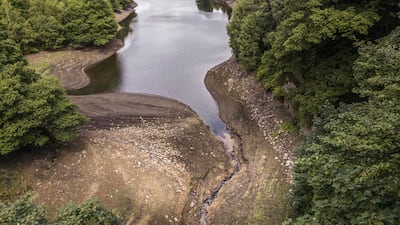
Low water levels at Holme Styes reservoir in Holmfirth, West Yorkshire. PA -

A parched Parliament Square in London. EPA -
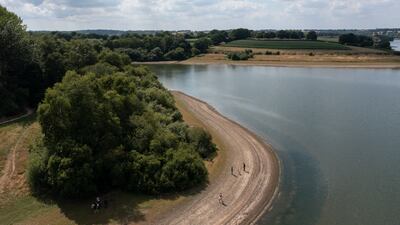
Low water levels at Bewl Water reservoir in Lamberhurst. Getty Images -
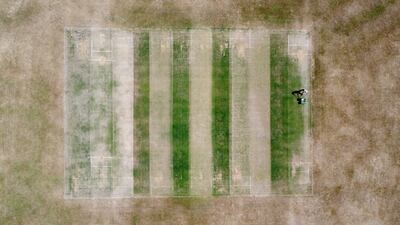
A groundsman at Boughton and Eastwell Cricket Club in Ashford, Kent, prepares the wickets for matches. PA


However, the Environment Agency has reassured the public that essential water supplies are safe.
A drought is defined as a prolonged shortage of water either in the atmosphere, on the surface or in the ground.
At a meeting earlier this summer, the group moved most of England into “prolonged dry weather” status, the first of four stages.
Eight of 14 areas have now moved to “drought”, the second stage, including Devon and Cornwall, Solent and South Downs, Kent and South London, Herts and North London, East Anglia, Thames, Lincolnshire and Northamptonshire, and the East Midlands.
How long will the drought last?
The drought status is likely to remain for months.
John Curtin, executive director for local operations at the Environment Agency, said it would take “weeks’ worth of rain” to replenish water sources.
What lies ahead?
Chris Thomas, professor of biology at the University of York, said the situation is already showing signs of being a possible repeat of the 1976 drought, which caused land to crack, gardens to wither and reservoirs to dry up.
The dry spell had a significant impact on British farming, wildlife and landscape and the recovery was slow.
Mr Thomas said the drought could lead to a huge decline in wildlife populations, including insects.
This will have a direct effect on the food chain, particularly on birds and animals who feed on such creatures.
“I lived through the drought of 1976 and this does seem like it is the most extreme drought since,” he told The National. “It had huge implications for the environment and this is starting to look the same.”
During the drought of 1976, farms did not have enough water for their animals and crops, as many bore holes dried out. Maize, cauliflower and sprouts were among the crops to fail in the sweltering heat.
After low grass growth, farmers were forced to feed barley straw and hay to their livestock.
Reacting to the declaration of drought for parts of England on Friday, Mr Thomas said: “I thought that it was really a good thing and they were likely delaying it in the hope that rain was going to come but it has not.”
He said he hopes the declaration will make people more conscious of how they use water and lead them to adopt a sensible approach.

“Satellite images show most of the south-east of the country is just brown,” he said.
“It’s dried up and dead, more or less. We hope a lot of the animals and plants will be able to come back from that but it’s a major challenge. We don’t know if 1976 will be repeated.”
Supermarkets on Friday began rationing bottled water in a bid to prevent supplies from running out as thirsty customers stocked up.
This weekend, parts of the UK are forecast to reach 36°C, and while rain is on the horizon, forecasters believe it will not go far enough to help fields that have been baking in the heat.
Greg Dewhurst, meteorologist at the Met Office, said the country needs more than a few days of rainfall.
“We will be seeing a change of weather as you go into next week,” he told The National. “We have issued thunderstorm warnings for parts of the UK for Sunday and Monday.
“There likely there will be rain for about two days next week. But it’s not going to be enough to alleviate the driest [ground]. It’s likely to need more than just a few showers. It’s been unusually dry.”
The Environment Agency's Mr Curtin said there is the possibility of the drought dragging on until next year.
“Mainly it is a signal that this is not a normal summer now, so that water will be an issue and probably will be an issue for months ahead, depending how the winter goes,” he told BBC Radio 4’s World At One.
He added: “It all depends on the weather, I’m afraid. There will be heavy showers probably Monday, Tuesday next week.”

