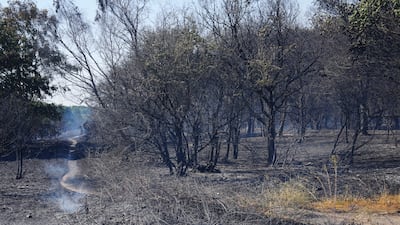
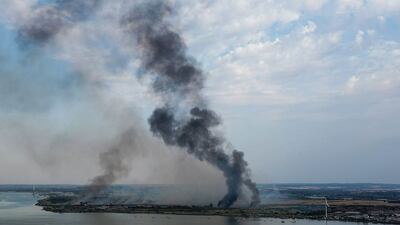
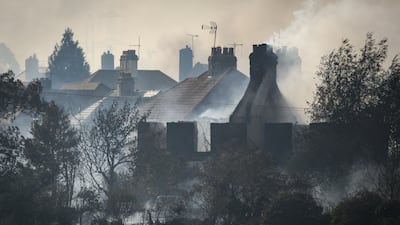
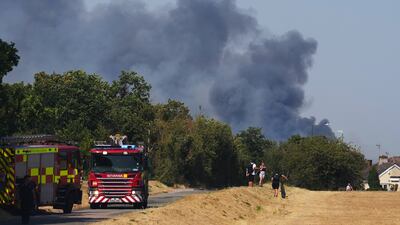
Reservoir levels have fallen across the UK as the lack of rain bites. Getty

UK faces August heatwave drought and farming crisis


  • English
  • Arabic

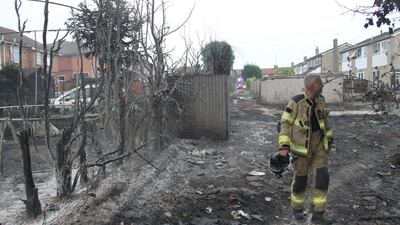
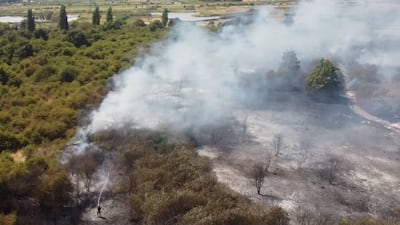
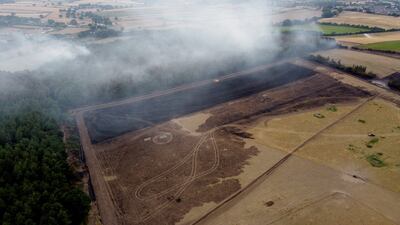
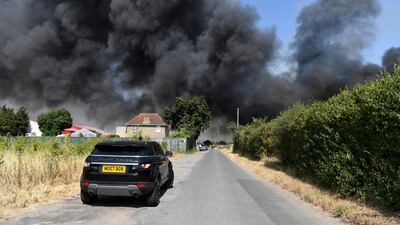
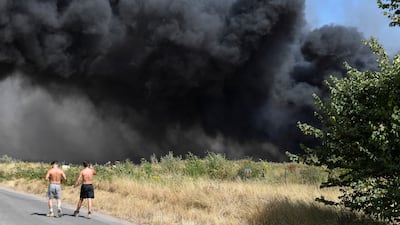
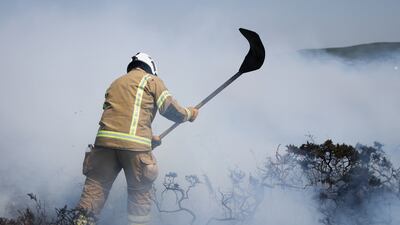
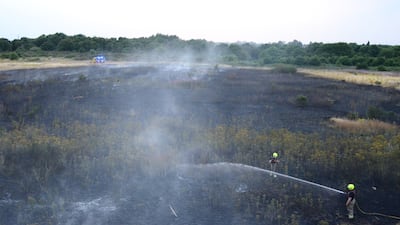
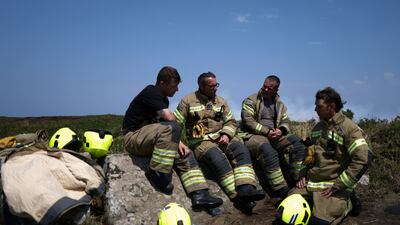
The UK's National Drought Group is set to meet on Tuesday following a warning from the Environment Agency that a drought in August is likely, placing even more pressure on the country's strained agriculture sector with fears mounting that this year's crop yield could already be significantly reduced.

Comprising government departments, water companies and other concerned parties, the National Drought Group convenes as when weather conditions threaten shortages ― and temperatures exceeding 40°C in the UK are certainly placing demands on the system this summer.

It will now attempt to formulate a plan to mitigate any water shortages and other consequence of the record-breaking heatwave and unusually dry weather that has beset the country in recent weeks.

The combination has already pushed the UK into the first of four drought categories ― "prolonged dry weather". And with significant rain not forecast until mid-August at the earliest, there is a strong possibility the UK will move into its second drought stage, in which water companies could limit non-essential use by taking measures such as banning the use of hosepipes.

The last time a drought was declared in the UK was in 2018, and before that in 2012.

One of the areas most affected by the extreme temperatures is agriculture, and National Drought Group member the National Farmers' Union is pressing for urgent action.

“We don’t have time to waste. The situation with water is very, very serious for growers – there are implications for costs and crop viability,” said NFU president Minette Batters, alluding to the contracts many growers have already signed with retailers.

“Who is going to be paying for these extra costs? Everybody in the supply chain, retailers, have to make sure they pick up the tab for rising costs. Growers have already signed their contracts with supermarkets. It needs others in the chain to come and take these extra costs into account.”

Ms Batters also took aim at the UK government's complacency over its water supply.

“This really does highlight the futility of just relying on imports; other European countries are in far worse situations than we are,” she said.

“We have taken our water supply for granted in this country for so long. We are not storing and moving water in the way that we should be. Water security and food security are inextricably linked and food security is incredibly important. We can’t see growers not having a viable crop.”

From droughts to floods

Following the severe European heatwave this summer, Manoj Joshi, Professor of Climate Dynamics at the University of East Anglia last week told The National that climate change is "as much about water" as it about rising temperatures.

He wasn't just alluding to problems with water supply but also but also to flooding, which is likely to become prevalent as flood water is harder to retain when the ground is hard.

Land animals aren't the only ones to be challenged. This year in the UK, the Environment Agency has been called upon to carry out far more fish rescues than usual, with record-breaking temperatures and poorly oxygenated water affecting the amphibious creatures.

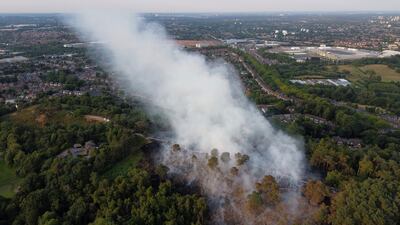
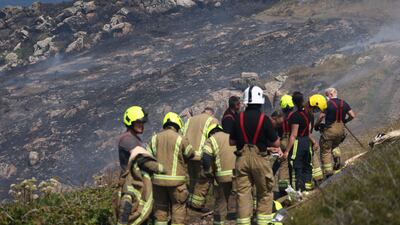
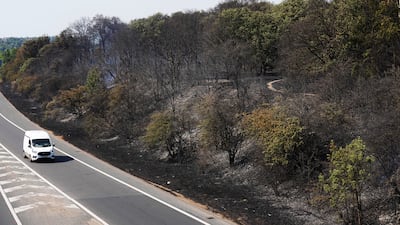
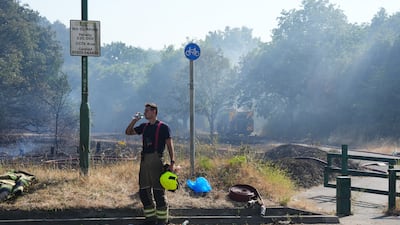
UK wildfires following heatwave - in pictures

Tips on buying property during a pandemic

Islay Robinson, group chief executive of mortgage broker Enness Global, offers his advice on buying property in today's market.

While many have been quick to call a market collapse, this simply isn’t what we’re seeing on the ground. Many pockets of the global property market, including London and the UAE, continue to be compelling locations to invest in real estate.

While an air of uncertainty remains, the outlook is far better than anyone could have predicted. However, it is still important to consider the wider threat posed by Covid-19 when buying bricks and mortar. 

Anything with outside space, gardens and private entrances is a must and these property features will see your investment keep its value should the pandemic drag on. In contrast, flats and particularly high-rise developments are falling in popularity and investors should avoid them at all costs.

Attractive investment property can be hard to find amid strong demand and heightened buyer activity. When you do find one, be prepared to move hard and fast to secure it. If you have your finances in order, this shouldn’t be an issue.

Lenders continue to lend and rates remain at an all-time low, so utilise this. There is no point in tying up cash when you can keep this liquidity to maximise other opportunities. 

Keep your head and, as always when investing, take the long-term view. External factors such as coronavirus or Brexit will present challenges in the short-term, but the long-term outlook remains strong. 

Finally, keep an eye on your currency. Whenever currency fluctuations favour foreign buyers, you can bet that demand will increase, as they act to secure what is essentially a discounted property.

GIANT REVIEW

Starring: Amir El-Masry, Pierce Brosnan

Director: Athale

Rating: 4/5

Results:

6.30pm: Maiden Dh165,000 2,000m - Winner: Powderhouse, Sam Hitchcott (jockey), Doug Watson (trainer)

7.05pm: Handicap Dh165,000 2,200m - Winner: Heraldic, Richard Mullen, Satish Seemar

7.40pm: Conditions Dh240,000 1,600m - Winner: Walking Thunder, Connor Beasley, Ahmed bin Harmash

8.15pm: Handicap Dh190,000 2,000m - Winner: Key Bid, Fernando Jara, Ali Rashid Al Raihe

8.50pm: The Garhoud Sprint Listed Dh265,000 1,200m - Winner: Drafted, Sam Hitchcott, Doug Watson

9.25pm: Handicap Dh170,000 1,600m - Winner: Cachao, Tadhg O’Shea, Satish Seemar

10pm: Handicap Dh190,000 1,400m - Winner: Rodaini, Connor Beasley, Ahmed bin Harmash

UAE currency: the story behind the money in your pockets

Mercer, the investment consulting arm of US services company Marsh & McLennan, expects its wealth division to at least double its assets under management (AUM) in the Middle East as wealth in the region continues to grow despite economic headwinds, a company official said.

Mercer Wealth, which globally has $160 billion in AUM, plans to boost its AUM in the region to $2-$3bn in the next 2-3 years from the present $1bn, said Yasir AbuShaban, a Dubai-based principal with Mercer Wealth.

Within the next two to three years, we are looking at reaching $2 to $3 billion as a conservative estimate and we do see an opportunity to do so,” said Mr AbuShaban.

Mercer does not directly make investments, but allocates clients’ money they have discretion to, to professional asset managers. They also provide advice to clients.

“We have buying power. We can negotiate on their (client’s) behalf with asset managers to provide them lower fees than they otherwise would have to get on their own,” he added.

Mercer Wealth’s clients include sovereign wealth funds, family offices, and insurance companies among others.

From its office in Dubai, Mercer also looks after Africa, India and Turkey, where they also see opportunity for growth.

Wealth creation in Middle East and Africa (MEA) grew 8.5 per cent to $8.1 trillion last year from $7.5tn in 2015, higher than last year’s global average of 6 per cent and the second-highest growth in a region after Asia-Pacific which grew 9.9 per cent, according to consultancy Boston Consulting Group (BCG). In the region, where wealth grew just 1.9 per cent in 2015 compared with 2014, a pickup in oil prices has helped in wealth generation.

BCG is forecasting MEA wealth will rise to $12tn by 2021, growing at an annual average of 8 per cent.

Drivers of wealth generation in the region will be split evenly between new wealth creation and growth of performance of existing assets, according to BCG.

Another general trend in the region is clients’ looking for a comprehensive approach to investing, according to Mr AbuShaban.

“Institutional investors or some of the families are seeing a slowdown in the available capital they have to invest and in that sense they are looking at optimizing the way they manage their portfolios and making sure they are not investing haphazardly and different parts of their investment are working together,” said Mr AbuShaban.

Some clients also have a higher appetite for risk, given the low interest-rate environment that does not provide enough yield for some institutional investors. These clients are keen to invest in illiquid assets, such as private equity and infrastructure.

“What we have seen is a desire for higher returns in what has been a low-return environment specifically in various fixed income or bonds,” he said.

“In this environment, we have seen a de facto increase in the risk that clients are taking in things like illiquid investments, private equity investments, infrastructure and private debt, those kind of investments were higher illiquidity results in incrementally higher returns.”

The Abu Dhabi Investment Authority, one of the largest sovereign wealth funds, said in its 2016 report that has gradually increased its exposure in direct private equity and private credit transactions, mainly in Asian markets and especially in China and India. The authority’s private equity department focused on structured equities owing to “their defensive characteristics.”

Top 10 most polluted cities
  1. Bhiwadi, India
  2. Ghaziabad, India
  3. Hotan, China
  4. Delhi, India
  5. Jaunpur, India
  6. Faisalabad, Pakistan
  7. Noida, India
  8. Bahawalpur, Pakistan
  9. Peshawar, Pakistan
  10. Bagpat, India
The Voice of Hind Rajab

Starring: Saja Kilani, Clara Khoury, Motaz Malhees

Director: Kaouther Ben Hania

Rating: 4/5

Scoreline:

Manchester City 1

Jesus 4'

Brighton 0

Results

Light Flyweight (49kg): Mirzakhmedov Nodirjon (UZB) beat Daniyal Sabit (KAZ) by points 5-0.

Flyweight (52kg): Zoirov Shakhobidin (UZB) beat Amit Panghol (IND) 3-2.

Bantamweight (56kg): Kharkhuu Enkh-Amar (MGL) beat Mirazizbek Mirzahalilov (UZB) 3-2.

Lightweight (60kg): Erdenebat Tsendbaatar (MGL) beat Daniyal Shahbakhsh (IRI) 5-0.

Light Welterweight (64kg): Baatarsukh Chinzorig (MGL) beat Shiva Thapa (IND) 3-2.

Welterweight (69kg): Bobo-Usmon Baturov (UZB) beat Ablaikhan Zhussupov (KAZ) RSC round-1.

Middleweight (75kg): Jafarov Saidjamshid (UZB) beat Abilkhan Amankul (KAZ) 4-1.

Light Heavyweight (81kg): Ruzmetov Dilshodbek (UZB) beat Meysam Gheshlaghi (IRI) 3-2.

Heavyweight (91kg): Sanjeet (IND) beat Vassiliy Levit (KAZ) 4-1.

Super Heavyweight ( 91kg): Jalolov Bakhodir (UZB) beat Kamshibek Kunkabayev (KAZ) 5-0.

Conflict, drought, famine

Estimates of the number of deaths caused by the famine range from 400,000 to 1 million, according to a document prepared for the UK House of Lords in 2024.
It has been claimed that the policies of the Ethiopian government, which took control after deposing Emperor Haile Selassie in a military-led revolution in 1974, contributed to the scale of the famine.
Dr Miriam Bradley, senior lecturer in humanitarian studies at the University of Manchester, has argued that, by the early 1980s, “several government policies combined to cause, rather than prevent, a famine which lasted from 1983 to 1985. Mengistu’s government imposed Stalinist-model agricultural policies involving forced collectivisation and villagisation [relocation of communities into planned villages].
The West became aware of the catastrophe through a series of BBC News reports by journalist Michael Buerk in October 1984 describing a “biblical famine” and containing graphic images of thousands of people, including children, facing starvation.

Band Aid

Bob Geldof, singer with the Irish rock group The Boomtown Rats, formed Band Aid in response to the horrific images shown in the news broadcasts.
With Midge Ure of the band Ultravox, he wrote the hit charity single Do They Know it’s Christmas in December 1984, featuring a string of high-profile musicians.
Following the single’s success, the idea to stage a rock concert evolved.
Live Aid was a series of simultaneous concerts that took place at Wembley Stadium in London, John F Kennedy Stadium in Philadelphia, the US, and at various other venues across the world.
The combined event was broadcast to an estimated worldwide audience of 1.5 billion.

The%20specs%3A%202024%20Mercedes%20E200
%3Cp%3E%3Cstrong%3EEngine%3A%20%3C%2Fstrong%3E2.0-litre%20four-cyl%20turbo%20%2B%20mild%20hybrid%0D%3Cbr%3E%3Cstrong%3EPower%3A%20%3C%2Fstrong%3E204hp%20at%205%2C800rpm%20%2B23hp%20hybrid%20boost%0D%3Cbr%3E%3Cstrong%3ETorque%3A%20%3C%2Fstrong%3E320Nm%20at%201%2C800rpm%20%2B205Nm%20hybrid%20boost%0D%3Cbr%3E%3Cstrong%3ETransmission%3A%20%3C%2Fstrong%3E9-speed%20auto%0D%3Cbr%3E%3Cstrong%3EFuel%20consumption%3A%20%3C%2Fstrong%3E7.3L%2F100km%0D%3Cbr%3E%3Cstrong%3EOn%20sale%3A%20%3C%2Fstrong%3ENovember%2FDecember%0D%3Cbr%3E%3Cstrong%3EPrice%3A%20%3C%2Fstrong%3EFrom%20Dh205%2C000%20(estimate)%3C%2Fp%3E%0A
Updated: July 26, 2022, 11:57 AM