

Salah Abdeslam has been given a life sentence after being found guilty of murder carried out during the 2015 Paris attacks that killed 130 people.
Nineteen other people, 10 of whom are in custody, were also found guilty of crimes including helping to provide the attackers with weapons or cars and planning to take part in the attack.
Crowds had gathered outside the central Paris court on Wednesday to hear the verdict in the trial of those involved in France's worst peacetime attack.
The Bataclan music hall, six bars and restaurants and the perimeter of the Stade de France sports arena were hit in hours-long attacks across the French capital.
Abdeslam was found guilty on terrorism and murder charges, Judge Jean-Louis Peries said.
He was sentenced to a full-life term, which offers only a small chance of parole after 30 years. Such sentences have been pronounced only four times they were introduced in 1994.
The Belgian-born Frenchman, 32, is the only surviving member of the group that carried out the attacks.
-
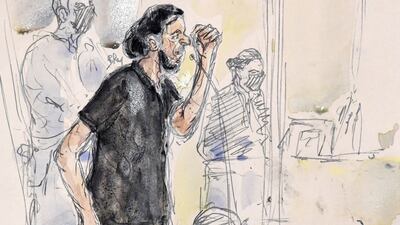
A court sketch of Salah Abdeslam during the first day of the trial of the November 2015 Paris terrorist attacks, taking place in a temporary courtroom at the Palais de Justice. AFP -

The sole survivor of the terrorist cell that carried out the November 2015 atrocity told the Paris courtroom he wanted to testify that he is being “treated like a dog” behind bars and that he would anyway be 'resuscitated' in death. Reuters -
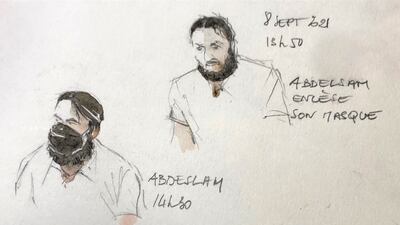
Sketches of defendant Salah Abdeslam with and without a mask in the special courtroom built for the 2015 Paris attacks trial. AP -

Abdeslam's lawyer Olivia Ronen (C) talks outside the courtroom in Paris. AP -

French police officers secure the courthouse before the arrival of the convoy transporting Abdeslam. EPA -
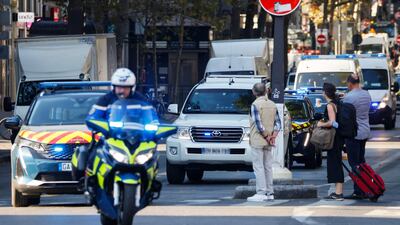
French Gendarmes escort a convoy understood to be transporting Abdeslam. AFP -

Victour Edou, the victims' lawyer, speaks to the press at the trial. EPA -
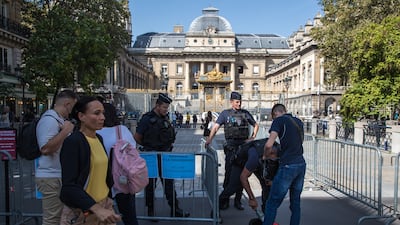
Policemen secure the access to the courthouse in Paris. EPA -

French Gendarmes stand guard outside the Palais de Justice in Paris. AFP -

Policemen arrive at the courthouse in Paris. EPA


Abdeslam said during the trial that he had chosen at the last minute not to detonate his explosive vest. But, based on the investigations and hearings, the court ruled otherwise.
"The court considered that the explosive vest malfunctioned," Mr Peries said.
Of the defendants besides Abdeslam, 18 were handed various terrorism-related convictions, and one was convicted on a lesser fraud charge.
A childhood friend of Abdeslam, Mohamed Abrini, who was accused of providing logistical support, was also sentenced by the court to a life sentence, with a minimum of 22 years.
Thirteen other people, 10 of whom were also in custody, were also in the courtroom. Six more were tried in their absence.
Some have taken responsibility for their role in the attacks. Others have not said a word. Those accused of crimes are not required to enter a plea in French trials.
The ruling can be challenged on appeal. For some victims, the fact that such a long, intense trial is about to end, stirs mixed feelings.

It has been a trial like no others, partly because of its length of 10 months, but also for the time devoted to allowing victims to give evidence about their struggles.
Relatives of those killed also spoke of how hard it was to move on.
“We became this huge community which wanted justice to exist, and that was very strong,” said Arthur Denouveaux, a survivor of the Bataclan attack, and the president of victims' association Life for Paris.
“I think we can be proud of what we achieved."
Mr Denouveaux said the trial surpassed victims' expectations “because terrorists spoke, terrorists in a way answered to our testimonies. That was so unexpected, that never happens in terrorist trials”.
“It is a relief because it means that this trial is behind me and I can go on with my life.
“There is also a little bit of fear … it filled our lives for the past 10 months and what will replace it?
"But we have overcome a terrorist attack. It will be easier to overcome the emptiness following the trial.”

