


Nato's secretary general Jens Stoltenberg has revealed a "transformative" summit for the alliance this week will decide to boost the troop numbers in its high-readiness response force to 300,000 from 40,000 currently.
The plan being discussed when the meeting gets underway in Madrid on Tuesday "constitutes the biggest overhaul of our collective deterrence and defence since the Cold War".
The alliance would decide on a new "strategic concept for a new security reality" when leaders will come together for a meeting at least as important as the 1997 gathering in the Spanish capital that began the alliance's post-Cold War expansion, when Poland, Hungary and the Czech Republic were invited to join.
The summit represents a watershed moment, amid discussions on upgrading the threat designation of Russia, significantly strengthening Nato's posture in eastern Europe and adopting a wholly new strategic concept.
The Russian invasion of Ukraine has fundamentally changed the organisation’s posture, leading to a major shake-up of defence budgets and armed forces.
Over three days in the Spanish capital, leaders from the 30 Nato nations will hammer out a range of issues such as supplying more weapons to Ukraine, China, climate change and the entry of new member states.
-

Ukrainian servicemen in a shelter at the frontline near Kharkiv. AP -

A Ukrainian and his puppy in the Donetsk region. AP -
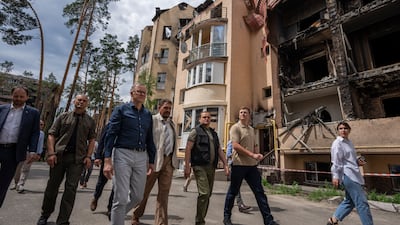
Australian Prime Minister Anthony Albanese, third left, is shown apartment buildings damaged by Russian shelling during his visit to Irpin on the outskirts of Kyiv. AP -
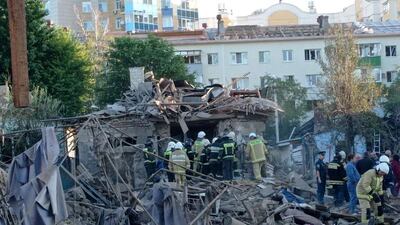
Rescue specialists work at the site of a destroyed residential building after blasts in Belgorod, Russia. Reuters -
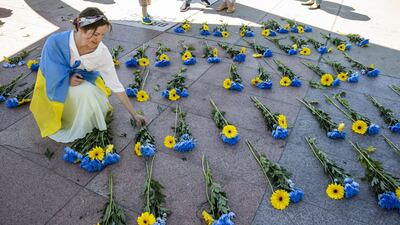
A woman lays flowers during a demonstration against the invasion of Ukraine in front of the Palais des Nations, in Geneva, Switzerland. EPA -
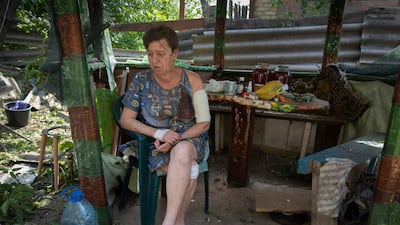
A woman injured when her house was damaged by the Russian shelling sits in the yard of her house, in Bakhmut, Ukraine. AP -
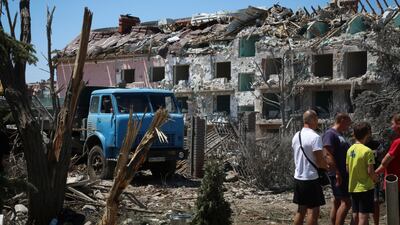
Local residents stand next to a damaged residential building in the town of Serhiivka, about 50 kilometres south-west of Odesa, Ukraine. AP -

Viktor Shevchenko stands in a crater to show its depth after a Russian shelling in the Saltivka district in Kharkiv. AP -
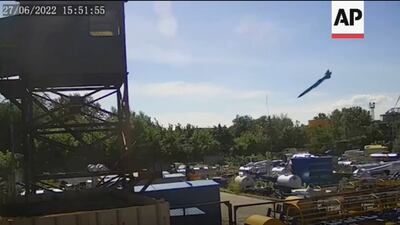
An image taken from a video provided by the Ukrainian Presidential Press Office purports to show the moment a missile struck the shopping mall in Kremenchuk. AP -

People watch as smoke rises after a Russian missile strike hit a crowded shopping mall, in Kremenchuk. AP -
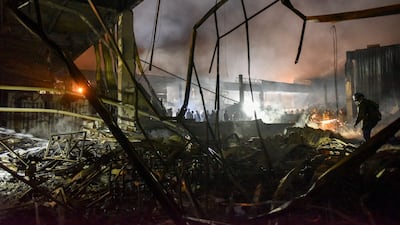
Firefighters clean the rubble of the destroyed Amstor shopping mall in Kremenchuk. EPA -
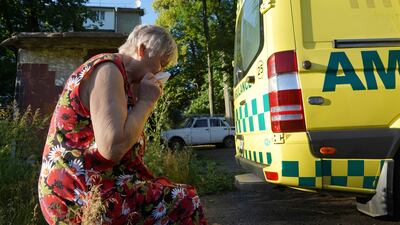
A woman cries after the body of her husband, who was killed in the yard of an apartment building during shelling, was loaded into an ambulance in Kharkiv, Ukraine. AP -

Firefighters and rescue workers at the destroyed Amstor shopping mall. EPA -
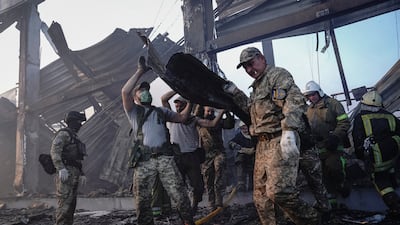
Rescuers work at the site of a shopping mall hit by a Russian missile strike, in Kremenchuk. Reuters -

A couple wounded by a Russian missile strike hold hands in a hospital, in Kremenchuk. Reuters -
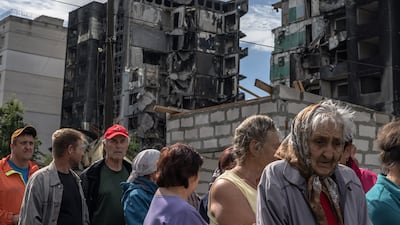
People wait to receive humanitarian aid in front of a residential building damaged during a Russian attack in Borodyanka, Ukraine. EPA -
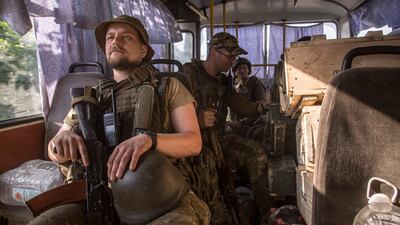
Ukrainian servicemen take a bus to their positions near Severodonetsk, in Luhansk area. EPA -
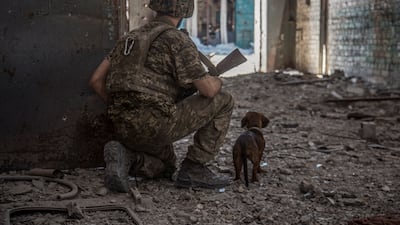
A Ukrainian service member and a dog in the industrial area of the city of Severodonetsk. Reuters -
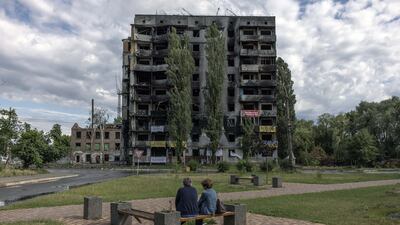
A couple sits in front of a residential building that was damaged during a Russian attack, in Borodyanka. EPA -
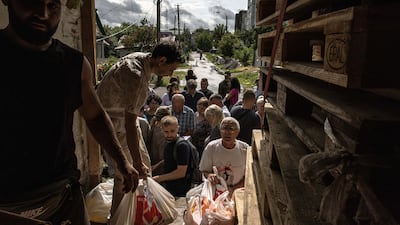
Local residents receive humanitarian aid in Borodyanka. EPA -
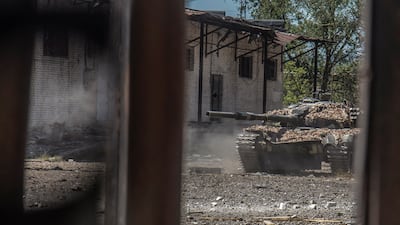
A Ukrainian armed forces tank in Severodonetsk. Reuters -
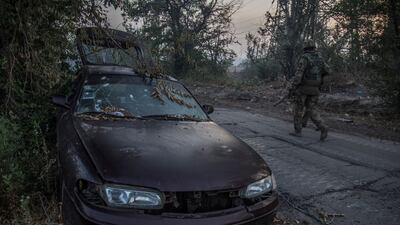
Ukrainian service members walk past a damaged car in Severodonetsk. Reuters -
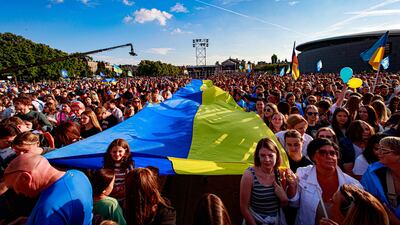
A giant Ukrainian flag is held up during the benefit concert 'Embrace Ukraine' on the Museumplein in Amsterdam. The free event will raise money for victims of the war in Ukraine and the purchase of mobile X-ray equipment that the country needs. EPA -
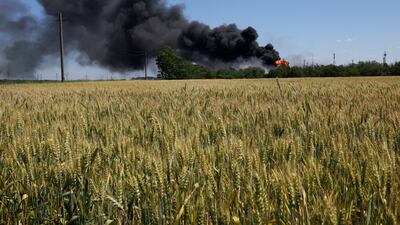
A fire from a gas processing plant continues to burn behind a field of wheat after it was hit by shelling a few days earlier in Andriivka, in the Kharkiv region. Reuters -
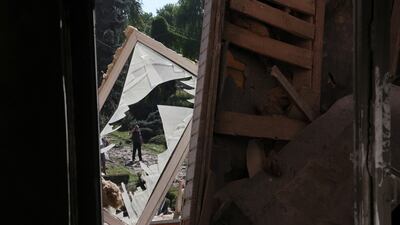
An onlooker takes in the damage from overnight shelling on Kharkiv's Housing and Communal College. Reuters -
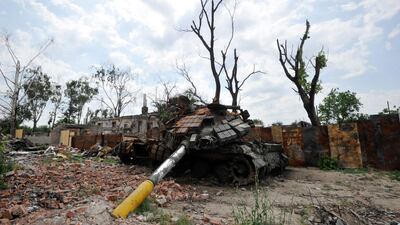
A destroyed tank in the village of Novoselivka, outside Chernigiv. AFP -
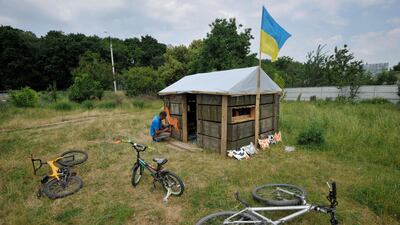
A man decorates a toy cabin for children made from used ammunition crates in the village of Novoselivka, outside Chernigiv. AFP -
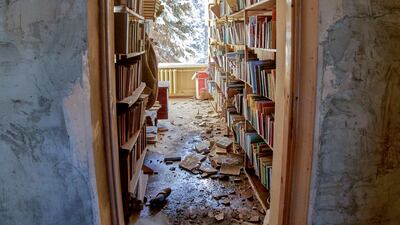
An internal view of the Housing and Communal College building damaged by recent shelling in Kharkiv. EPA


At the end of their discussions they will agree on a new strategic concept that will define how Nato will use and equip its nearly three million troops.
“This will be a transformative summit,” said Mr Stoltenberg, Nato’s Secretary General. “The Madrid strategic concept will reflect the new security environment, recommit to our values, and reaffirm our unity, ensuring that our alliance is fit for the future.”
That vision statement will look very different to the last one agreed in Lisbon in 2010, which declared that “the threat of a conventional attack against Nato territory is low,” and added: “We want to see a true strategic partnership between Nato and Russia.”
Speaking to the Financial Times on Monday, Mr Stoltenberg said Russia would be ranked as the “most direct and immediate threat to our security”.
Weapons to Ukraine
The world leaders attending the meeting in Madrid, including US President Joe Biden and British Prime Minister Boris Johnson, are likely to announce significant new arms supplies to Ukraine.
After Kyiv came under attack on Sunday and lost the eastern city of Severodonetsk, the calls for more sophisticated weaponry will intensify.
Mr Stoltenberg has promised a comprehensive package of hardware that will mean Ukraine goes through a “fundamental transition from Soviet-era equipment to Nato equipment”.
It is likely that the more hawkish countries will increase the numbers of long range precision missiles and advanced artillery pieces that can match Russia’s immense artillery formations.
Madrid may well involve Nato deciding to supply Ukraine with weapons that could push Russia out of the territory it has seized, roughly one fifth of the country.
Advanced fighters, tanks and anti-ship and anti-aircraft missiles could all be assigned to the war.
Eastern Flank

With President Vladimir Putin accused of crossing the red line of invading another country’s sovereign territory, far greater emphasis will be put on reinforcing those countries on the Russian frontier.
The Baltic states, Poland and other eastern Europe countries have all been pleading for more Nato troops on the what is called the Eastern Flank.
At the moment, there are a handful of 1,000-strong battle groups, from Britain, the US, Germany and France, numbering about 5,000 in total, to act as a tripwire force in case Russia invades.
But to make Russia consider any invasion entirely unwise and redundant there is a desire to increase these forces to at least brigade strength — about 10,000 troops each — with division headquarters.
“You don’t have 60 days to get your tanks to Estonia, because by that stage there will be no Estonia, given what the Russians have done in Ukraine,” said British Defence Secretary Ben Wallace earlier this month.
Division headquarters would mean that the countries commit advanced air defence systems, such as the Patriot system, more fighters and drones.
Other battle groups will also now be stationed in Slovakia, Romania, Hungary and Bulgaria, particularly to reinforce the south-east Black Sea flank.

Strategic concept
At the culmination of talks on Thursday, Nato will announce its new strategic concept. The document will give an assessment of the security challenges its faces and the military tasks Nato will undertake to address them.
It will ensure that Nato “adapts to a changing world and keep its one billion people safe,” the organisation stated. “How has Russia’s brutal and unprovoked invasion of Ukraine and the new security reality in Europe affected Nato’s approach to deterrence and defence?”
Since the Cold War ended, the concept has been updated once a decade to ensure the alliance is prepared for future threat.
The concept will address the military role in space as well as cyber warfare and climate change.
It will provide the blueprint for the alliance to adopt in a world where “authoritarian powers try to push back against the rules-based international order”, Nato said.
Sweden and Finland
As a result of the Russian threat, last month the two Nordic countries formally applied to join the alliance after decades of studied neutrality.
It was hoped that the Madrid summit could be used as a big occasion to announce the addition of Sweden and Finland, taking the alliance to 32 countries.
But Turkey’s objection to them joining, because of the apparent links between the Nordic countries and Kurdish separatists, has held up the application.
It is hoped that talks between the three countries, set for Tuesday, may well move the issue on. This could be significantly helped if the Americans become involved, cajoling Ankara with diplomacy and the potentially for advanced military hardware such as the F35 fighter.
China
The rising might of the Chinese military is still the greatest concern for America and others. Before the Ukraine invasion, Britain and other European countries had signalled a “Pacific tilt” by sending warships to Asia and into the South China Sea.
Nato’s leaders will know that at some point the Ukraine conflict will end and China will potentially be even stronger and more closely aligned to Russia with growing influence via is 5G technology.
This is why the leaders of Japan, South Korea, Australia and New Zealand are all in Madrid to garner long-term support in relation to China's Pacific role.
Climate change
At the Cop 26 conference in November last year, global rises in temperature were considered a serious issue for Nato. Rising sea levels and global weather events were creating territorial problems and immense pressure on food security.
Mr Stoltenberg raised the issue in several speeches, stating that armies needed to reform their hardware to make it more environmentally friendly. Electric powered tanks were not discounted. Neither were with solar-powered divisional headquarters, which would cut energy costs and an over-reliance on Russia for energy supplies.
But Mr Putin’s decision to invade Ukraine has changed the dynamic significantly. The western powers know that they have to rapidly move into renewables, weaning themselves off Russian oil and gas. But they will also realise that once the Ukraine war is over, climate change will present a security challenge that will last for decades.

