


Brazilian police on Friday officially identified the remains of British journalist Dom Phillips, who was found buried in the Amazon after going missing on a research trip.
Police and indigenous leaders have disagreed over how Phillips and his expert guide, Bruno Pereira, were killed.
Phillips was identified through “forensic dentistry combined with forensic anthropology”, federal police said in a statement and added that they were still working on confirming that other discovered remains belonged to Pereira.
Police insisted the men were killed by two suspects who were not part of a wider criminal group but said that more arrests may be made.
The Union of Indigenous Peoples of the Javari Valley, or Univaja, rejected the independent killer theory, saying they had reported a criminal gang operating in the area last year.
“These are not just two killers, but an organised group that planned the crime in detail,” Univaja said in a statement.
It said authorities had ignored their numerous complaints about the activities of criminal gangs in the area and that one of those suspected to have been involved in the killing was also involved in illegal fishing.
-
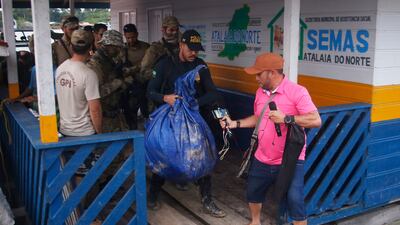
Brazilian federal police officers arrive at a pier with items found during a search for indigenous expert Bruno Pereira and British journalist Dom Phillips in Atalaia do Norte, Amazonas state, Brazil. The men have been missing for more than a week. AP -
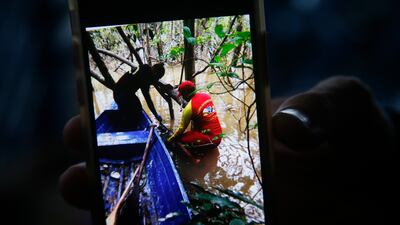
A firefighter holds a phone after a backpack was found during a search for indigenous expert Bruno Pereira and British journalist Dom Phillips in remote Atalaia do Norte, Amazonas state, Brazil. AP -
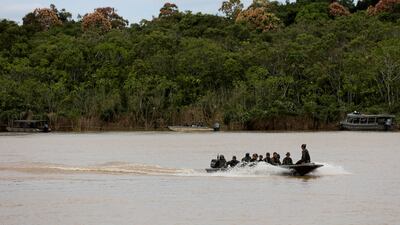
Brazilian soldiers aboard a skiff during the search for British journalist Dom Phillips and indigenous expert Bruno Pereira, who went missing in a remote part of the Amazon rainforest, near the border with Peru, at Atalaia do Norte, Amazonas state. Reuters -
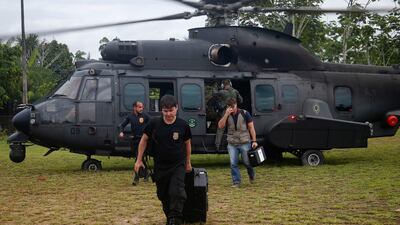
Brazilian Federal Police officers arrive to join a search operation for British journalist Dom Phillips and indigenous affairs expert Bruno Pereira in Atalaia do Norte, Amazonas state. AP -
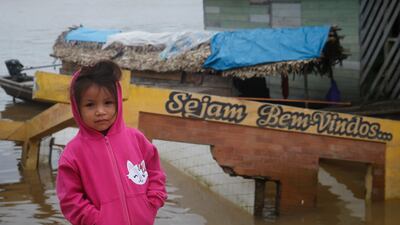
A child of the Mayuruna people watches from a pier at the Atalaia do Norte river shore in Amazonas state, Brazil, as Federal Police and military personnel search for British journalist Dom Phillips and indigenous affairs expert Bruno Pereira in Javari Valley. AP -
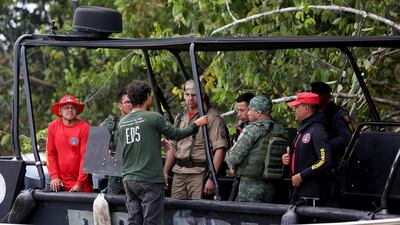
Brazilian police officers and rescue team members during the search operation for British journalist Dom Phillips and indigenous expert Bruno Pereira, who went missing in a remote and lawless part of the Amazon rainforest at Atalaia do Norte, Amazonas state, Brazil. Reuters -

Campaigners, friends and supporters of British journalist Dom Phillips and expert on indigenous affairs Bruno Pereira take part in a protest on Copacabana beach, Rio de Janeiro, to draw attention to their disappearance in the Amazon rainforest. AP -
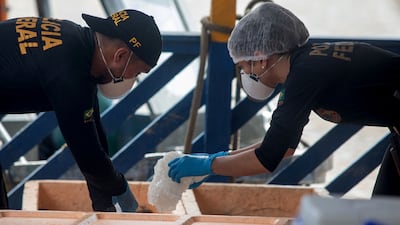
Federal Police forensics officers examine a boat seized by the task force sent to rescue of missing indigenous expert Bruno Pereira and British journalist Dom Phillips at the port of the city of Atalaia do Norte, Amazonas, Brazil. On Friday, authorities say they found ‘apparently human’ material. AFP -
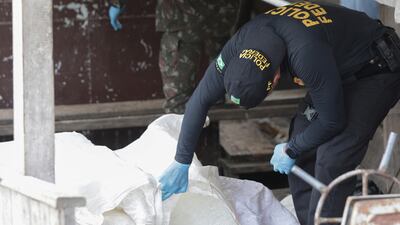
Brazilian Federal police officers examine a fishing boat during the search for British journalist Dom Phillips and indigenous expert Bruno Pereira, who both went missing in the Amazon rainforest more than a week ago. Reuters -
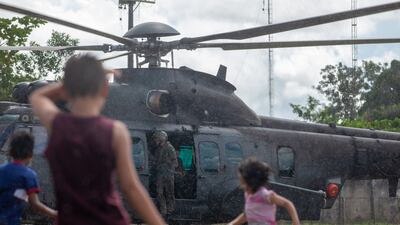
The Brazilian Army sent helicopters to help in the search for missing indigenous expert Bruno Pereira and British journalist Dom Phillips in the municipality of Atalaia do Norte, Amazonas state. The two planned a research trip to Javari Valley, a far-flung jungle where illegal fishing, logging, mining and drug trafficking are common. AFP -
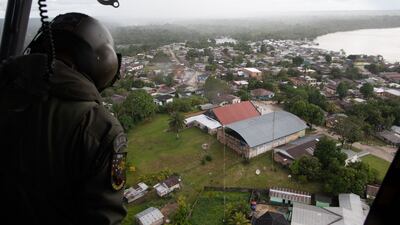
A Brazilian Army helicopter circles the municipality of Atalaia do Norte, Amazonas state, in the direction of the Itaquai River, in the search for missing indigenous expert Bruno Pereira and British journalist Dom Phillips. AFP


Brazil's federal police said the investigation into the murders so far point to killers acting without the involvement of a criminal organisation.
“The investigations … suggest that the perpetrators acted alone, without there being an intellectual author or criminal organisation behind the crime,” police said. “The investigations continue and there are indications of the participation of more people” in the murders”
Phillips and Pereira were last seen alive on June 5 before vanishing in the remote Javari Valley bordering Peru and Colombia.
Preliminary investigations, police said, suggested the crime involved more people beyond the one man who confessed to the murders.
“The investigations also point out that the killers acted alone, with no heads of criminal organisation behind the crime,” police said.
Univaja said it had informed the federal police numerous times since last year that there was an organised crime group operating in the Javari Valley.
“The cruelty of the crime makes clear that Pereira and Phillips crossed paths with a powerful criminal organisation that tried at all costs to cover its tracks during the investigation,” Univaja said.
The organisation played a leading role in finding the remains of the two men, which were sent to the capital of Brasilia.

