

The UN refugee report for 2021 has shown that 89.3 million people were displaced worldwide as a result of persecution, conflict, violence, human rights abuses or events seriously disturbing public order.
The figure did not include the mass departure of seven million, Ukrainians caused by Russia's invasion, but it shows an 8 per cent increase of almost seven million people in the span of only 12 months.
The new total is more than double the 42.7 million people who had been forcibly displaced at the end of 2012.
Within the 89.3 million were 27.1 million refugees, 53.3 million internally displaced people and 4.6 million asylum seekers.
In a clear indicator of the uneven spread of displacement, 69 per cent of the 89.3 million came from only five countries.
The figures for these countries are shown in the chart below alongside the next five that make up the 10 nations with the largest number of displacements in 2021.
The year was perhaps most notable for the number of existing conflicts that escalated and new conflicts that flared.
The World Bank reported that 23 countries, hosting a combined population of 850 million people, faced high- or medium-intensity conflicts in 2021.
The number of conflict-affected countries has doubled over the past decade, with women and children disproportionately exposed to deep-rooted discrimination and extreme vulnerability.
In Afghanistan, the events leading up to the Taliban’s takeover of Kabul in August 2021 resulted in displacement within the country as well as into neighbouring countries.
The number of people displaced internally rose for the 15th straight year, even as more than 790,000 Afghans returned during the year.
The conflict in the Tigray region in Ethiopia led to at least 2.5 million more people being displaced within their country, with about 1.5 million of them returning to their homes during the course of the year.
Violent insurgencies in the central Sahel region of Africa continued to drive internal displacement, particularly in Burkina Faso.
The root causes of conflict in the region include extreme poverty and chronic underdevelopment. The climate crisis, with temperatures in the region rising 1.5 times faster than the global average, is making the humanitarian situation even worse.
In Myanmar, the military takeover in February 2021 ignited widespread violence and forced many people to flee.
With renewed displacement from Venezuela, primarily to other Latin American countries, the number of Venezuelans displaced abroad also grew by more than half a million.
In addition, the Democratic Republic of the Congo, Nigeria, South Sudan, Sudan, Syria and Yemen all reported increases of between 100,000 and 500,000 people displaced internally during the year.
Countries hosting most refugees
The Syrian refugee population continues to be the largest globally, with 6.8 million refugees hosted in 129 countries.
Syrian refugees constituted 27 per cent of the global refugee population at the end of 2021. In the course of the year, the number of Syrian refugees increased by 145,900 due to new births and a rise in individual recognitions in Germany (38,100), Austria (7,900) and other countries in Europe.
Even so, and after more than a decade of conflict, more than three quarters of Syrian refugees are still hosted by neighbouring countries.
This explains why Turkey has for several years hosted the most refugees. 2021 was no exception and the number of displaced people hosted by the country rose to 3,759,800 from 3,696,831 in 2020.
A new entrant in the 2021 top 10 was Colombia, which hosted the second largest number of displaced people at 1,843,900. The exponential rise was driven by the exodus from neighbouring Venezuela.
Countries receiving most asylum applications
In 2021, the number of new individual asylum applications registered globally increased by 25 per cent, from 1.1 million to 1.4 million, compared with the previous year, although this remains lower than the 1.7 million and two million applications in 2018 and 2019, respectively.
Given the numerous new and existing displacement situations, the lower number of new asylum applications reflects continued travel restrictions and barriers relating to access to territory that resulted from the coronavirus pandemic.
In the US, more than half of all new applications in 2021 were lodged by citizens of only five countries: Venezuela (27,000 or 14 per cent), Guatemala (23,000 or 12 per cent), Honduras (19,600 or 10 per cent), El Salvador (14,900 or 8 per cent) and Cuba (12,900 or 7 per cent).
In Germany, nearly two thirds of new applications were from citizens of Syria (54,900), Afghanistan (23,300) and Iraq (15,600).
Mexico received the third largest number of new asylum applications (131,400), which increased more than three-fold from 41,200 in 2020. More than two thirds of them originated from Haiti (51,800, or 39 per cent) and Honduras (36,400, or 28 per cent).
Despite giving the impression that it is overwhelmed by refugees, the UK is only seventh on the list for countries that received the most applications, with 56,500, a little more than half the number received by its cross-Channel neighbour, France, which received 90,200.
The numerical reality hasn't stopped the UK from striking a deportation agreement with Rwanda to take its unwanted asylum seekers.
The US processed the most applications in 2021 (188,900), a reflection of the more welcoming approach to refugees enacted by President Joe Biden compared to his anti-immigration predecessor, Donald Trump.
Immigration-friendly Germany received the most applications in Europe by a significant margin, with 148,200
As new refugee situations emerge and intensify — as happened in Ukraine next year — and existing ones reignite or remain unresolved, the UN refugee agency said there is an acute need for durable solutions at increasing scale.
“Our report today shows that by the end of 2021, those displaced by war, violence, persecution, and human rights abuses stood at almost 90 million, well over double the figure of 10 years ago,' the UNHCR's Matthew Saltmarsh told The National.
"And since then the figure has passed 100 million due to the Russian invasion of Ukraine – causing the fastest and one of the largest forced displacement crises since World War II – and other emergencies, from Africa to Afghanistan.
"One hundred million is an alarming figure. It’s a record that should never have been set. And it should serve as a wake-up call to resolve and prevent destructive conflicts, end persecution, and address the underlying causes that force innocent people to flee their homes.”
Major refugee crises of 2021 - in pictures
-
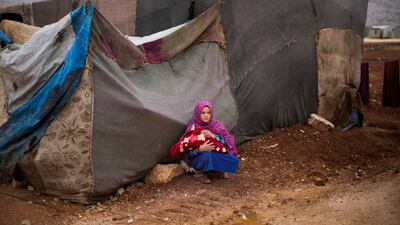
A young Syrian woman holds a baby at a refugee camp for displaced people in Sarmada district, north of Idlib city, in Syria. The fallout from the Ukraine war is worsening long-term humanitarian crises elsewhere, including in Syria. AP -
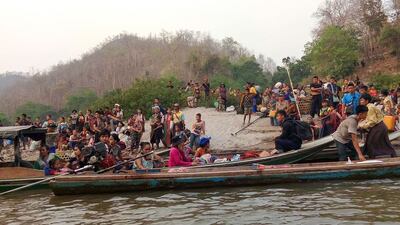
People from Karen state in Myanmar are requested by Thai authorities to head back to their country's side of the river after the military takeover in February 2021 ignited widespread violence and forced many people to flee. AFP -
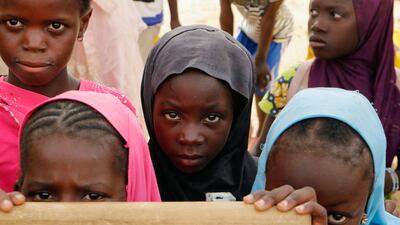
Displaced children attend class in Dori town, Burkina Faso. Violent insurgencies in the central Sahel region of Africa continued to drive internal displacement, particularly in Burkina Faso. AP -

Men carry a sack of wheat during the distribution of food aid by the World Food Programme in Debark, Ethiopia. The conflict in the Tigray region displaced at least 2.5 million more people in Ethiopia last year. AFP -
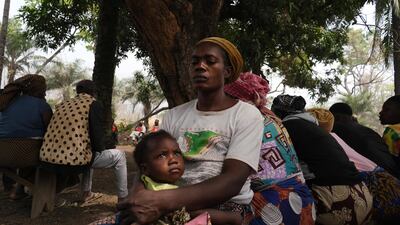
Relatives of the late chief react outside their burnt-out house in Manga, a village in north-eastern Nigeria that lies near the border with Cameroon, weeks after an attack by suspected Cameroonian separatist fighters. The Cameroonian army and the separatists have been engaged in a five-year battle that has displaced thousands of civilians. AFP -

Venezuelans cross a bridge in Cucuta, Colombia, as they return to their country. With renewed displacement, primarily to other Latin American countries, the number of Venezuelans displaced abroad grew by more than half a million. AFP -
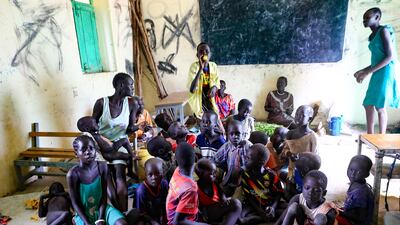
People gather inside a classroom at the Dibba Busin camp for South Sudanese refugees in Sudan's White Nile state after heavy flooding. South Sudan and Sudan are among a group of countries that all reported increases of between 100,000 and 500,000 people displaced internally during the year. AFP



