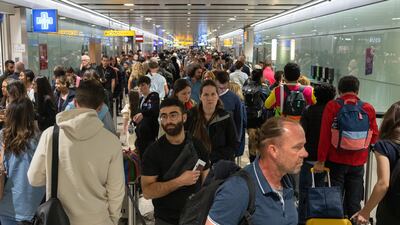
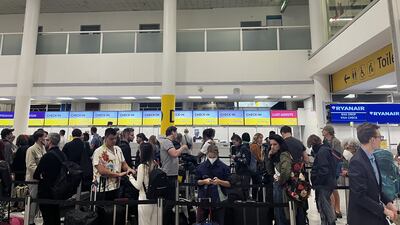
Britain's RMT union is taking its members out on strike across several dates in June. EPA

UK rail strikes: when are they and why are they happening?


Neil Murphy
  • English
  • Arabic

Railway workers across Britain will walk out this month in what is expected to be the biggest strike in the industry for decades.

Members of the Rail, Maritime and Transport (RMT) union will stage a walkout across several dates, which will likely cause severe disruption to travel plans for millions of travellers.

Britain is already struggling with shortages in the workforce, which have led to flight cancellations and lengthy queues at airports that experts predict could last up to 18 months.

The announcement comes only days after a strike on the London Underground, which resulted in the UK capital coming to halt on Monday after the platinum jubilee weekend.

Here's what we know so far.

What is happening?

Members of the RMT at Network Rail and 13 train operators will walk out on June 21, 23 and 25. The union said it will be the biggest strike on the railways since 1989.

Fewer than one in five trains are set to run and only between 7am and 7pm, probably only on main lines.

Rail bosses are drawing up contingency plans, with the strikes expected to cause disruption to services for six days, from the first walkout on Tuesday, June 21 to the day after the third strike.

The RMT has also announced another 24-hour strike on the London Underground on June 21 in a separate row.

Why are the strikes taking place?

The disputes are over pay, jobs and pensions, with the RMT complaining that rail staff who worked through the pandemic are facing job cuts, a pay freeze and poor employment conditions.

Talks between Network Rail and the union are expected to be held in the next few days in the hope that the strikes can be averted.

The union says it is "unacceptable" that workers at British railways will be hit by a pay freeze amid a cost-of-living crisis in which consumer inflation in Britain has risen to more than 9 per cent.

Which events will be affected?

The strikes take place as a number of major events are being held, including concerts, Test cricket and the Glastonbury festival.

Glastonbury starts on June 22, and in the same week England play New Zealand in Leeds, the British Athletics Championships take place in Manchester and London’s Hyde Park stages gigs by Sir Elton John (June 24) and The Rolling Stones (June 25).

There will also be a Commonwealth heads of government meeting in London on June 24 and June 25, the latter date also being Armed Forces Day.

How will holiday plans be hit?

The announcement of a national rail strike is the latest evidence that the UK faces a summer of travel misery.

Airline passengers have suffered widespread cancellations and long queues at airports for several months.

The aviation industry is desperately trying to recruit more staff but it is feared the chaos will continue during the peak summer holiday period in July and August.

Ferry companies are not suffering the same level of disruption as airlines, although passengers arriving at the Port of Dover before last week’s half-term school holiday were forced to queue for several hours.

Chaos in UK and airports – in pictures

  • Picture taken with permission from the Twitter feed of Diego Garcia Rodriguez of queues to enter security at London's Gatwick Airport on Tuesday. PA
    Picture taken with permission from the Twitter feed of Diego Garcia Rodriguez of queues to enter security at London's Gatwick Airport on Tuesday. PA
  • Passengers queue to check-in for a Qatar Airways flight at Heathrow Airport. The UK transport secretary has rejected calls for an emergency visa for aviation workers, industry bosses have claimed. PA
    Passengers queue to check-in for a Qatar Airways flight at Heathrow Airport. The UK transport secretary has rejected calls for an emergency visa for aviation workers, industry bosses have claimed. PA
  • Long queues at Heathrow. The aviation industry is struggling to recruit staff after waves of layoffs during the Covid-19 pandemic. Getty
    Long queues at Heathrow. The aviation industry is struggling to recruit staff after waves of layoffs during the Covid-19 pandemic. Getty
  • Transport Secretary Grant Shapps said airlines and operators had 'seriously oversold flights and holidays' relative to their capacity to deliver. Getty
    Transport Secretary Grant Shapps said airlines and operators had 'seriously oversold flights and holidays' relative to their capacity to deliver. Getty
  • Queues at Gatwick. Hundreds of flights from Britain are being cancelled by airlines and travel companies. PA
    Queues at Gatwick. Hundreds of flights from Britain are being cancelled by airlines and travel companies. PA
  • Holidaymakers across the UK face continuing travel disruption, such as here a Gatwick. EPA
    Holidaymakers across the UK face continuing travel disruption, such as here a Gatwick. EPA
  • Chaos at Gatwick. EPA
    Chaos at Gatwick. EPA
Abu Dhabi traffic facts

Drivers in Abu Dhabi spend 10 per cent longer in congested conditions than they would on a free-flowing road

The highest volume of traffic on the roads is found between 7am and 8am on a Sunday.

Travelling before 7am on a Sunday could save up to four hours per year on a 30-minute commute.

The day was the least congestion in Abu Dhabi in 2019 was Tuesday, August 13.

The highest levels of traffic were found on Sunday, November 10.

Drivers in Abu Dhabi lost 41 hours spent in traffic jams in rush hour during 2019


Mercer, the investment consulting arm of US services company Marsh & McLennan, expects its wealth division to at least double its assets under management (AUM) in the Middle East as wealth in the region continues to grow despite economic headwinds, a company official said.

Mercer Wealth, which globally has $160 billion in AUM, plans to boost its AUM in the region to $2-$3bn in the next 2-3 years from the present $1bn, said Yasir AbuShaban, a Dubai-based principal with Mercer Wealth.

Within the next two to three years, we are looking at reaching $2 to $3 billion as a conservative estimate and we do see an opportunity to do so,” said Mr AbuShaban.

Mercer does not directly make investments, but allocates clients’ money they have discretion to, to professional asset managers. They also provide advice to clients.

“We have buying power. We can negotiate on their (client’s) behalf with asset managers to provide them lower fees than they otherwise would have to get on their own,” he added.

Mercer Wealth’s clients include sovereign wealth funds, family offices, and insurance companies among others.

From its office in Dubai, Mercer also looks after Africa, India and Turkey, where they also see opportunity for growth.

Wealth creation in Middle East and Africa (MEA) grew 8.5 per cent to $8.1 trillion last year from $7.5tn in 2015, higher than last year’s global average of 6 per cent and the second-highest growth in a region after Asia-Pacific which grew 9.9 per cent, according to consultancy Boston Consulting Group (BCG). In the region, where wealth grew just 1.9 per cent in 2015 compared with 2014, a pickup in oil prices has helped in wealth generation.

BCG is forecasting MEA wealth will rise to $12tn by 2021, growing at an annual average of 8 per cent.

Drivers of wealth generation in the region will be split evenly between new wealth creation and growth of performance of existing assets, according to BCG.

Another general trend in the region is clients’ looking for a comprehensive approach to investing, according to Mr AbuShaban.

“Institutional investors or some of the families are seeing a slowdown in the available capital they have to invest and in that sense they are looking at optimizing the way they manage their portfolios and making sure they are not investing haphazardly and different parts of their investment are working together,” said Mr AbuShaban.

Some clients also have a higher appetite for risk, given the low interest-rate environment that does not provide enough yield for some institutional investors. These clients are keen to invest in illiquid assets, such as private equity and infrastructure.

“What we have seen is a desire for higher returns in what has been a low-return environment specifically in various fixed income or bonds,” he said.

“In this environment, we have seen a de facto increase in the risk that clients are taking in things like illiquid investments, private equity investments, infrastructure and private debt, those kind of investments were higher illiquidity results in incrementally higher returns.”

The Abu Dhabi Investment Authority, one of the largest sovereign wealth funds, said in its 2016 report that has gradually increased its exposure in direct private equity and private credit transactions, mainly in Asian markets and especially in China and India. The authority’s private equity department focused on structured equities owing to “their defensive characteristics.”

Friday's schedule in Madrid

Men's quarter-finals

Novak Djokivic (1) v Marin Cilic (9) from 2pm UAE time

Roger Federer (4) v Dominic Thiem (5) from 7pm

Stefanos Tsitsipas (8) v Alexander Zverev (3) from 9.30pm

Stan Wawrinka v Rafael Nadal (2) from 11.30pm

Women's semi-finals

Belinda Bencic v Simona Halep (3) from 4.30pm

Sloane Stephens (8) v Kiki Bertens (7) from 10pm

How to get exposure to gold

Although you can buy gold easily on the Dubai markets, the problem with buying physical bars, coins or jewellery is that you then have storage, security and insurance issues.

A far easier option is to invest in a low-cost exchange traded fund (ETF) that invests in the precious metal instead, for example, ETFS Physical Gold (PHAU) and iShares Physical Gold (SGLN) both track physical gold. The VanEck Vectors Gold Miners ETF invests directly in mining companies.

Alternatively, BlackRock Gold & General seeks to achieve long-term capital growth primarily through an actively managed portfolio of gold mining, commodity and precious-metal related shares. Its largest portfolio holdings include gold miners Newcrest Mining, Barrick Gold Corp, Agnico Eagle Mines and the NewMont Goldcorp.

Brave investors could take on the added risk of buying individual gold mining stocks, many of which have performed wonderfully well lately.

London-listed Centamin is up more than 70 per cent in just three months, although in a sign of its volatility, it is down 5 per cent on two years ago. Trans-Siberian Gold, listed on London's alternative investment market (AIM) for small stocks, has seen its share price almost quadruple from 34p to 124p over the same period, but do not assume this kind of runaway growth can continue for long

However, buying individual equities like these is highly risky, as their share prices can crash just as quickly, which isn't what what you want from a supposedly safe haven.

Bullet%20Train
%3Cp%3E%3Cstrong%3EDirector%3A%3C%2Fstrong%3E%20David%20Leitch%3Cbr%3E%3Cstrong%3EStars%3A%3C%2Fstrong%3E%20Brad%20Pitt%2C%20Aaron%20Taylor-Johnson%2C%20Brian%20Tyree%20Henry%2C%20Sandra%20Bullock%3Cbr%3E%3Cstrong%3ERating%3A%3C%2Fstrong%3E%203%2F5%3C%2Fp%3E%0A
Our family matters legal consultant

Name: Hassan Mohsen Elhais

Position: legal consultant with Al Rowaad Advocates and Legal Consultants.

Updated: June 08, 2022, 3:18 PM