


Britain’s armed forces may lack the “modern battle-winning capabilities” they need to meet the demands of future warfare, MPs have said.
The Commons Public Accounts Committee said the Russian invasion of Ukraine was a reminder of the “risks and responsibilities” that come with the UK’s membership in Nato.
But while other countries have been developing new technology such as hypersonic weapons, the committee said the Ministry of Defence has had to face “capability gaps” in the current forces.
The Government Integrated Review of foreign policy and defence last year identified Russia as “the most acute threat” to national security.
But the committee said it was concerned that recent events meant the ministry still “downplays” the scale of the threat Moscow poses to the UK’s interests.
Despite a £16.5 billion budget increase in the four years to 2024-25, the committee expressed frustration with the “complacency” within the ministry over the affordability of its equipment plan.
“We are concerned that the department may not have identified all the modern battle-winning capabilities our armed forces need and also that it is not developing its existing large programmes with sufficient urgency,” it said.
“The invasion of Ukraine highlights rapid technological advances by other potential adversaries beg serious questions about the pace, scope and ambition of the department’s equipment plan.”
The committee said that while the ministry was beginning to develop next-generation systems, there was “relatively little money” to exploit promising research during the coming decade and a lack of clarity as to whether they would be truly “battle-winning”.
It noted that new radar for the RAF’s Typhoon fighter jets was not due to enter service until 2030, even though it was first announced in 2015 and development work had begun much earlier.
-
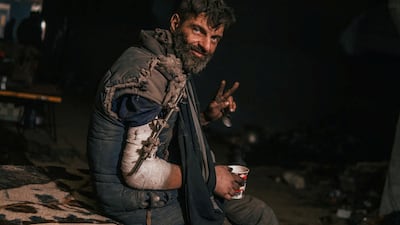
An injured Ukrainian service member sits at a field hospital inside Azovstal steel works in Mariupol, Ukraine. Reuters -
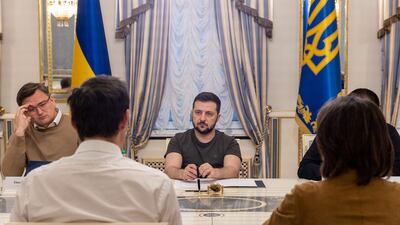
Ukraine’s President Volodymyr Zelenskyy attends a meeting in Kyiv with German Foreign Minister Annalena Baerbock and Dutch Foreign Minister Wopke Hoekstra. Reuters -
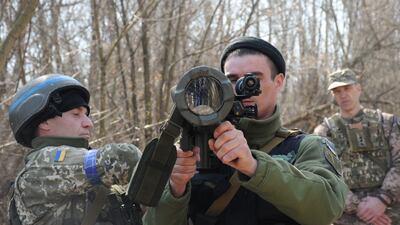
Ukrainian servicemen study a Swedish shoulder-launched weapon system during a training session near Kharkiv. AP Photo -
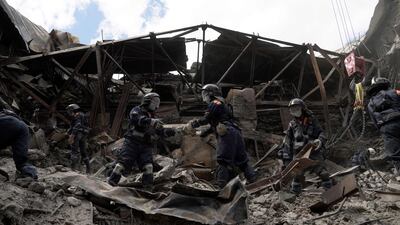
Russian emergency personnel clear debris inside Mariupol's drama theatre. AFP -
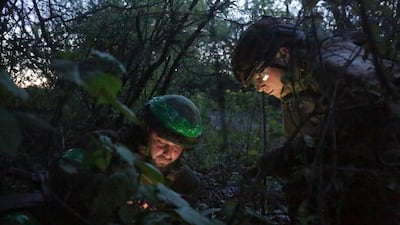
Ukrainian servicemen study a map near Kharkiv. EPA -
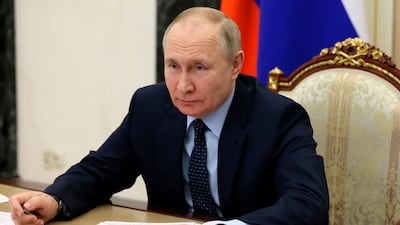
Russian President Vladimir Putin attends an online meeting with the Saratov region's acting governor, Roman Busargin, in Moscow. AP -
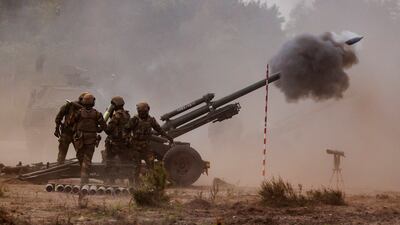
Belgian soldiers take part in a Nato military exercise near Munster, Germany. Getty -
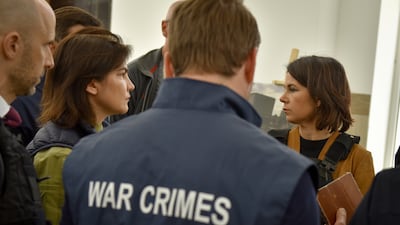
Ukraine's prosecutor general Iryna Venediktova, left, speaks with German Foreign Minister Annalena Baerbock, right, during her visit to mass graves in Bucha, Ukraine. EPA -
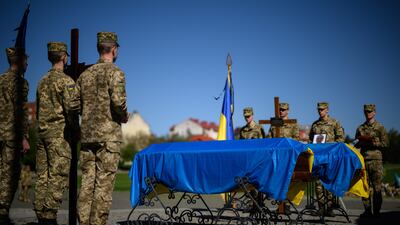
A guard of honour stands at attention during the funerals of Sgt Olexandr Moisenko and Sergiy Turpetko in Lviv, Ukraine. Getty -
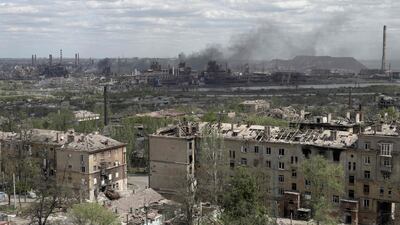
Plumes of smoke rise above the Azovstal steel plant in Mariupol amid Russian shelling. AFP -
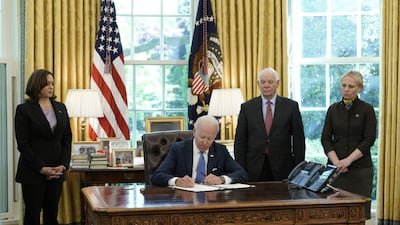
US President Joe Biden signs into law a measure making it easier for Washington to send weapons and supplies to the government in Kyiv. Bloomberg -
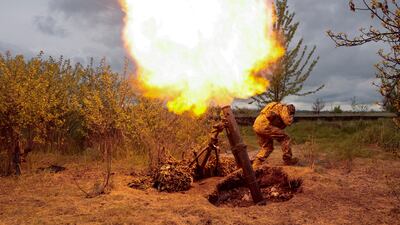
A Ukrainian soldier fires with a mortar, in the Kharkiv region. Reuters -

The Eiffel Tower is lit up in blue and yellow, the national colours of Ukraine, to express solidarity with its people at the request of the French Presidency of the EU, in Paris. Reuters -
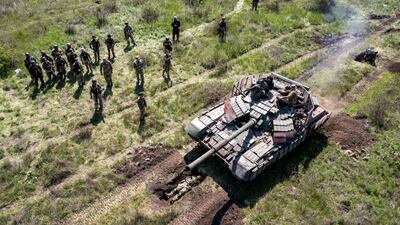
A Ukrainian Army tank drives over an infantryman during a training exercise near Kryvyi Rih. Getty Images -
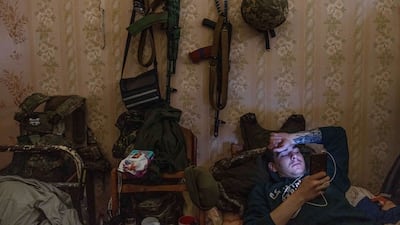
A Ukrainian soldier rests in his room at a front-line field hospital near Popasna, Luhansk region. EPA -
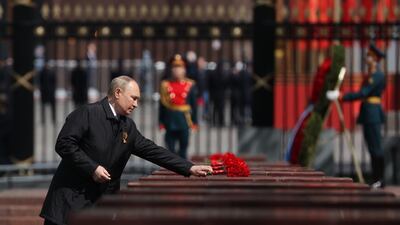
Russian President Vladimir Putin lays flowers at the Memorial to Hero Cities at the Tomb of the Unknown Soldier after the Victory Day military parade in Moscow. EPA -

Ukrainian refugees from the Azovstal steel plant in Mariupol are seen in a bus as they arrive at a humanitarian aid centre for internally displaced people, in Zaporizhzhia. Reuters -
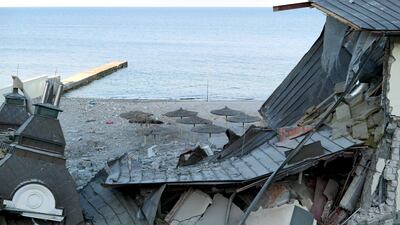
A hotel complex destroyed by a Russian missile is pictured in Odesa, Ukraine. Reuters -
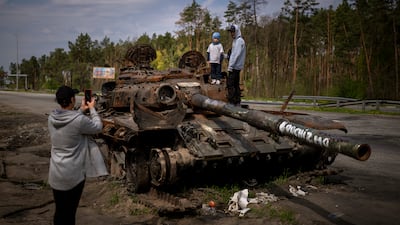
Maksym, 3, is photographed with his brother, Dmytro, 16, on top of a destroyed Russian tank on the outskirts of Kyiv, Ukraine. AP Photo -
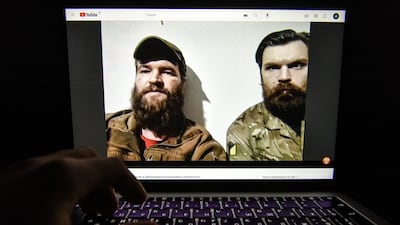
A video of a press conference from the Azovstal steel plant in Mariupol by Azov regiment servicemen Illia Samoilenko, right, and Sviatoslav Palamar, seen on a computer screen in Kyiv. EPA -
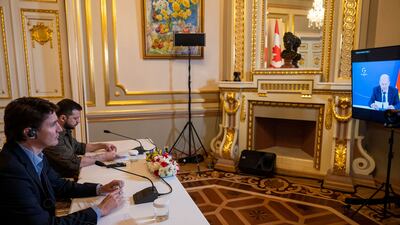
Canadian Prime Minister Justin Trudeau and Ukrainian President Volodymyr Zelenskyy take part in a online meeting of G7 leaders in Kyiv. Reuters -
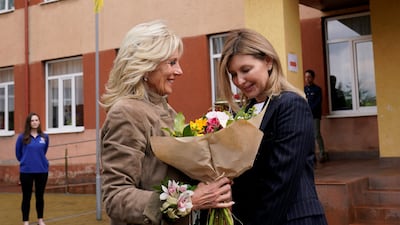
US first lady Jill Biden greets Olena Zelenska, wife of Ukrainian President Zelenskyy, outside a public school in Uzhhorod, Ukraine. Reuters -

Irish singer and activist Bono, the lead vocalist of rock band U2, performs at a subway station that has been turned into a bomb shelter in Kyiv. AFP -

A boy looks out of a bus window as people evacuated from Mariupol arrive in Zaporizhzhia. AFP -
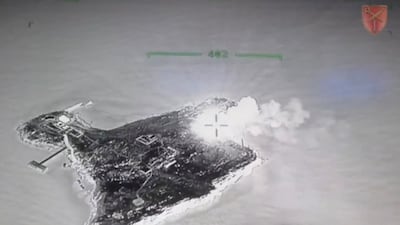
A night-vision image shows fire on Ukraine's Zmiinyi Island. Reuters -

Women sing the Ukrainian national anthem below the Euro Monument during a demonstration in Frankfurt, Germany. AP -
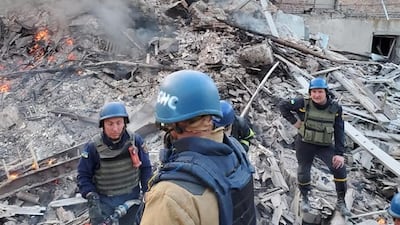
Emergency personnel at a school building hit by shelling, in the village of Bilohorivka, Luhansk. Reuters -

A man plays piano in an abandoned photo studio in Severodonetsk, eastern Ukraine. AFP -
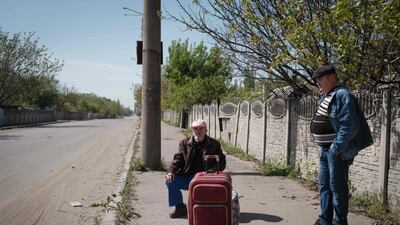
A man and his son wait for an evacuation bus in Lysychansk, eastern Ukraine. AFP -

Volunteers deliver food supplies to residents, taken from the warehouse of a humanitarian aid distribution centre in Severodonetsk. AFP -
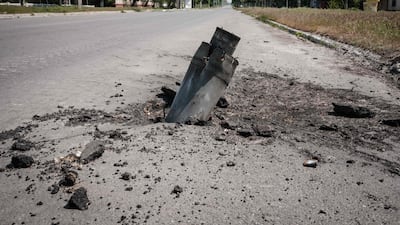
An unexploded ordnance on a road in Severodonetsk. AFP -

Galina Abdurashikova, 65, has been staying in an abondoned car in front of her apartment since her room was destroyed by shelling five days ago, in Severodonetsk. AFP -
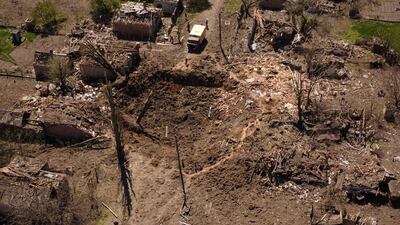
A large hole at the site where a missile strike hit a residential area in Bakhmut, Donetsk region. Reuters -
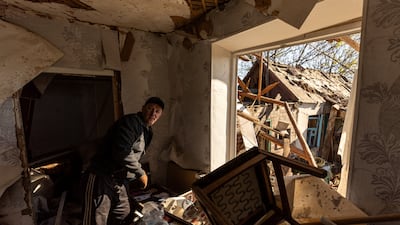
A man searches for useful items inside his house after a missile strike in a residential area, in Bakhmut. Reuters -
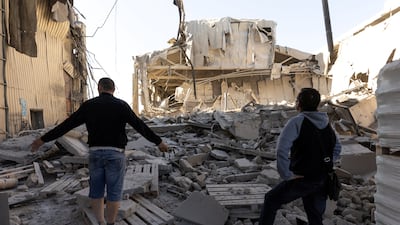
Two men look at the damage after a missile struck a cement plant, in Bakhmut. Reuters -

Civilians attempting to leave Mariupol wait in line at a checkpoint near the temporary accommodation centre in Bezimenoye village. EPA -

Civilians who were evacuated from Azovstal, walk in the temporary accommodation centre in Bezimenoye village, near Mariupol. EPA -
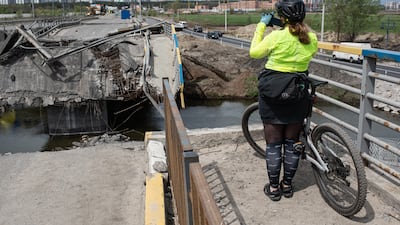
A cyclist photographs the destroyed bridge over the Irpin river, in Irpin. Getty Images -
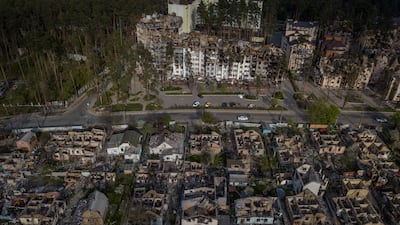
A residential area destroyed by Russian shelling, in Irpin. Reuters -

People with their luggage walk to a station to wait for the evacuation train heading to the west of Ukraine, in Pokrovsk, Donetsk region. EPA -
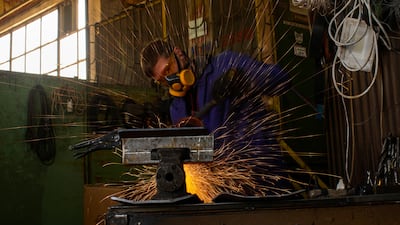
A volunteer shapes metal plates at a factory producing material for Ukrainian soldiers in Zaporizhzhia, Ukraine. AP -
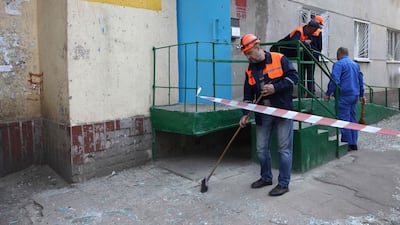
Workers clean shattered glass and debris in front of a residential building next to a site of a Russian missile attack in the southern Ukrainian city of Odessa. AFP -
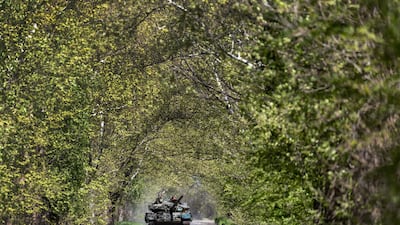
A Ukrainian Army tank moves towards a fron-tline position in Dnipropetrovsk Oblast. Getty Images -

Eugene Yevchenko cries as he bids farewell to his daughter Maria at a coach station in Lviv. Getty Images -
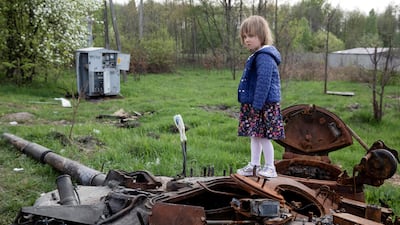
A child stands on a destroyed Russian tank near Makariv, Kyiv region. Reuters -
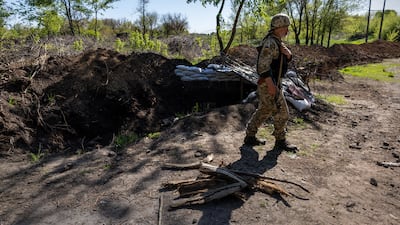
A Ukrainian national guard soldier mans a fighting position near the front line in Zelenodolsk. Getty Images -
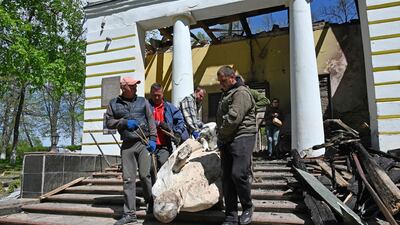
Museum workers carry the sculpture of Ukrainian philosopher Hryhorri Skovoroda from the destroyed building of the Hryhoriy Skovoroda National Literary Memorial Museum in the village of Skovorodynivka, in Kharkiv Region. AFP


The committee also questioned the overall affordability of the equipment plan, which depended upon delivering billions of pounds of future cost reductions but no plans as to how they would be achieved.
It expressed concern that a Treasury “contingency” for the new Dreadnought submarines — which will carry the UK’s Trident nuclear deterrent — was being seen as a “blank cheque” by the ministry, “freeing it from the need to control costs”.
Committee chairwoman Dame Meg Hillier, said: “The MoD trumpeted a step change in this year’s equipment plan after the Integrated Review, with new priorities and a huge cash injection — but the invasion of Ukraine has cast in stark relief the realities of current and future warfare.
“Senior officials appear unable to recognise the poor state of affairs in MoD’s procurement or the deep-rooted issues that undermine our confidence that it will actually get a grip on the situation.
“A diminished role in global security, enhanced risk to our national security and the service personnel defending it are the unacceptable costs of the ministry’s ongoing and repeated failures.”

