Boris Johnson will use the Queen's Speech in an attempt to secure his leadership following a bruising set of local elections that saw the Tories lose control of key authorities and suffer a net loss of almost 400 councillors.
The speech on Tuesday setting out the UK government's priorities would focus on the economy, health and national security, UK Education Secretary Nadhim Zahawi said, as he urged Tory MPs to rally round the prime minister.
Mr Zahawi insisted the prime minister who delivered 2019's general election landslide remained an electoral asset to the Tories despite issues in No 10 and Westminster being blamed for the local defeats inflicted on the party.
The loss of Wandsworth and Westminster councils in London to Labour after decades of Tory control and significant defeats to the Liberal Democrats in southern heartlands such as Woking could persuade more MPs to submit letters of no-confidence in the prime minister.
The “partygate” row, which has seen Mr Johnson and Rishi Sunak fined for breaching coronavirus laws, and scandals involving MPs Neil Parish and Imran Ahmad Khan, as well as the cost-of-living crisis, all contributed to a difficult set of results for the prime minister.
Sinn Fein's Northern Leader Michelle O'Neill celebrates wins. AFP
“People don't like to vote for split parties, for teams that are divided,” said Mr Zahawi.
“We are strongest when we are united, we've got a Queen's Speech next week where we will demonstrate to the nation that the second half of this parliament is all about dealing with repairing the economy, recovering from Covid, the backlog of the NHS and national security — here at home, safer streets — and, of course, abroad.
“All of these things we have a plan for.
“We are stronger when we are united and that would be my message to all my colleagues.”
He told Sky News Mr Johnson “absolutely” remained an electoral asset: “Boris cuts through in places like Nuneaton, places like Newcastle-under-Lyme, other parts of the country as well — Harrow in London.”
Harrow provided a rare bright spot in the capital, with the Tories taking the authority from Labour, while the Conservative majority increased in Newcastle-under-Lyme.
Partygate prominent in electorate's minds
But Aaron Bell, MP for Newcastle-under-Lyme, said the “partygate” row had come up on some doorsteps in the Staffordshire council and the issues around Mr Johnson's leadership had to be brought to a head.
Mr Bell, who has already submitted a letter of no confidence in Mr Johnson, told BBC Radio 4's Today programme: “It's not really up to me, it's up to my colleagues and I'm sure when we get back to Westminster there will be a discussion about that.
“What I do think is it needs to be brought to a head sooner rather than later because I don't think we can continue having this hanging over the party for many more months to come, with the Metropolitan Police and Sue Gray and then the Privileges Committee.”
Scotland Yard is still looking at parties in Downing Street and Whitehall, with the publication of senior civil servant Sue Gray's report awaiting the conclusion of the police inquiry.
An analysis for the BBC by elections expert Professor Sir John Curtice calculated that if the whole country had been voting, Labour would have gained 35 per cent of the vote — five points before the Tories on 30 per cent — the party's biggest lead in local elections for a decade.
After 196 out of the 200 councils had declared full results, the Tories had lost 12 authorities and 398 seats, Labour had gained eight councils and 264 councillors, and the Liberal Democrats had gained five councils and 189 councillors.
Labour is facing its own difficulties, however, after police announced a probe into whether leader Sir Keir Starmer broke lockdown rules last year.
Shadow cabinet minister Jo Stevens said the election results showed the party is ready for government.
“What the results this week have shown is that we have regained the trust of the British public,” she told Times Radio.
“For example, taking control of Barnet Council in London, which has a substantial Jewish population, demonstrates both to our party and to the country at large that Labour has changed under the leadership of Keir Starmer in the last two years and that we are ready for government.”
Sinn Fein marks historic victory
In Scotland, the Tories slipped into third place as the SNP increased its tally of councillors by 22 to 453, while Scottish Labour was able to capitalise on the collapse of Conservative support to come second.
In Wales, the Tories lost control of their only council, Monmouthshire, with Labour, the Lib Dems and Plaid Cymru all gaining seats across the nation.
In Northern Ireland, Sinn Fein scored a historic victory in the Assembly election. Sinn Fein's Michelle O'Neill now has the right to provide the First Minister of an entity that it does not believe should exist. The party has 27 seats.
Sinn Fein party leader Mary Louise McDonald looks on course for victory. Getty
Mary Lou McDonald, president and leader of the party, told TalkTV she believed a border poll would be “possible within a five-year time frame”.
But issues around the Northern Ireland Protocol could derail attempts to form an administration, with the DUP threatening to refuse to join an executive until action is taken to address problems with the post-Brexit deal.
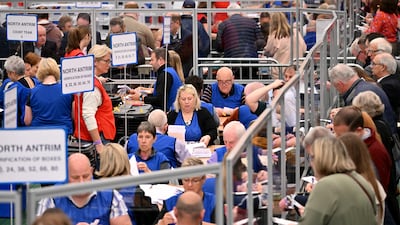
Votes are counted in Northern Ireland — in pictures
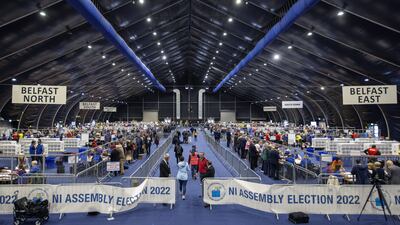
Votes are counted in the Northern Ireland Assembly elections at the Ulster University campus in Jordanstown. Getty Images
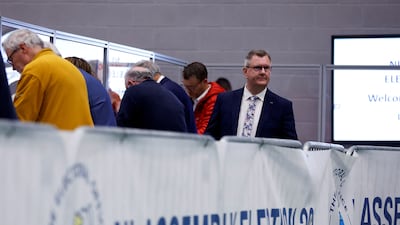
Democratic Unionist Party leader Sir Jeffrey Donaldson watches votes being counted in Jordanstown. Reuters
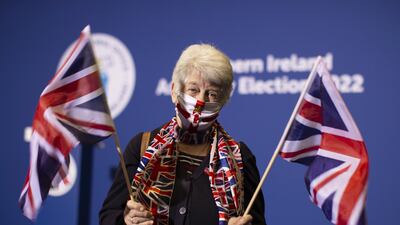
Ann Dickson supporting her husband, Trade Unionist Voice candidate Billy Dickson, at the Titanic Exhibition Centre in Belfast. PA
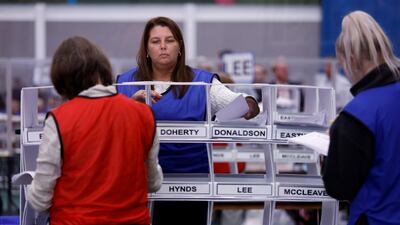
Electoral officers at the Ulster University Jordanstown count centre. Reuters
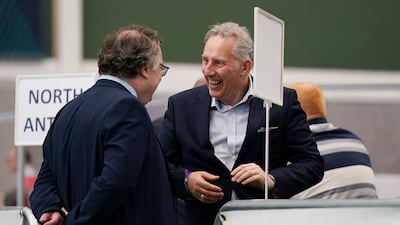
Democratic Unionist Party MP Ian Paisley Jr, right, with Alliance Party MP Stephen Farry at the Jordanstown count centre. PA
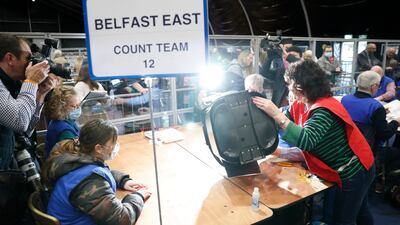
Election staff begin counting votes early on Friday in Belfast. AP Photo
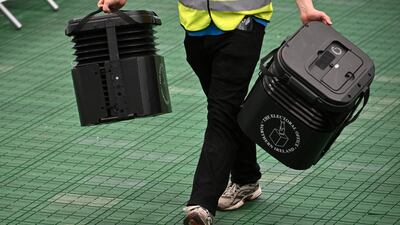
Ballot boxes ready to be counted at the Jordanstown campus. Getty Images
Counting begins at the Titanic Exhibition Centre in Belfast. PA
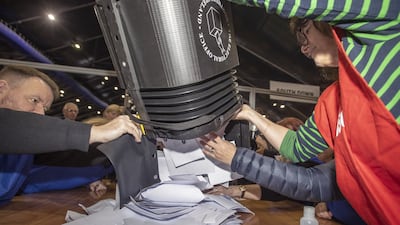
Ballot cards are poured onto a table for counting at the Titanic centre. PA
Founded in 1985 by Sheikh Mohammed bin Rashid, Vice President and Ruler of Dubai, the Central Veterinary Research Laboratory (CVRL) is a government diagnostic centre that provides testing and research facilities to the UAE and neighbouring countries.
One of its main goals is to provide permanent treatment solutions for veterinary related diseases.
The taxidermy centre was established 12 years ago and is headed by Dr Ulrich Wernery.
Islamophobia definition
A widely accepted definition was made by the All Party Parliamentary Group on British Muslims in 2019: “Islamophobia is rooted in racism and is a type of racism that targets expressions of Muslimness or perceived Muslimness.” It further defines it as “inciting hatred or violence against Muslims”.
In addition to the Emirates and Etihad programmes, there is the Air Miles Middle East card, which offers members the ability to choose any airline, has no black-out dates and no restrictions on seat availability. Air Miles is linked up to HSBC credit cards and can also be earned through retail partners such as Spinneys, Sharaf DG and The Toy Store.
An Emirates Dubai-London round-trip ticket costs 180,000 miles on the Air Miles website. But customers earn these ‘miles’ at a much faster rate than airline miles. Adidas offers two air miles per Dh1 spent. Air Miles has partnerships with websites as well, so booking.com and agoda.com offer three miles per Dh1 spent.
“If you use your HSBC credit card when shopping at our partners, you are able to earn Air Miles twice which will mean you can get that flight reward faster and for less spend,” says Paul Lacey, the managing director for Europe, Middle East and India for Aimia, which owns and operates Air Miles Middle East.
The National Archives, Abu Dhabi
Founded over 50 years ago, the National Archives collects valuable historical material relating to the UAE, and is the oldest and richest archive relating to the Arabian Gulf.
Much of the material can be viewed on line at the Arabian Gulf Digital Archive - https://www.agda.ae/en
Mercer, the investment consulting arm of US services company Marsh & McLennan, expects its wealth division to at least double its assets under management (AUM) in the Middle East as wealth in the region continues to grow despite economic headwinds, a company official said.
Mercer Wealth, which globally has $160 billion in AUM, plans to boost its AUM in the region to $2-$3bn in the next 2-3 years from the present $1bn, said Yasir AbuShaban, a Dubai-based principal with Mercer Wealth.
“Within the next two to three years, we are looking at reaching $2 to $3 billion as a conservative estimate and we do see an opportunity to do so,” said Mr AbuShaban.
Mercer does not directly make investments, but allocates clients’ money they have discretion to, to professional asset managers. They also provide advice to clients.
“We have buying power. We can negotiate on their (client’s) behalf with asset managers to provide them lower fees than they otherwise would have to get on their own,” he added.
Mercer Wealth’s clients include sovereign wealth funds, family offices, and insurance companies among others.
From its office in Dubai, Mercer also looks after Africa, India and Turkey, where they also see opportunity for growth.
Wealth creation in Middle East and Africa (MEA) grew 8.5 per cent to $8.1 trillion last year from $7.5tn in 2015, higher than last year’s global average of 6 per cent and the second-highest growth in a region after Asia-Pacific which grew 9.9 per cent, according to consultancy Boston Consulting Group (BCG). In the region, where wealth grew just 1.9 per cent in 2015 compared with 2014, a pickup in oil prices has helped in wealth generation.
BCG is forecasting MEA wealth will rise to $12tn by 2021, growing at an annual average of 8 per cent.
Drivers of wealth generation in the region will be split evenly between new wealth creation and growth of performance of existing assets, according to BCG.
Another general trend in the region is clients’ looking for a comprehensive approach to investing, according to Mr AbuShaban.
“Institutional investors or some of the families are seeing a slowdown in the available capital they have to invest and in that sense they are looking at optimizing the way they manage their portfolios and making sure they are not investing haphazardly and different parts of their investment are working together,” said Mr AbuShaban.
Some clients also have a higher appetite for risk, given the low interest-rate environment that does not provide enough yield for some institutional investors. These clients are keen to invest in illiquid assets, such as private equity and infrastructure.
“What we have seen is a desire for higher returns in what has been a low-return environment specifically in various fixed income or bonds,” he said.
“In this environment, we have seen a de facto increase in the risk that clients are taking in things like illiquid investments, private equity investments, infrastructure and private debt, those kind of investments were higher illiquidity results in incrementally higher returns.”
The Abu Dhabi Investment Authority, one of the largest sovereign wealth funds, said in its 2016 report that has gradually increased its exposure in direct private equity and private credit transactions, mainly in Asian markets and especially in China and India. The authority’s private equity department focused on structured equities owing to “their defensive characteristics.”
We are bringing you the inside story from the World Economic Forum's Annual Meeting in Davos, a gathering of hundreds of world leaders, top executives and billionaires.
Favourite car: Koenigsegg Agera RS or Renault Trezor concept car.
Favourite book:I Am Pilgrim by Terry Hayes or Red Notice by Bill Browder.
Biggest inspiration: My husband Nik. He really got me through a lot with his positivity.
Favourite holiday destination: Being at home in Australia, as I travel all over the world for work. It’s great to just hang out with my husband and family.
UAE v Gibraltar
What: International friendly
When: 7pm kick off
Where: Rugby Park, Dubai Sports City
Admission: Free
Online: The match will be broadcast live on Dubai Exiles’ Facebook page
UAE squad: Lucas Waddington (Dubai Exiles), Gio Fourie (Exiles), Craig Nutt (Abu Dhabi Harlequins), Phil Brady (Harlequins), Daniel Perry (Dubai Hurricanes), EsekaiaDranibota (Harlequins), Matt Mills (Exiles), JaenBotes (Exiles), KristianStinson (Exiles), Murray Reason (Abu Dhabi Saracens), Dave Knight (Hurricanes), Ross Samson (Jebel Ali Dragons), DuRandt Gerber (Exiles), Saki Naisau (Dragons), Andrew Powell (Hurricanes), EmosiVacanau (Harlequins), NikoVolavola (Dragons), Matt Richards (Dragons), Luke Stevenson (Harlequins), Josh Ives (Dubai Sports City Eagles), Sean Stevens (Saracens), ThinusSteyn (Exiles)
U19 World Cup in South Africa
Group A: India, Japan, New Zealand, Sri Lanka
Group B: Australia, England, Nigeria, West Indies
Group C: Bangladesh, Pakistan, Scotland, Zimbabwe
Group D: Afghanistan, Canada, South Africa, UAE
UAE fixtures
Saturday, January 18, v Canada
Wednesday, January 22, v Afghanistan
Saturday, January 25, v South Africa
UAE squad
Aryan Lakra (captain), Vriitya Aravind, Deshan Chethyia, Mohammed Farazuddin, Jonathan Figy, Osama Hassan, Karthik Meiyappan, Rishabh Mukherjee, Ali Naseer, Wasi Shah, Alishan Sharafu, Sanchit Sharma, Kai Smith, Akasha Tahir, Ansh Tandon