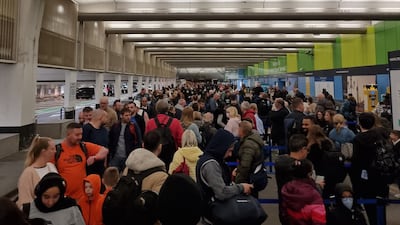
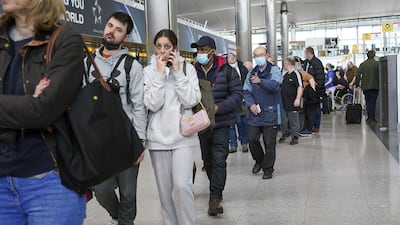
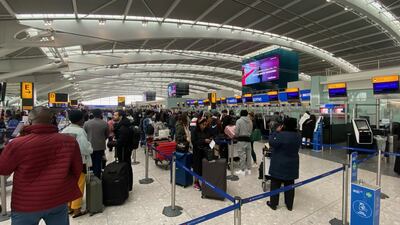
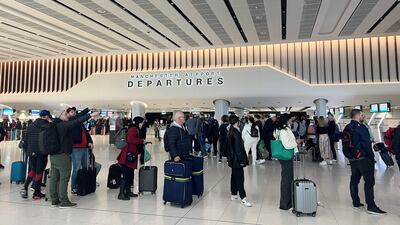
Heathrow’s week of manic queues and flight cancellations, relayed to me by countless passengers who had been caught up in the chaos, meant I was fully expecting to experience a similar nightmare first-hand when I arrived at the airport on Friday afternoon.
But instead of being greeted by long lines of frustrated travellers snaking their way towards unmanned desks I was surprised to find just a handful of people in front of me in the check-in line and more than enough staff on hand to assist.
Those travelling with other airlines, however, appeared less fortunate.
I watched a queue of about 50 passengers waiting to check in with Swiss Air that barely moved during the 15 minutes it took to drop my luggage off.
After managing to clear check-in I was surprised to have just seven passengers in front of me at security.
Half an hour after arriving at Heathrow I found myself pondering my luck in a half-empty terminal, with check-in and security behind me. I thought of the thousands of passengers who had been stranded in queues for hours earlier this week. Passengers arriving into the country had faced even longer queues, as problems with e-gates meant delays at passport control.
While the Easter break has brought a much-needed boost to the travel industry, not everyone is happy about the west London airport’s handling of the sudden upsurge in passenger numbers.
Heathrow, like Manchester Airport, is struggling to recruit enough staff to cater for the swelling passenger numbers.
A waiter at one of the restaurants told me he wanted to see Terminal 4 opened “as soon as possible” to ease the strain on T2, T3 and T5.
'A dangerous cocktail'
The airport has said it will bring it back into operation by July.
“It’s not fair on the workers and passengers in the other terminals when there’s no room to walk here,” the waiter said.
He blamed the extended waiting times at check-in, security and passport control on three factors: the lack of transparency from the UK government, Heathrow bosses’ handling of the situation and the pandemic.
“When you get those three things together it’s a dangerous cocktail,” he said as he poured a drink for an awaiting customer.
He believes the Conservative-led government should have been more open with the travel industry before lifting restrictions, and Heathrow management should have stepped up and done more to ease the pressure this week.
“Sorry is just not part of the managers’ vocabulary,” he said.
But despite the strain that the pent-up demand for travel has placed on Heathrow and other airports in Britain, shop assistants told me it offered a dose of cash the industry has long been waiting for.
One employee said travel pillows had been flying off the shelves. Her store had sold 400 in the previous five days — double the rate of recent weeks.
Another saleswoman said her manager was scrambling to hire more staff following the rush that started last week when schools shut for the Easter holidays.
An assistant at a make-up counter said the Easter break coinciding with the beginning of Ramadan was just what airport businesses needed.
“It's been busy this week for Easter. There have also been a lot of people travelling to the Middle East for Ramadan,” she said.
“It’s good. Things are picking up now that the travel restrictions are gone.”
Passengers around me appeared upbeat, but I doubt they would have been so excited to be boarding a plane for the first time in months, perhaps years, if they had been stranded in the massive queues at Heathrow early this week.
One woman remarked how she was looking forward to “cuddles on the other side” when she met up with loved ones for their first reunion since the pre-pandemic days. An air hostess with bright red lipstick also commented on how “it’s great to be back”.
After breezing through the entire departure process I sat on the plane and breathed a sigh of relief. I had dodged the dreaded chaos and as a result started my holiday on a positive note.
I considered myself to be equally lucky to have booked a flight on Friday, given that Heathrow is braced for more chaos in the coming days. Saturday is tipped to be the busiest day of the year so far for the travel industry, as the first batch of Easter holidaymakers arrive back and the second wave leave.
An influx of travellers is also expected to hit Heathrow next week as people head abroad and others fly to the UK for the bank holiday Easter weekend.
And then I remembered … my return flight to Heathrow is next week.

Red flags
- Promises of high, fixed or 'guaranteed' returns.
- Unregulated structured products or complex investments often used to bypass traditional safeguards.
- Lack of clear information, vague language, no access to audited financials.
- Overseas companies targeting investors in other jurisdictions - this can make legal recovery difficult.
- Hard-selling tactics - creating urgency, offering 'exclusive' deals.
Courtesy: Carol Glynn, founder of Conscious Finance Coaching
Mercer, the investment consulting arm of US services company Marsh & McLennan, expects its wealth division to at least double its assets under management (AUM) in the Middle East as wealth in the region continues to grow despite economic headwinds, a company official said.
Mercer Wealth, which globally has $160 billion in AUM, plans to boost its AUM in the region to $2-$3bn in the next 2-3 years from the present $1bn, said Yasir AbuShaban, a Dubai-based principal with Mercer Wealth.
“Within the next two to three years, we are looking at reaching $2 to $3 billion as a conservative estimate and we do see an opportunity to do so,” said Mr AbuShaban.
Mercer does not directly make investments, but allocates clients’ money they have discretion to, to professional asset managers. They also provide advice to clients.
“We have buying power. We can negotiate on their (client’s) behalf with asset managers to provide them lower fees than they otherwise would have to get on their own,” he added.
Mercer Wealth’s clients include sovereign wealth funds, family offices, and insurance companies among others.
From its office in Dubai, Mercer also looks after Africa, India and Turkey, where they also see opportunity for growth.
Wealth creation in Middle East and Africa (MEA) grew 8.5 per cent to $8.1 trillion last year from $7.5tn in 2015, higher than last year’s global average of 6 per cent and the second-highest growth in a region after Asia-Pacific which grew 9.9 per cent, according to consultancy Boston Consulting Group (BCG). In the region, where wealth grew just 1.9 per cent in 2015 compared with 2014, a pickup in oil prices has helped in wealth generation.
BCG is forecasting MEA wealth will rise to $12tn by 2021, growing at an annual average of 8 per cent.
Drivers of wealth generation in the region will be split evenly between new wealth creation and growth of performance of existing assets, according to BCG.
Another general trend in the region is clients’ looking for a comprehensive approach to investing, according to Mr AbuShaban.
“Institutional investors or some of the families are seeing a slowdown in the available capital they have to invest and in that sense they are looking at optimizing the way they manage their portfolios and making sure they are not investing haphazardly and different parts of their investment are working together,” said Mr AbuShaban.
Some clients also have a higher appetite for risk, given the low interest-rate environment that does not provide enough yield for some institutional investors. These clients are keen to invest in illiquid assets, such as private equity and infrastructure.
“What we have seen is a desire for higher returns in what has been a low-return environment specifically in various fixed income or bonds,” he said.
“In this environment, we have seen a de facto increase in the risk that clients are taking in things like illiquid investments, private equity investments, infrastructure and private debt, those kind of investments were higher illiquidity results in incrementally higher returns.”
The Abu Dhabi Investment Authority, one of the largest sovereign wealth funds, said in its 2016 report that has gradually increased its exposure in direct private equity and private credit transactions, mainly in Asian markets and especially in China and India. The authority’s private equity department focused on structured equities owing to “their defensive characteristics.”
The Kites
Romain Gary
Penguin Modern Classics
'Worse than a prison sentence'
Marie Byrne, a counsellor who volunteers at the UAE government's mental health crisis helpline, said the ordeal the crew had been through would take time to overcome.
“It was worse than a prison sentence, where at least someone can deal with a set amount of time incarcerated," she said.
“They were living in perpetual mystery as to how their futures would pan out, and what that would be.
“Because of coronavirus, the world is very different now to the one they left, that will also have an impact.
“It will not fully register until they are on dry land. Some have not seen their young children grow up while others will have to rebuild relationships.
“It will be a challenge mentally, and to find other work to support their families as they have been out of circulation for so long. Hopefully they will get the care they need when they get home.”
The alternatives
• Founded in 2014, Telr is a payment aggregator and gateway with an office in Silicon Oasis. It’s e-commerce entry plan costs Dh349 monthly (plus VAT). QR codes direct customers to an online payment page and merchants can generate payments through messaging apps.
• Business Bay’s Pallapay claims 40,000-plus active merchants who can invoice customers and receive payment by card. Fees range from 1.99 per cent plus Dh1 per transaction depending on payment method and location, such as online or via UAE mobile.
• Tap started in May 2013 in Kuwait, allowing Middle East businesses to bill, accept, receive and make payments online “easier, faster and smoother” via goSell and goCollect. It supports more than 10,000 merchants. Monthly fees range from US$65-100, plus card charges of 2.75-3.75 per cent and Dh1.2 per sale.
• 2checkout’s “all-in-one payment gateway and merchant account” accepts payments in 200-plus markets for 2.4-3.9 per cent, plus a Dh1.2-Dh1.8 currency conversion charge. The US provider processes online shop and mobile transactions and has 17,000-plus active digital commerce users.
• PayPal is probably the best-known online goods payment method - usually used for eBay purchases - but can be used to receive funds, providing everyone’s signed up. Costs from 2.9 per cent plus Dh1.2 per transaction.
Classification of skills
A worker is categorised as skilled by the MOHRE based on nine levels given in the International Standard Classification of Occupations (ISCO) issued by the International Labour Organisation.
A skilled worker would be someone at a professional level (levels 1 – 5) which includes managers, professionals, technicians and associate professionals, clerical support workers, and service and sales workers.
The worker must also have an attested educational certificate higher than secondary or an equivalent certification, and earn a monthly salary of at least Dh4,000.
Timeline
2012-2015
The company offers payments/bribes to win key contracts in the Middle East
May 2017
The UK SFO officially opens investigation into Petrofac’s use of agents, corruption, and potential bribery to secure contracts
September 2021
Petrofac pleads guilty to seven counts of failing to prevent bribery under the UK Bribery Act
October 2021
Court fines Petrofac £77 million for bribery. Former executive receives a two-year suspended sentence
December 2024
Petrofac enters into comprehensive restructuring to strengthen the financial position of the group
May 2025
The High Court of England and Wales approves the company’s restructuring plan
July 2025
The Court of Appeal issues a judgment challenging parts of the restructuring plan
August 2025
Petrofac issues a business update to execute the restructuring and confirms it will appeal the Court of Appeal decision
October 2025
Petrofac loses a major TenneT offshore wind contract worth €13 billion. Holding company files for administration in the UK. Petrofac delisted from the London Stock Exchange
November 2025
180 Petrofac employees laid off in the UAE
if you go
The flights
Air Astana flies direct from Dubai to Almaty from Dh2,440 per person return, and to Astana (via Almaty) from Dh2,930 return, both including taxes.
The hotels
Rooms at the Ritz-Carlton Almaty cost from Dh1,944 per night including taxes; and in Astana the new Ritz-Carlton Astana (www.marriott) costs from Dh1,325; alternatively, the new St Regis Astana costs from Dh1,458 per night including taxes.
When to visit
March-May and September-November
Visas
Citizens of many countries, including the UAE do not need a visa to enter Kazakhstan for up to 30 days. Contact the nearest Kazakhstan embassy or consulate.
Nick's journey in numbers
Countries so far: 85
Flights: 149
Steps: 3.78 million
Calories: 220,000
Floors climbed: 2,000
Donations: GPB37,300
Prostate checks: 5
Blisters: 15
Bumps on the head: 2
Dog bites: 1
Sanju
Produced: Vidhu Vinod Chopra, Rajkumar Hirani
Director: Rajkumar Hirani
Cast: Ranbir Kapoor, Vicky Kaushal, Paresh Rawal, Anushka Sharma, Manish’s Koirala, Dia Mirza, Sonam Kapoor, Jim Sarbh, Boman Irani
Rating: 3.5 stars
Reading List
Practitioners of mindful eating recommend the following books to get you started:
Savor: Mindful Eating, Mindful Life by Thich Nhat Hanh and Dr Lilian Cheung
How to Eat by Thich Nhat Hanh
The Mindful Diet by Dr Ruth Wolever
Mindful Eating by Dr Jan Bays
How to Raise a Mindful Eaterby Maryann Jacobsen
More from Rashmee Roshan Lall
The%20specs%3A%202024%20Mercedes%20E200
%3Cp%3E%3Cstrong%3EEngine%3A%20%3C%2Fstrong%3E2.0-litre%20four-cyl%20turbo%20%2B%20mild%20hybrid%0D%3Cbr%3E%3Cstrong%3EPower%3A%20%3C%2Fstrong%3E204hp%20at%205%2C800rpm%20%2B23hp%20hybrid%20boost%0D%3Cbr%3E%3Cstrong%3ETorque%3A%20%3C%2Fstrong%3E320Nm%20at%201%2C800rpm%20%2B205Nm%20hybrid%20boost%0D%3Cbr%3E%3Cstrong%3ETransmission%3A%20%3C%2Fstrong%3E9-speed%20auto%0D%3Cbr%3E%3Cstrong%3EFuel%20consumption%3A%20%3C%2Fstrong%3E7.3L%2F100km%0D%3Cbr%3E%3Cstrong%3EOn%20sale%3A%20%3C%2Fstrong%3ENovember%2FDecember%0D%3Cbr%3E%3Cstrong%3EPrice%3A%20%3C%2Fstrong%3EFrom%20Dh205%2C000%20(estimate)%3C%2Fp%3E%0A
Ferrari 12Cilindri specs
Engine: naturally aspirated 6.5-liter V12
Power: 819hp
Torque: 678Nm at 7,250rpm
Price: From Dh1,700,000
Available: Now
SPECS
Toyota land Cruiser 2020 5.7L VXR
Engine: 5.7-litre V8
Transmission: eight-speed automatic
Power: 362hp
Torque: 530Nm
Price: Dh329,000 (base model 4.0L EXR Dh215,900)
THE SPECS
Cadillac XT6 2020 Premium Luxury
Engine: 3.6L V-6
Transmission: nine-speed automatic
Power: 310hp
Torque: 367Nm
Price: Dh280,000