


Live updates: follow the latest news on Russia-Ukraine
Nato leaders said on Friday they were deploying more troops to Eastern Europe after Russia began its military operation in Ukraine.
Secretary General Jens Stoltenberg said the alliance was deploying — for the first time as a defensive unit — parts of its combat-ready response force and would continue to send defence support to Ukraine.
Mr Stoltenberg did not say how many troops would be deployed, but confirmed that the move would involve land, sea and air power.
“We are deploying the Nato response force for the first time in a collective defence context. We speak about thousands of troops. We speak about air and maritime capabilities,” he said.
“Several allies have already assigned troops and forces to the Nato response force.
“We have the high readiness force, the Nato response force, and that is why we are deploying it. To prevent any misunderstanding that we are not prepared to protect all allies.”
-

A solemn welcoming ceremony of US soldiers at Adazi military base, Latvia, on February 25, 2022. More than 300 soldiers of the 173rd Air Force Brigade arrived to demonstrate the US commitment to defend Nato allies and strengthen Latvia's defence capabilities following Russia's military operation in Ukraine. EPA -
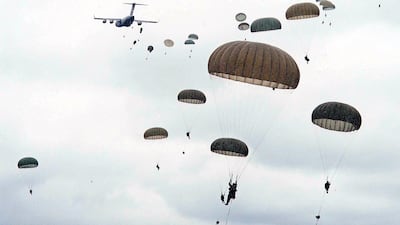
US paratroopers in Ukraine's western Lviv region during a Nato-sponsored training exercise in 2020. AP -
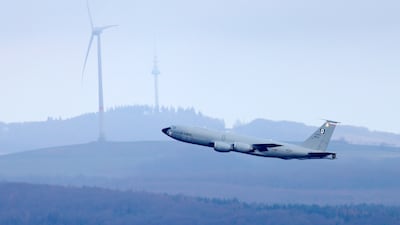
A US military aircraft takes off at the US Air Base Ramstein, in Landstuhl, Germany, on February 25. US President Joe Biden February 24 authorised the deployment of further armed forces to Germany as part of Nato's response to Russia's military aggression on Ukraine. EPA -
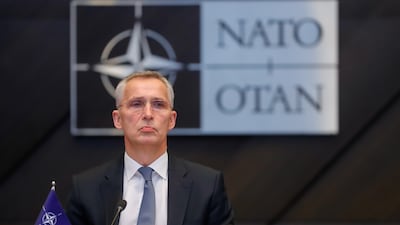
Nato Secretary General Jens Stoltenberg at the alliance's headquarters in Brussels, Belgium, on February 25. EPA -
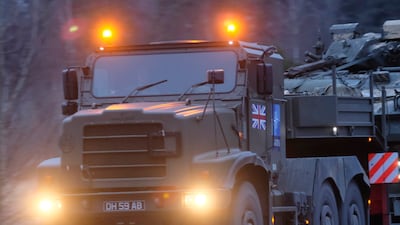
A convoy of British armoured vehicles of the Royal Welsh Battlegroup on the way to Estonia, driving through Liepupe, Latvia, on February 25. British troops and equipment are heading to Estonia as part of the UK's contribution to strengthen Nato's uplift to Eastern Europe. EPA -
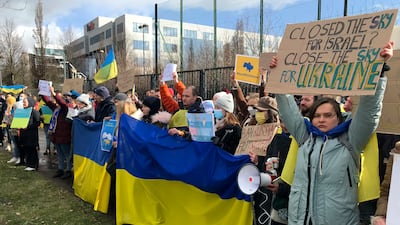
Protesters outside a Nato leaders virtual summit in Brussels on February 25. AP -
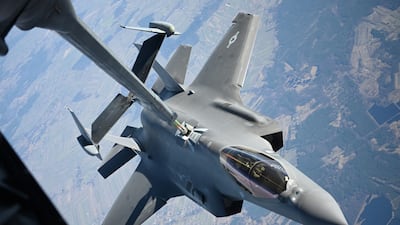
A US Air Force F-35 Lightning II aircraft assigned to the 34th Fighter Squadron receives fuel from a KC-10 Extender aircraft over Poland on February 24. US Air Force/Reuters -
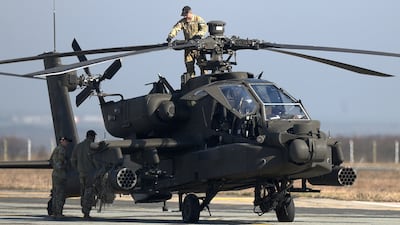
US military personnel check an Apache attack helicopter AH-64 during a technical stop on the tarmac at Traian Vuia International Airport in Timisoara, Romania, on February 24. EPA -
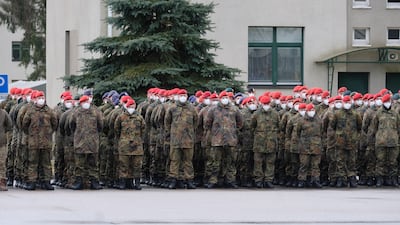
German soldiers of the Nato enhanced Forward Presence (EFP) Battalion Battle Group in Lithuania attend a ceremony during a visit of German Defence Minister Christine Lambrecht to Rukla Military Base, Lithuania, on February 22. EPA


The force can number up to 40,000 troops, but Mr Stoltenberg would only say that the entire force would not be deployed immediately.
Nato previously had about 5,000 troops stationed in Poland and the Baltic countries Estonia, Latvia and Lithuania.
“Russia has shattered peace on the European continent. What we have warned against for months has come to pass despite all of our efforts to find a diplomatic solution,” Mr Stoltenberg said.
The UK government said it is prepared to meet any further request from Nato’s Supreme Allied Commander Europe to extend military support.
UK Prime Minister Boris Johnson warned the alliance that Russian President Vladimir Putin’s ambitions might extend beyond Ukraine.
A Downing Street spokeswoman said: “The prime minister told the group that a catastrophe was engulfing Ukraine and President Putin was engaging in a revanchist mission to overturn post-Cold War order.
“He warned the group that the Russian president’s ambitions might not stop there and that this was a Euro-Atlantic crisis with global consequences.”

