


Omicron live updates: Live blog on the latest developments
Mass staff shortages in hospitals have left nurses “despairing” as the busy Christmas period begins, a health chief has said.
The wave of the new more transmissible Omicron variant has caused Covid infections to surge to new daily highs and has forced many more uninfected people into isolation.
Pat Cullen, chief executive of the Royal College of Nursing, said staff were “exhausted” from routinely working shifts as long as 14 hours as hospitals struggle to cope.
She predicted the crisis could place the National Health Service under a more severe level of strain than it suffered last Christmas because of its “very, very depleted workforce”.
“Those staff that are isolating are actually quite sick, and the reason for that being their resources are so low, going off sick because of the shifts they’ve been working, some working 14-hour days,” she told BBC Breakfast.
“We talked to a nurse yesterday who described her colleagues and her staff as on the 13th day on a 12-hour shift.
“So if you get ill on the back of that, inevitably your own internal personal resources are pretty low.
-
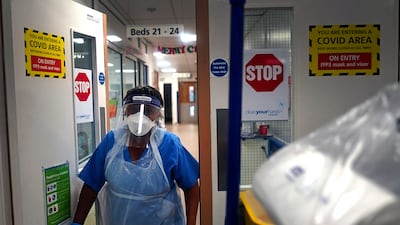
A member of staff walks through a ward for Covid-19 patients at King's College Hospital in London. PA -

A sign urging residents to wear face masks in Nottingham. People who have tested positive for the coronavirus will now be able to leave home on day seven if they have two negative tests. AP -

A waiter cleans a table at an empty restaurant in London. Authorities are still urging people to stay at home amid fears over the Omicron coronavirus variant. Reuters -

Passengers wearing Santa hats sit on the top deck of a tour bus as they view the Christmas lights in central London. AFP -
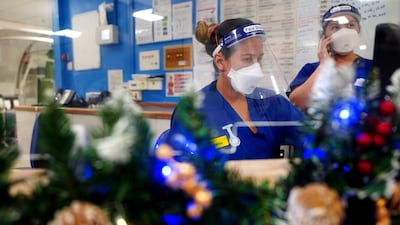
Nurses work at a desk surrounded by Christmas decorations in a ward for Covid-19 patients at King's College Hospital. PA -
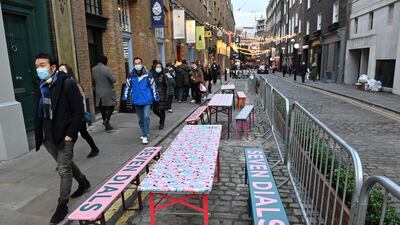
Empty tables outside a restaurant in the Seven Dials district of London. Covid-19 infections have surged in recent days, authorities say. AFP -
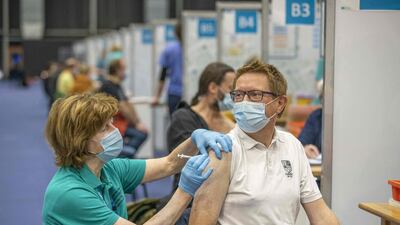
People receive a dose of a Covid-19 vaccine at a temporary clinic set up in the Titanic Exhibition Centre in Belfast. AFP -
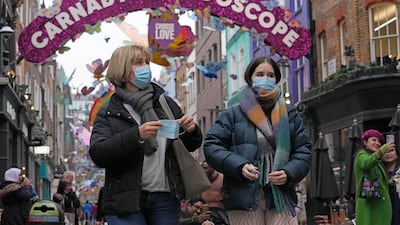
Shoppers stroll through Carnaby Street in London. AP -

People, most of them without masks, skate around the Christmas tree at the Natural History Museum in London. Reuters -
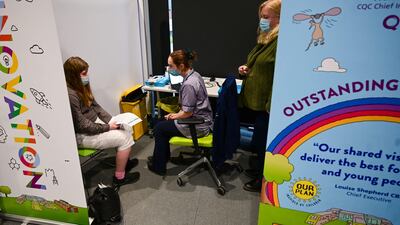
Health workers speak with a patient inside a vaccination centre in Liverpool. AFP -
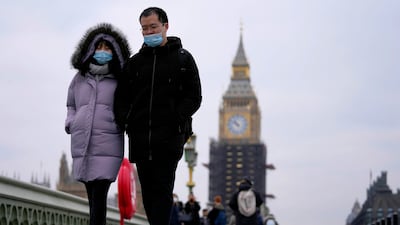
Tourists cross Westminster Bridge in London. AP -
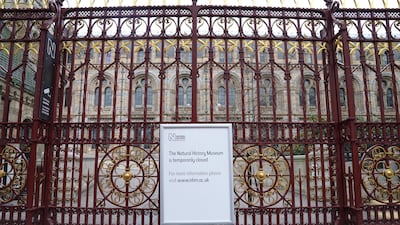
A sign outside the Natural History Museum in South Kensington, London, which has been forced to close its doors for a week due to staff shortages related to coronavirus. PA -

Commuters at a quiet Waterloo Station in south London. PA


“The despair that nurses are facing and the fear and the sheer struggle they’re facing every day will continue over the Christmas period, because this Christmas, of course, will not be normal. It will be similar to last year, if not worse, is what they’re telling us.”
Last week the NHS was told to prepare for a “new and significant threat” from Omicron.
Ms Cullen urged government ministers to take action to protect the NHS, including tighter Covid restrictions if necessary.
“Nurses and other healthcare workers are quite ill from the spin-off with Covid, and continue to be simply because their internal and personal resources are low going into this because of the number of hours that they’re working and the shifts they’ve been working,” she said.
“They would like to see political leaders making decisions that will support the health service and them to be able to do the job that they want to do and be able to care for their patients safely.
“If that means tighter measures, that’s for political leaders to decide based on the scientific evidence.”
She said ministers may have left it “too late” to protect the NHS against the Omicron wave.
“We need to listen to the wonderful scientific experts that we have throughout the country,” she said.
“We listened to them yesterday evening and many evenings on TV and what [they are] saying, that something needs to happen in terms of perhaps a circuit breaker, and that if we leave it much longer unfortunately our nurses fear it will be a little bit too late for the health service.”
But many Britons would probably disagree with her view about more curbs as they prepare to enjoy the Christmas and New Year period.
This week Prime Minister Boris Johnson urged people to exercise caution when mixing with family and friends but stopped short of imposing stricter measures to slow the spread of Omicron.
At a cabinet meeting, his decision to resist scientists’ advice for more restrictions is understood to have been backed by Chancellor Rishi Sunak, Foreign Secretary Liz Truss and Transport Secretary Grant Shapps.
However, Mr Johnson has not ruled out bringing in more limits on social freedoms before the New Year.
On Thursday, data released by the UK Health Service Agency suggested Omicron may be less likely to lead to serious illness than the Delta variant of coronavirus.
The agency estimates that someone with Omicron is between 31 and 45 per cent less likely to seek emergency hospital treatment, and 50 to 70 per cent less likely to be admitted to hospital than an individual with the Delta variant.
However, Dr Jenny Harries, chief executive of the group, said the data was collected when Omicron was predominantly detected in the younger population and the situation was likely to change if it spreads to older people.
She said recently the variant has been making its way into people who are in their 60s and 70s, who are more likely to need hospital care.
“We’re not seeing very significant rises in intensive care utilisation or in the use of ventilation beds,” she told BBC Radio 4's Today programme.
“Now that may be because a lot of the people who’ve been infected to date are actually younger people and we will see that coming through.”
“Critically, what we’re seeing is Omicron largely in young people and it’s only just now that the cases are starting to tip into the older population, particularly the 60 and 70-year-olds,” she said. “There are a number of different reasons why we need to continue to look at this data further.”

