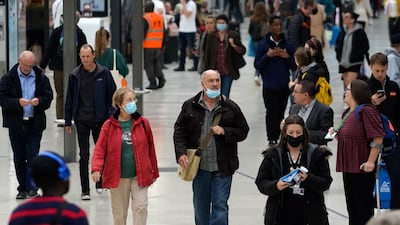
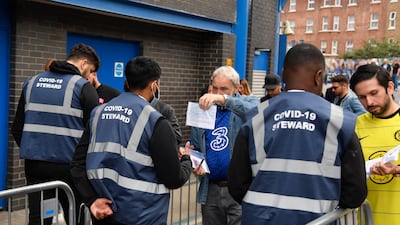
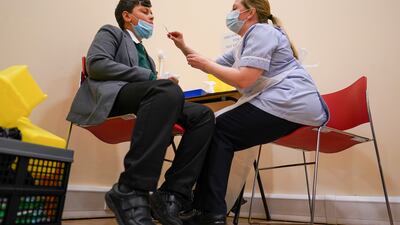
Covid-19 rates are surging among young teenagers, underlining fears that the British government missed an opportunity to vaccinate them earlier, figures released on Friday show.
Infections in children aged between 12 and 15 have risen considerably, with one in 12 now suffering from coronavirus, the Office for National Statistics reported.
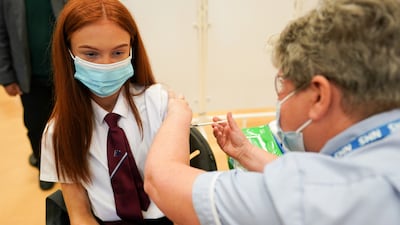
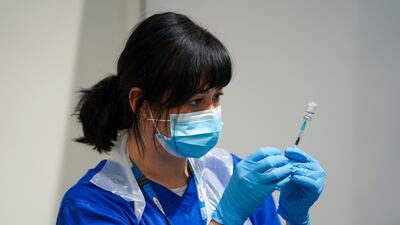
In the past week, there was a 17 per cent surge among schoolchildren, overwhelming the belated government efforts to give them a single shot of the Pfizer vaccine.
With 204,000 pupils currently off sick, questions are being asked why the government did not take earlier action to inoculate young teenagers.
Given this age group has been devastated by loss of social interaction and interrupted education, it is deeply unfortunate that so many are now again missing school
Dr Ilan Kelman,
London University
“Trying to find the logic in any aspect of the UK government's approach to the pandemic is challenging,” said Dr Ilan Kelman, a disaster planner at London University.
He said an “abundance of caution” might have resulted from the criticism that arose, after some young adults had adverse reactions to the AstraZeneca vaccine.
“But given this age group has been devastated by loss of social interaction and interrupted education, it is deeply unfortunate that so many are now again missing school. My concerns are over bad governmental leadership and a lack of decision-making early on.”
While Pfizer was approved by the European Medicines Agency in May for children aged over 12, Britain only began vaccinating in late September, about three weeks after children had already returned from summer holidays.
In June other countries, such as Denmark, Spain, France and Canada pressed ahead, inoculating youngsters, with the majority now protected.
So far only 12 per cent of British secondary school pupils have received a single shot despite a government promise to administer the doses to all by the October half-term break, which begins in days.
Britain is now experiencing another surge in infections, with 45,000 reported on Thursday, the highest in a single day since July.
Other European countries that have vaccinated the over-12s have seen either slight increases as schools returned or in Spain’s case a decrease, where nearly all the children have been vaccinated.
The percentage of British people testing positive for coronavirus was highest among 12 to 15-year-olds increasing from 6.9 per cent to 8.1 per cent in the week to 8 October, the ONS found.
Scientists have criticised the government for failing to vaccinate children much earlier.
“We should have started vaccinating children earlier but the government does seem to have got away with it because children are not dying from Covid,” said Prof Graeme Ackland, of Edinburgh University.
Much of the government decision-making was based on the Joint Committee on Vaccination and Immunisation, which advised there was only a marginal benefit to children’s health in having a vaccine. But it was not in its remit to highlight infection rates.
“I think it was very strange decision that the government just went with the JVCI advice and did not consider the benefit to other age groups,” said Prof Ackland.
“It is not what I would have suggested at the time especially with this group now clearly the most infectious cohort at the moment.”
There is also growing concern about infections spreading in other cohorts, with the latest ONS figures showing rises in the 2 to 11-years-olds, 15 to 24-year-olds and 35 to 49-year-olds.
This could point to the young teenage cohort now infecting younger and older siblings as well as their parents.
However, Prof Ackland said it was now clear the vaccines' main benefit was in reducing the severity of infection to something like flu.
“Data from Israel shows that infection-acquired immunity seems to be better than vaccine-acquired, though whether this works for the very mild version suffered by children we don't know.”

Ten tax points to be aware of in 2026
1. Domestic VAT refund amendments: request your refund within five years
If a business does not apply for the refund on time, they lose their credit.
2. E-invoicing in the UAE
Businesses should continue preparing for the implementation of e-invoicing in the UAE, with 2026 a preparation and transition period ahead of phased mandatory adoption.
3. More tax audits
Tax authorities are increasingly using data already available across multiple filings to identify audit risks.
4. More beneficial VAT and excise tax penalty regime
Tax disputes are expected to become more frequent and more structured, with clearer administrative objection and appeal processes. The UAE has adopted a new penalty regime for VAT and excise disputes, which now mirrors the penalty regime for corporate tax.
5. Greater emphasis on statutory audit
There is a greater need for the accuracy of financial statements. The International Financial Reporting Standards standards need to be strictly adhered to and, as a result, the quality of the audits will need to increase.
6. Further transfer pricing enforcement
Transfer pricing enforcement, which refers to the practice of establishing prices for internal transactions between related entities, is expected to broaden in scope. The UAE will shortly open the possibility to negotiate advance pricing agreements, or essentially rulings for transfer pricing purposes.
7. Limited time periods for audits
Recent amendments also introduce a default five-year limitation period for tax audits and assessments, subject to specific statutory exceptions. While the standard audit and assessment period is five years, this may be extended to up to 15 years in cases involving fraud or tax evasion.
8. Pillar 2 implementation
Many multinational groups will begin to feel the practical effect of the Domestic Minimum Top-Up Tax (DMTT), the UAE's implementation of the OECD’s global minimum tax under Pillar 2. While the rules apply for financial years starting on or after January 1, 2025, it is 2026 that marks the transition to an operational phase.
9. Reduced compliance obligations for imported goods and services
Businesses that apply the reverse-charge mechanism for VAT purposes in the UAE may benefit from reduced compliance obligations.
10. Substance and CbC reporting focus
Tax authorities are expected to continue strengthening the enforcement of economic substance and Country-by-Country (CbC) reporting frameworks. In the UAE, these regimes are increasingly being used as risk-assessment tools, providing tax authorities with a comprehensive view of multinational groups’ global footprints and enabling them to assess whether profits are aligned with real economic activity.
Contributed by Thomas Vanhee and Hend Rashwan, Aurifer
The Internet
Hive Mind
four stars
More from Neighbourhood Watch
The%20specs
%3Cp%3E%3Cstrong%3EEngine%3A%20%3C%2Fstrong%3E77kWh%202%20motors%0D%3Cbr%3E%3Cstrong%3EPower%3A%20%3C%2Fstrong%3E178bhp%0D%3Cbr%3E%3Cstrong%3ETorque%3A%20%3C%2Fstrong%3E410Nm%0D%3Cbr%3E%3Cstrong%3ERange%3A%20%3C%2Fstrong%3E402km%0D%3Cbr%3E%3Cstrong%3EPrice%3A%20%3C%2Fstrong%3EDh%2C150%2C000%20(estimate)%0D%3Cbr%3E%3Cstrong%3EOn%20sale%3A%20%3C%2Fstrong%3ETBC%3C%2Fp%3E%0A
Essentials
The flights: You can fly from the UAE to Iceland with one stop in Europe with a variety of airlines. Return flights with Emirates from Dubai to Stockholm, then Icelandair to Reykjavik, cost from Dh4,153 return. The whole trip takes 11 hours. British Airways flies from Abu Dhabi and Dubai to Reykjavik, via London, with return flights taking 12 hours and costing from Dh2,490 return, including taxes.
The activities: A half-day Silfra snorkelling trip costs 14,990 Icelandic kronur (Dh544) with Dive.is. Inside the Volcano also takes half a day and costs 42,000 kronur (Dh1,524). The Jokulsarlon small-boat cruise lasts about an hour and costs 9,800 kronur (Dh356). Into the Glacier costs 19,500 kronur (Dh708). It lasts three to four hours.
The tours: It’s often better to book a tailor-made trip through a specialist operator. UK-based Discover the World offers seven nights, self-driving, across the island from £892 (Dh4,505) per person. This includes three nights’ accommodation at Hotel Husafell near Into the Glacier, two nights at Hotel Ranga and two nights at the Icelandair Hotel Klaustur. It includes car rental, plus an iPad with itinerary and tourist information pre-loaded onto it, while activities can be booked as optional extras. More information inspiredbyiceland.com
MATCH INFO
Syria v Australia
2018 World Cup qualifying: Asia fourth round play-off first leg
Venue: Hang Jebat Stadium, Malayisa
Kick-off: Thursday, 4.30pm (UAE)
Watch: beIN Sports HD
* Second leg in Australia on October 10
The specs: 2018 Opel Mokka X
Price, as tested: Dh84,000
Engine: 1.4L, four-cylinder turbo
Transmission: Six-speed auto
Power: 142hp at 4,900rpm
Torque: 200Nm at 1,850rpm
Fuel economy, combined: 6.5L / 100km
Jiu-jitsu calendar of events for 2017-2018:
August 5:
Round-1 of the President’s Cup in Al Ain.
August 11-13:
Asian Championship in Vietnam.
September 8-9:
Ajman International.
September 16-17
Asian Indoor and Martial Arts Games, Ashgabat.
September 22-24:
IJJF Balkan Junior Open, Montenegro.
September 23-24:
Grand Slam Los Angeles.
September 29:
Round-1 Mother of The Nation Cup.
October 13-14:
Al Ain U18 International.
September 20-21:
Al Ain International.
November 3:
Round-2 Mother of The National Cup.
November 4:
Round-2 President’s Cup.
November 10-12:
Grand Slam Rio de Janeiro.
November 24-26:
World Championship, Columbia.
November 30:
World Beach Championship, Columbia.
December 8-9:
Dubai International.
December 23:
Round-3 President’s Cup, Sharjah.
January 12-13:
Grand Slam Abu Dhabi.
January 26-27:
Fujairah International.
February 3:
Round-4 President’s Cup, Al Dhafra.
February 16-17:
Ras Al Khaimah International.
February 23-24:
The Challenge Championship.
March 10-11:
Grand Slam London.
March 16:
Final Round – Mother of The Nation.
March 17:
Final Round – President’s Cup.
Mercer, the investment consulting arm of US services company Marsh & McLennan, expects its wealth division to at least double its assets under management (AUM) in the Middle East as wealth in the region continues to grow despite economic headwinds, a company official said.
Mercer Wealth, which globally has $160 billion in AUM, plans to boost its AUM in the region to $2-$3bn in the next 2-3 years from the present $1bn, said Yasir AbuShaban, a Dubai-based principal with Mercer Wealth.
“Within the next two to three years, we are looking at reaching $2 to $3 billion as a conservative estimate and we do see an opportunity to do so,” said Mr AbuShaban.
Mercer does not directly make investments, but allocates clients’ money they have discretion to, to professional asset managers. They also provide advice to clients.
“We have buying power. We can negotiate on their (client’s) behalf with asset managers to provide them lower fees than they otherwise would have to get on their own,” he added.
Mercer Wealth’s clients include sovereign wealth funds, family offices, and insurance companies among others.
From its office in Dubai, Mercer also looks after Africa, India and Turkey, where they also see opportunity for growth.
Wealth creation in Middle East and Africa (MEA) grew 8.5 per cent to $8.1 trillion last year from $7.5tn in 2015, higher than last year’s global average of 6 per cent and the second-highest growth in a region after Asia-Pacific which grew 9.9 per cent, according to consultancy Boston Consulting Group (BCG). In the region, where wealth grew just 1.9 per cent in 2015 compared with 2014, a pickup in oil prices has helped in wealth generation.
BCG is forecasting MEA wealth will rise to $12tn by 2021, growing at an annual average of 8 per cent.
Drivers of wealth generation in the region will be split evenly between new wealth creation and growth of performance of existing assets, according to BCG.
Another general trend in the region is clients’ looking for a comprehensive approach to investing, according to Mr AbuShaban.
“Institutional investors or some of the families are seeing a slowdown in the available capital they have to invest and in that sense they are looking at optimizing the way they manage their portfolios and making sure they are not investing haphazardly and different parts of their investment are working together,” said Mr AbuShaban.
Some clients also have a higher appetite for risk, given the low interest-rate environment that does not provide enough yield for some institutional investors. These clients are keen to invest in illiquid assets, such as private equity and infrastructure.
“What we have seen is a desire for higher returns in what has been a low-return environment specifically in various fixed income or bonds,” he said.
“In this environment, we have seen a de facto increase in the risk that clients are taking in things like illiquid investments, private equity investments, infrastructure and private debt, those kind of investments were higher illiquidity results in incrementally higher returns.”
The Abu Dhabi Investment Authority, one of the largest sovereign wealth funds, said in its 2016 report that has gradually increased its exposure in direct private equity and private credit transactions, mainly in Asian markets and especially in China and India. The authority’s private equity department focused on structured equities owing to “their defensive characteristics.”
What can victims do?
Always use only regulated platforms
Stop all transactions and communication on suspicion
Save all evidence (screenshots, chat logs, transaction IDs)
Report to local authorities
Warn others to prevent further harm
Courtesy: Crystal Intelligence
Have you been targeted?
Tuan Phan of SimplyFI.org lists five signs you have been mis-sold to:
1. Your pension fund has been placed inside an offshore insurance wrapper with a hefty upfront commission.
2. The money has been transferred into a structured note. These products have high upfront, recurring commission and should never be in a pension account.
3. You have also been sold investment funds with an upfront initial charge of around 5 per cent. ETFs, for example, have no upfront charges.
4. The adviser charges a 1 per cent charge for managing your assets. They are being paid for doing nothing. They have already claimed massive amounts in hidden upfront commission.
5. Total annual management cost for your pension account is 2 per cent or more, including platform, underlying fund and advice charges.
The%20specs%20
%3Cp%3E%3Cstrong%3EEngine%3A%20%3C%2Fstrong%3E2.0-litre%204cyl%20turbo%0D%3Cbr%3E%3Cstrong%3EPower%3A%20%3C%2Fstrong%3E261hp%20at%205%2C500rpm%0D%3Cbr%3E%3Cstrong%3ETorque%3A%20%3C%2Fstrong%3E400Nm%20at%201%2C750-4%2C000rpm%0D%3Cbr%3E%3Cstrong%3ETransmission%3A%20%3C%2Fstrong%3E7-speed%20dual-clutch%20auto%0D%3Cbr%3E%3Cstrong%3EFuel%20consumption%3A%20%3C%2Fstrong%3E10.5L%2F100km%0D%3Cbr%3E%3Cstrong%3EOn%20sale%3A%20%3C%2Fstrong%3ENow%0D%3Cbr%3E%3Cstrong%3EPrice%3A%20%3C%2Fstrong%3EFrom%20Dh129%2C999%20(VX%20Luxury)%3B%20from%20Dh149%2C999%20(VX%20Black%20Gold)%3C%2Fp%3E%0A
THE SPECS
2020 Toyota Corolla Hybrid LE
Engine: 1.8 litre combined with 16-volt electric motors
Transmission: Automatic with manual shifting mode
Power: 121hp
Torque: 142Nm
Price: Dh95,900
Milestones on the road to union
1970
October 26: Bahrain withdraws from a proposal to create a federation of nine with the seven Trucial States and Qatar.
December: Ahmed Al Suwaidi visits New York to discuss potential UN membership.
1971
March 1: Alex Douglas Hume, Conservative foreign secretary confirms that Britain will leave the Gulf and “strongly supports” the creation of a Union of Arab Emirates.
July 12: Historic meeting at which Sheikh Zayed and Sheikh Rashid make a binding agreement to create what will become the UAE.
July 18: It is announced that the UAE will be formed from six emirates, with a proposed constitution signed. RAK is not yet part of the agreement.
August 6: The fifth anniversary of Sheikh Zayed becoming Ruler of Abu Dhabi, with official celebrations deferred until later in the year.
August 15: Bahrain becomes independent.
September 3: Qatar becomes independent.
November 23-25: Meeting with Sheikh Zayed and Sheikh Rashid and senior British officials to fix December 2 as date of creation of the UAE.
November 29: At 5.30pm Iranian forces seize the Greater and Lesser Tunbs by force.
November 30: Despite a power sharing agreement, Tehran takes full control of Abu Musa.
November 31: UK officials visit all six participating Emirates to formally end the Trucial States treaties
December 2: 11am, Dubai. New Supreme Council formally elects Sheikh Zayed as President. Treaty of Friendship signed with the UK. 11.30am. Flag raising ceremony at Union House and Al Manhal Palace in Abu Dhabi witnessed by Sheikh Khalifa, then Crown Prince of Abu Dhabi.
December 6: Arab League formally admits the UAE. The first British Ambassador presents his credentials to Sheikh Zayed.
December 9: UAE joins the United Nations.
GAC GS8 Specs
Engine: 2.0-litre 4cyl turbo
Power: 248hp at 5,200rpm
Torque: 400Nm at 1,750-4,000rpm
Transmission: 8-speed auto
Fuel consumption: 9.1L/100km
On sale: Now
Price: From Dh149,900
A Prayer Before Dawn
Director: Jean-Stephane Sauvaire
Starring: Joe Cole, Somluck Kamsing, Panya Yimmumphai
Three stars
Some of Darwish's last words
"They see their tomorrows slipping out of their reach. And though it seems to them that everything outside this reality is heaven, yet they do not want to go to that heaven. They stay, because they are afflicted with hope." - Mahmoud Darwish, to attendees of the Palestine Festival of Literature, 2008
His life in brief: Born in a village near Galilee, he lived in exile for most of his life and started writing poetry after high school. He was arrested several times by Israel for what were deemed to be inciteful poems. Most of his work focused on the love and yearning for his homeland, and he was regarded the Palestinian poet of resistance. Over the course of his life, he published more than 30 poetry collections and books of prose, with his work translated into more than 20 languages. Many of his poems were set to music by Arab composers, most significantly Marcel Khalife. Darwish died on August 9, 2008 after undergoing heart surgery in the United States. He was later buried in Ramallah where a shrine was erected in his honour.
More on animal trafficking
About Okadoc
Date started: Okadoc, 2018
Founder/CEO: Fodhil Benturquia
Based: Dubai, UAE
Sector: Healthcare
Size: (employees/revenue) 40 staff; undisclosed revenues recording “double-digit” monthly growth
Funding stage: Series B fundraising round to conclude in February
Investors: Undisclosed
The biog
Favourite car: Ferrari
Likes the colour: Black
Best movie: Avatar
Academic qualifications: Bachelor’s degree in media production from the Higher Colleges of Technology and diploma in production from the New York Film Academy