

In 2002, United States lawmakers passed what was nicknamed the Hague Invasion Act, authorising military action to free any American service members who were being held on war crimes charges at the International Criminal Court.
This week, such a bizarre scenario came one small step closer to being realised, with ICC judges ruling that a probe into claims of torture and other atrocities committed in Afghanistan should go ahead.
Legal experts told The National not to expect to see US marines storming Dutch beachheads any time soon. But the ICC decision and the angry reaction from the Trump administration augur a rocky road ahead.
The row comes amid sensitive deal-making over a US military pull-out from Afghanistan and could see Washington slap sanctions on ICC judges, stirring tensions between Washington and its European allies which are strong backers of the court.
"It's a long road from the ICC decision to the execution of arrest warrants against US nationals," Liz Evenson, a Washington-based global justice expert at Human Rights Watch, told The National.
“Investigations take a long time, the court has no police force and it relies on members to enforce its warrants. This is definitely a long game and a difficult one that will require support from those who believe in accountability. But justice has a long memory.”
On Thursday, an ICC appeals panel gave the green light to prosecutor Fatou Bensouda to investigate whether war crimes were committed in Afghanistan by the Taliban, Afghan military and US forces between 2003 and 2014.

Ms Bensouda, a Gambian lawyer, seeks to probe everything from alleged civilian killing sprees by Taliban militants to the torture of detainees by Afghan security services and, to a lesser extent, by US forces and the CIA.
After the ruling, Ms Bensouda said the "many victims of atrocities" in Afghanistan were "one step closer" to justice.
In Washington, US Secretary of State Mike Pompeo delivered a fiery response. He blasted an "unaccountable political institution masquerading as a legal body" that was drifting away from its mandate by focusing on America when it should be going after rogue regimes.
"We have lots of young men and women who served in Afghanistan, and not only our military but intelligence warriors and diplomats who served there," Mr Pompeo told Fox News on Friday.
"Now you have this crazy, renegade body sitting in The Hague, Netherlands, who wants to come after them for actions that the American people wanted them to undertake."
The US and other forces entered Afghanistan after the 9/11 attacks to topple the Taliban government, which had protected Al Qaeda leader Osama bin Laden.
In its reports, HRW accused Afghan police and the National Directorate of Security of widespread abuse of detainees, including electro-shocks and head-drilling, in a long-running battle with Taliban insurgents.
-
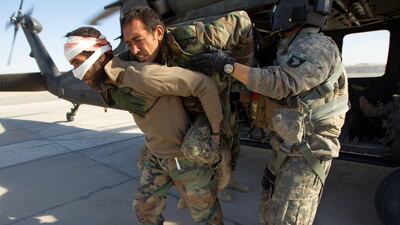
Sergeant Jay Kenney, 26, with the 101st Airborne Division, Task Force Destiny, assists wounded Afghan National Army (ANA) soldiers off the Blackhawk UH-60A helicopter after they were rescued in an air mission in Kandahar on December 12, 2010 in Kandahar province, Afghanistan. Getty Images -
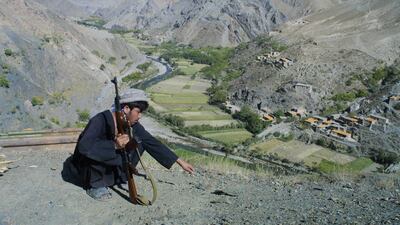
An Afghan Northern Alliance fighter mans the front line against the Taliban on October 2, 2001 near Jabul os Sarache, 30 miles north of Kabul. Getty Images -
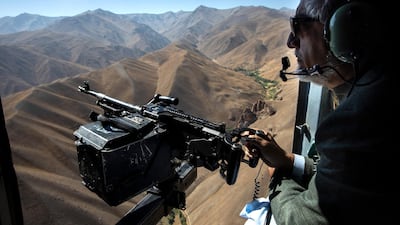
Abdullah Abdullah, chief executive of Afghanistan travelling via helicopter for the final campaign rally in Bamiyan, Afghanistan on September 25, 2019. Afghans will head to the polls on Saturday, September 28th. Getty Images -
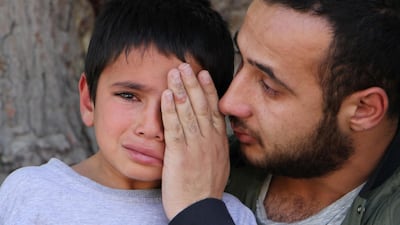
Mustafa Tamanna, 10, son of Afghan reporter Zabihullah Tamanna, weeps during the funeral ceremony in Kabul, Afghanistan on June 7, 2016. Tamanna was killed by a rocket-propelled grenade fired by the Taliban. Getty Images -
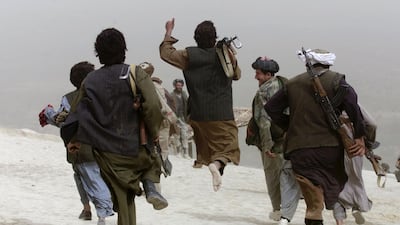
Northern Alliance soldiers come back from the front line after a battle near Charatoy town in the north of Afghanistan on October 10, 2001. REUTERS -
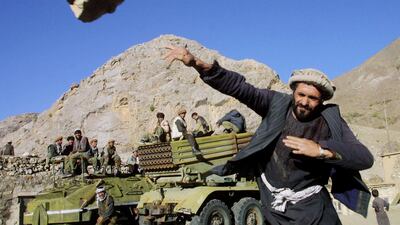
A Northern Alliance fighter throwing rocks as part of a popular national game yards away from a multiple Grad missile launcher in October 12, 2001 in the Salang Gorge in Northern Afghanistan. Getty Images -
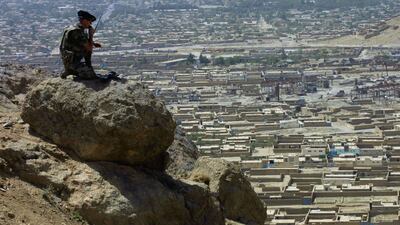
A French soldier from the 7th Mountain Regiment, part of the International Security and Assistance Force (ISAF) stands on a boulder overlooking Kabul during a patrol August 3, 2002 in Afghanistan. The ISAF has been patrolling Kabul since January 2002, working with the government and a new police force to prevent the violence and lawlessness that threatened to engulf the city after a U.S.-led coalition forced the Taliban from power. Getty Images -
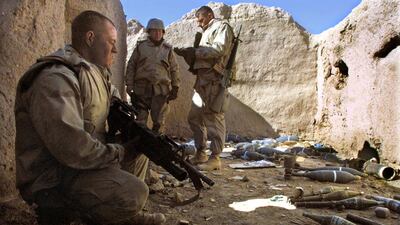
US Marine Sgt. Jerry Brown (L) of Jacksonville, North Carolina watches over a weapons cache found during a patrol near the American military compound at Kandahar Airport in January 16, 2002 in Kandahar, Afghanistan. The Marines recovered mortars, rockets, rocket-propelled grenades and artillery rounds discovered in various caches near the base while on the patrol. Getty Images) -
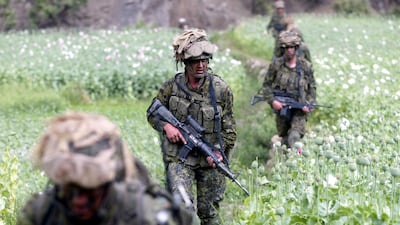
Members of the Princess Patricia's Canadian Light Infantry patrol through poppy fields in the village of Markhanai in May 6, 2002 in the Tora Bora valley region of Afghanistan. Getty Images -
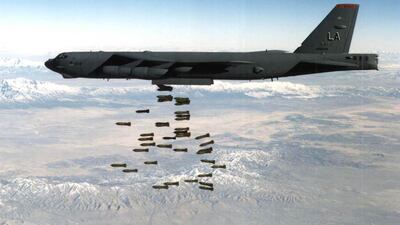
The United States and Britain on October 7, 2001 launched a first wave of air strikes against Afghanistan. President George W. Bush said the action heralded a "sustained, comprehensive and relentless" campaign against terrorism. REUTERS -
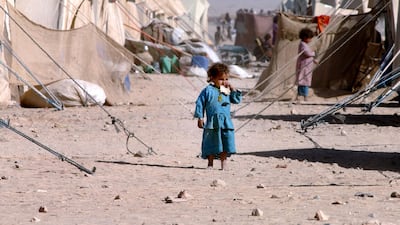
A young Afghan girl eats a piece of bread at the Chaman refugee camp on November 8, 2001 on the Pakistan border with Afghanistan. The UNHCR has estimated that since September 11, 2001 over 135,000 Afghans have crossed the border into Pakistan, adding to the already millions of refugees living in the country. Getty Images -
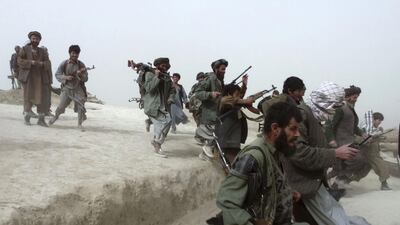
Afghan opposition Northern Alliance soldiers leap over a trench as they return from front line positions after battle near the town of Charatoy in the north of Afghanistan October 10, 2001. REUTERS -
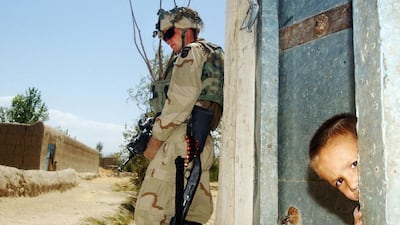
An Afghan child peeks out from the doorway of his family's home as a US Army soldier from the 101st Airborne stands guard in the eastern Afghan village of Hesarak on July 16, 2002 during what the Army refers to as a 'sensitive site exploitation' mission or 'SSE'. Getty Images -
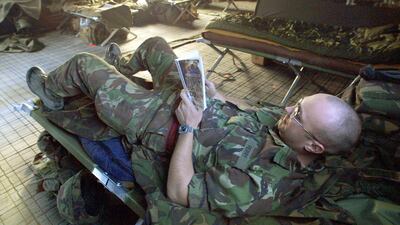
Fred Perry, a British Royal Engineer soldier, reads the book "Black Hawk Down" inside his tent after a day of work on January 29, 2002 at the International Security Assistance Force (ISAF) barracks at the Kabul airport in Kabul, Afghanistan. Getty Images -
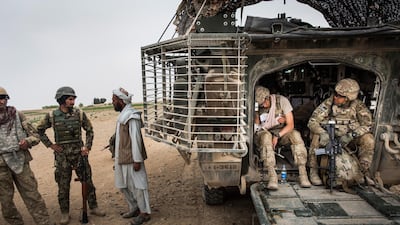
Afghan soldiers (L) speak to a local Afghan, while a medic in the U.S. Army's 1st Battalion, 36th Infantry Regiment, Charlie Company (R) monitors a soldier who has just survived a blast from an improvised explosive device (IED) while driving a vehicle during a mission near Command Outpost Pa'in Kalay, on March 19, 2013 in Kandahar Province, Maiwand District, Afghanistan. Getty Images -

Marines on a light armored vehicle prepare for patrol as an AH1W "Super Cobra" helicopter flies by on December 28, 2001 at the U.S. Marine Corps Base in Kandahar, Afghanistan. Getty Images -
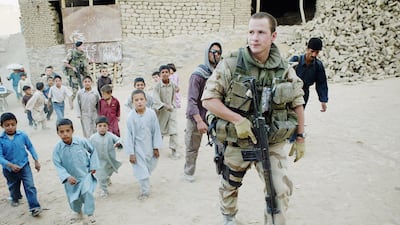
A Norwegian ISAF (International Security Assistance Force)soldier from Recce Squadron 3 patrols on October 4, 2004 in Kabul, Afghanistan as election officials get ready for the Presidential elections. Getty Images -
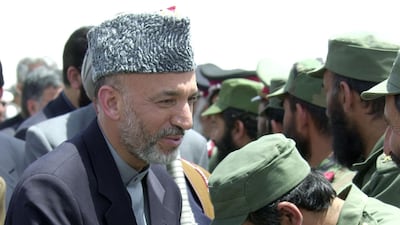
Interim Afghan leader Hamid Karzai (L) is greeted by a group of Afghan military officers on his arrival to Kandahar airbase on May 04, 2002 in Southern Afghanistan. Getty Images -
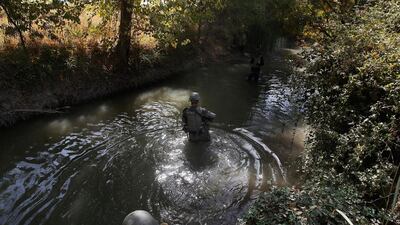
Soldiers in the U.S. Army's 101st Airborne Division wade though a creek to avoid buried insurgent bombs while on patrol October 16, 2010 in Zhari district west of Kandahar, Afghanistan. Getty Images -

British commandos descend from a mountain observation post overlooking the beginning of the Helmand River at the Kajaki hydroelectric dam on March 13, 2007 in Afghanistan's southern Helmand province. Getty Images -
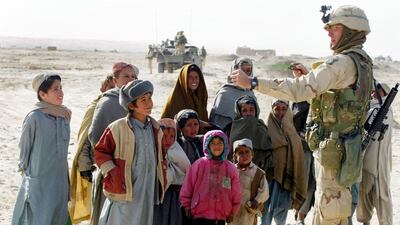
101st Airbornes 1st Sgt. Kerry Black from Westmoreland, Tennessee uses an Afghan child's sling shot on February 6, 2002 as children crowd around him while he patrols on the outskirts of Kandahar, Afghanistan. Getty Images -

Marine Cpl. Jonathan Eckert of Oak Lawn, IL attached to India Battery, 3rd Battalion, 12th Marine Regiment works his improvised explosive device (IED) sniffing dog Bee as they secure a compound during a patrol near Forward Operating Base (FOB) Zeebrugge on October 11, 2010 in Kajaki, Afghanistan. Getty Images -
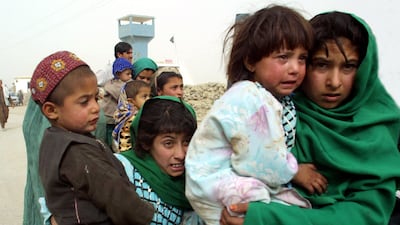
Afghan refugees walk across the border into Pakistan on October 11, 2001 as they leave Afghanistan at the Chaman crossing point on the 4th day of U.S.-led air strikes against the ruling Taliban and terrorist networks in the country. Getty Images -

Anti-Taliban Afghan fighters watch several explosions from U.S. bombings in the Tora Bora mountains in Afghanistan on December 16, 2001. -
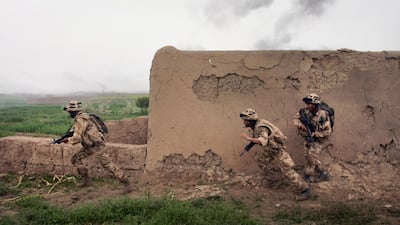
British Marines run under fire from the Taliban during a morning operation on March 18, 2007 near Kajaki in the Afghan province of Helmand. Getty Images -

Afghan Army troops prepare to board a British chinook helicopter from their base at Shorabak on March 12, 2007 in Southern Helmand province, Afghanistan. Getty Images -
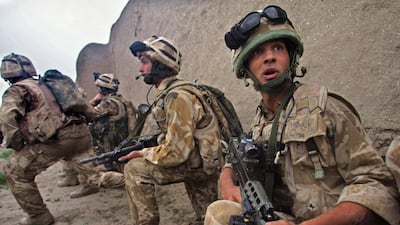
British Marine Joe Harvey from Stafford, England (R), watches as British forces come under fire by Taliban insurgents on March 18, 2007 near Kajaki in the Afghan province of Helmand. Getty Images -

U.S. Army 101st Airborne 3-187 "Bravo" company soliders pass through a corn field while conducting a sensitive site exploitation (SSE) mission July 23, 2002 near the town of Narizah in Southeastern Afghanistan. Getty Images -
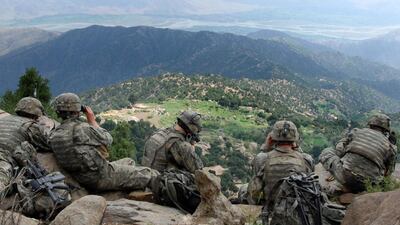
Scouts from 2nd Battalion, 503rd Infantry Regiment (Airborne), pull overwatch during Operation Destined Strike while 2nd Platoon, Able Company searches a village below the Chowkay Valley in Kunar Province, Afghanistan on August 22, 2006. US Army


For its part, the Taliban has carried out suicide and other deliberate attacks on thousands of civilians, including judges, lawmakers, community elders and journalists, including by suicide attacks, car bombs and booby traps, HRW says.
The probe also shines a light on US forces. Washington is not a party to the court, and says it will protect US servicemen from politicised prosecutions. But the ICC prosecutor has jurisdiction over alleged crimes committed on Afghan territory by foreigners that are not being properly addressed in domestic courts.
"There's a whole panoply of criminality by the Taliban and Afghan security forces that would make for feasible ICC cases, while alleged US crimes are just one small sliver of what the court is assessing," Christopher "Kip" Hale, an atrocity crime attorney who prosecuted Khmer Rouge cases in Cambodia, told The National.
Still, there is evidence of wrongdoing by US service members. The ICC prosecutor’s early-stage findings showed “crimes of torture, outrages upon personal dignity and rape and other forms of sexual violence” by US personnel.
A study by US lawmakers in 2014 detailed the CIA's harsh detention and interrogation programme of waterboarding and other "enhanced interrogation techniques" in Afghanistan and at other black sites globally.
In the past, human rights groups have called for criminal probes into former president George W Bush, vice president Dick Cheney, defence secretary Donald Rumsfeld, CIA director George Tenet and lawyers from that administration, including John Yoo and attorney general John Ashcroft.
"The US has shown itself entirely unwilling to hold the perpetrators of its torture programme to account and has actively tried to impede the court’s investigation," said Grant Shubin, legal director of the Global Justice Centre, a campaign group.
World governments should support the ICC's recent "critical step towards justice", he said.
Any ICC indictment of an American official would not come for many years, said Mr Hale, but would pose challenges for US allies like South Korea, Britain and France that back the court yet value ties with the US.
“You enter a world of dicey international intrigue by which more than 120-plus ICC members around the world become obliged to execute arrest warrants of ex-American officials, and all the trouble this creates between that government and Washington,” Mr Hale said.
While it is intriguing to imagine a Bush-era official taking an ill-advised shopping trip to Paris and ending up in a Dutch courtroom, Stephen Rapp, a prominent war crimes lawyer, said that the chances of any ICC charges against Americans were slim.
In 2012, US attorney general Eric Holder concluded that there was not enough evidence to prosecute anybody in the US for the deaths of a prisoner in Afghanistan in 2002 and another in Iraq in 2003. Ms Bensouda would likely reach the same conclusion, said Mr Rapp.
The ICC was designed to prosecute the kinds of ethnic cleansing that ravaged Rwanda and the Balkans in the 1990s. It charges the ringleaders of systematic abuses when domestic courts are unwilling or unable to prosecute.
In her Afghanistan probe, Ms Bensouda will see “horrible” evidence of CIA waterboarding, but the small number of detainee deaths and a “genuine, if imperfect” US effort to hold wrongdoers to account makes the case unsuitable for the ICC, said Mr Rapp, a US ambassador on war crimes during the Obama administration.
“There can be bad things that happen, but a prosecutor has to be able to go to court and tie it all together.”
Still, Mr Pompeo’s response suggested that the Trump administration would not wait around for any ICC indictments. Last April, Washington revoked Ms Bensouda’s US visa for her work on Afghanistan. ICC insiders expect more to follow.
In September 2018, the national security adviser at the time, John Bolton, threatened to target ICC prosecutors and judges with travel bans, freezing their bank accounts and even prosecuting them in US courts.
The US may also try to circumvent the court. Ted Cruz, a Texas senator, is hatching plans for a UN Security Council resolution to bar the ICC from bringing charges against citizens of non-member states — which includes the US, Russia, China and Israel.
Similarly, the US could ask the UN Security Council to freeze the ICC probe for a year, arguing that cutting a deal with the Taliban, ending its longest war and withdrawing some 13,000 US troops was more important than historic claims of torture, Mr Rapp said.

