The West Wing is a ghost town. Staff members are scared of exposure. And the White House is now a treatment ward for not one – but two – Covid patients, including a president who has long taken the threat of the virus lightly.
President Donald Trump’s decision to return home from a military hospital despite his continued illness is putting new focus on the people around him who could be further exposed if he doesn’t abide by strict isolation protocols.
Throughout the pandemic, White House custodians, ushers, kitchen staff and members of the US Secret Service have continued to show up for work in what is now a coronavirus hot spot, with more than a dozen known cases this week alone.
Mr Trump, still contagious, has made clear that he has little intention of abiding by best containment practices.
-
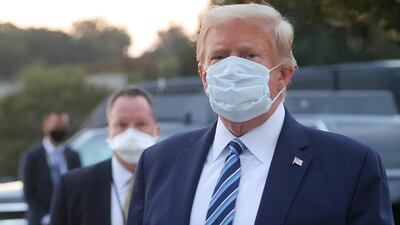
US President Donald Trump leaves Walter Reed National Military Medical Centre in Washington after undergoing treatment for the coronavirus infection. Reuters -
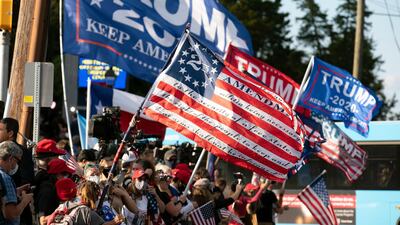
President Donald Trump supporters cheer outside the Walter Reed National Military Medical Centre in Bethesda. AP Photo -

US President Donald Trump wears a protective mask while boarding Marine One outside Walter Reed National Military Medical Centre in Bethesda, Maryland. Bloomberg -
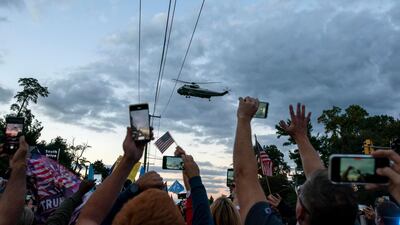
Marine One lifts off from Walter Reed National Military Medical Centre in Bethesda. AP Photo -
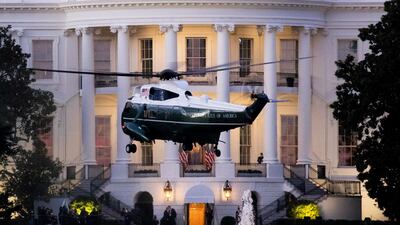
Marine One arrives at the South Lawn of the White House, carrying US President Donald Trump as he returns from Walter Reed hospital, in Washington, DC. EPA -
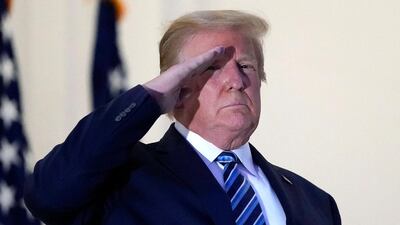
President Donald Trump salutes Marine One as he stands on the balcony outside of the Blue Room as returns to the White House. AP Photo -

President Donald Trump gives thumbs up as he stands on the Blue Room Balcony upon returning to the White House. AP Photo -
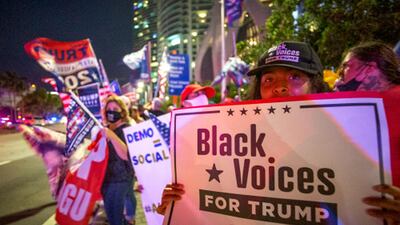
Supporters of US President Donald Trump demonstrate in front of the Perez Art Museum, where his Democratic rival Joe Biden is delivering a speech, in Miami, Florida. EPA -
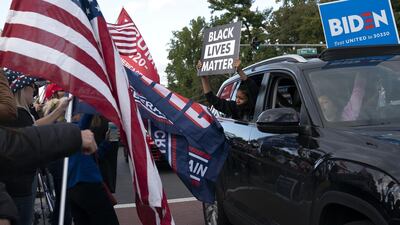
Supporters and critics of US President Donald Trump clash outside Walter Reed National Military Medical Centre in Bethesda. Bloomberg -
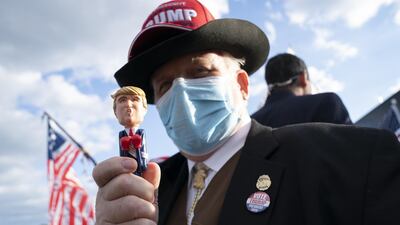
A supporter of US President Donald Trump holds a pen in his likeness outside Walter Reed National Military Medical Centre in Bethesda. Bloomberg -
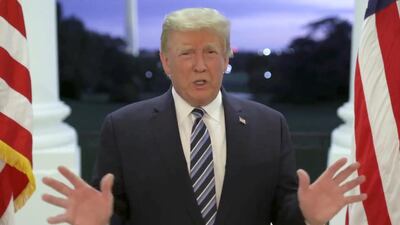
US President Donald Trump speaks at the White House after returning from treatment at the Walter Reed Medical Centre for coronavirus, in Washington. Reuters -

A cleaner at the White House sprays disinfectant in the James Brady Press Briefing room after US President Donald Trump return to the White House. EPA -

A member of the White House cleaning staff sprays disinfectant in the press briefing room before US President Donald Trump's return from Walter Reed Medical Centre. Reuters -
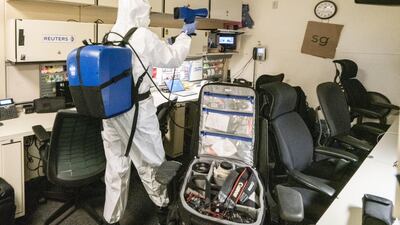
A cleaner at the White House sprays disinfectant after US President Donald Trump returned to the White House. EPA


As he arrived back at the White House on Monday evening, the president defiantly removed his face mask and stopped to pose on a balcony within feet of a White House photographer. He was seen inside moments later, surrounded by numerous people as he taped a video message urging Americans not to fear a virus that has killed more than 210,000 in the US and 1 million worldwide.
White House spokesman Judd Deere said the White House was “taking every precaution necessary” to protect not just the first family but “every staff member working on the complex” consistent with Centres for Disease Control and Prevention guidelines and best practices. He said physical access to the president would be significantly limited and appropriate protective gear must be worn by those near him.
Nonetheless, the mood within the White House remains sombre, with staff fearful they may have been exposed to the virus. As they confront a new reality – a worksite that once seemed like a bubble of safety is anything but – they also have been engaged in finger-pointing over conflicting reports released about the president’s health as well as a lack of information provided internally.
Many have learnt about positive tests from media reports and several were exposed, without their knowledge, to people the White House already knew could be contagious.
Indeed, it took until late on Sunday night, nearly three full days after Mr Trump’s diagnosis, for the White House to send a staff-wide note in response. Even then, it did not acknowledge the outbreak.
“As a reminder,” read the letter from the White House Management Office, “if you are experiencing any symptoms … please stay home and do not come to work”. Staff who develop symptoms were advised to “go home immediately” and contact their doctors rather than the White House Medical Unit.
Even when Mr Trump was at the hospital, his staff were not immune to risk.
Mr Trump had aides there recording videos and taking photographs of him. On Sunday evening, he took a surprise drive around the hospital to wave to supporters from the window of an SUV. The Secret Service agents in the car with him were dressed in personal protective equipment.
“Appropriate precautions were taken in the execution of this movement to protect the president and all those supporting it, including PPE,” Mr Deere said.
Mr Trump's campaign spokesman Hogan Gidley dismissed media concern about the agents’ safety as “absolutely stupid and foolish”.
“How do they think he’s going to leave? Is someone gonna toss him the keys to a Buick and let him drive home by himself? They’re always around him because that’s their job,” Mr Gidley said on Fox News.
But agents told a very different story.
Several who spoke with the Associated Press expressed concern over the cavalier attitude the White House has taken when it comes to masks and distancing. Colleagues, they said, are angry, but feel there’s little they can do.
One, speaking after White House press secretary Kayleigh McEnany tested positive on Monday, said it felt like he and some of his colleagues had been spared only by a measure of good luck.
Others noted the difference between facing outside threats they have trained for – a gun, a bomb or a biohazard – and being put at additional risk because of behaviour they characterised as reckless at times. The agents spoke without revealing their identity to avoid jeopardising their jobs.
The Secret Service has refused to disclose how many of its employees have tested positive or have had to quarantine, citing privacy and security. But in the midst of the election, thousands of agents are on duty and anyone who tests positive can easily be subbed out, officials have said.
Secret Service spokeswoman Julia McMurray said the agency takes “every precaution to keep our protectees, employees and families, and the general public, safe and healthy.”
Mr Trump has joined first lady Melania Trump, who also tested positive, in the residential area of the White House. It is typically served by a staff of roughly 100 people, including housekeepers, cooks, florists, groundskeepers and five or six butlers – who interact most closely with the president, said Kate Andersen Brower, who wrote the “The Residence: Inside the Private World of the White House.”
During the pandemic, that staff has been reduced to a skeleton crew, with mask-wearing much more prevalent than in the West Wing, where few have worn them regularly.
Mr Brower said she recently spoke with three former employees who expressed concern about the health of current workers, but were too afraid to speak publicly.
“The butlers always feel protective of the first family, but there’s just a concern about whether or not the staff would get sick,” Mr Brower said. Most are older, she said, “because they work from one generation to the next. They are people who have been on the job for 20 to 30 years. They want to work to get their full pensions”.
For months now, cleaning staff have also privately voiced concerns about their safety, including lack of access to testing and inadequate protective gear.
Stephanie Grisham, the first lady’s spokeswoman, said that “all precautions are being taken to ensure the health and safety of the residence staff”, but she declined to be specific.
While the White House has refused to implement new safety procedures – such as making masks mandatory – the building was noticeably emptier on Monday, with more staffers now staying home on days when they are not needed on site.
On Monday morning, there was just a single staff member in the ground floor press office, where two medical staff members administered Covid-19 tests, surrounded by empty desks.
It’s not the first time a White House has had to contend with a virus. During the flu pandemic of 1918, President Woodrow Wilson was infected as were members of his family and White House staff, including his secretary and several Secret Service members, according to the White House Historical Association.
So were two sheep who spent their days grazing on the South Lawn. They were admitted in hospital but recovered.

