

President-elect Joe Biden will act quickly to restore multilateralism to US foreign policy but skyrocketing coronavirus cases at home could weigh on his plans, the Abu Dhabi Strategic Debate heard on Monday.
Under the Biden administration the US is likely to re-join international accords from which President Donald Trump had pulled Washington out to signal re-engagement on global issues, panellists said at the online event, organised by the Emirates Policy Centre.
Richard Fontaine, head of the Centre for a New American Security, expected the White House to sound “a very different” and “substantive” tone by re-joining the World Health Organisation, the Paris Agreement on climate change and the Joint Comprehensive Plan of Action on Iran’s nuclear programme.
Mr Fontaine said Mr Biden “wants to break with President Trump’s approach to allies and demonstrate that the United State is reliable and consistent in our approach,” toward issues such as climate change and the coronavirus.
“The first set of priorities that will occupy the Biden administration will be Covid-19. It will be largely domestically focused but have international implications,” he said.
-
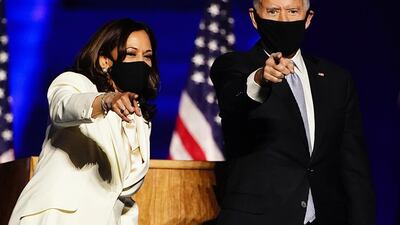
US vice president-elect Kamala Harris and president-elect Joe Biden arrive for victory address after being declared the winner in the 2020 presidential election, in Wilmington, Delaware. EPA -
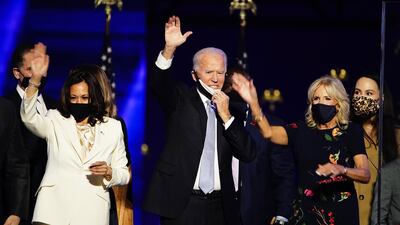
US president-elect Joe Biden and Jill Biden with vice president-elect Kamala Harris are joined by family members after Mr Biden delivered his victory address following the announcement of the winner in the 2020 presidential election, in Wilmington, Delaware. EPA -

People watch fireworks after media announced that Democratic US presidential candidate Joe Biden has won the 2020 election, in Wilmington, Delaware. Reuters -
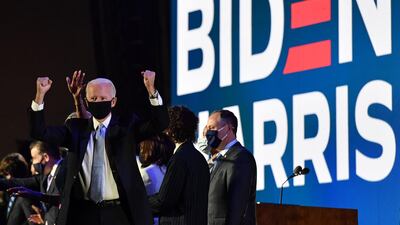
US president-elect Joe Biden gestures in celebration after delivering remarks in Wilmington, Delaware. AFP -
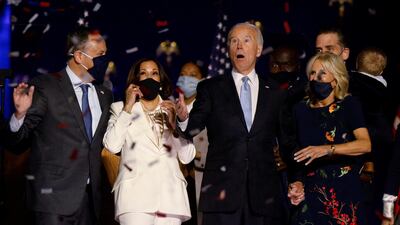
Democratic presidential nominee Joe Biden and his wife Jill, and Democratic vice presidential nominee Kamala Harris and her husband Doug, react to the confetti at their rally in Wilmington, Delaware. Reuters -
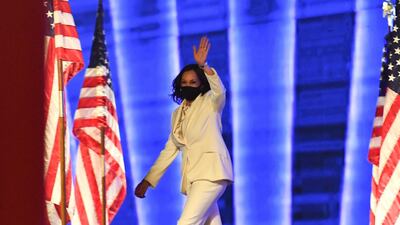
Vice president-elect Kamala Harris arrives to deliver remarks before introducing the US president-elect Joe Biden in Wilmington, Delaware. AFP -
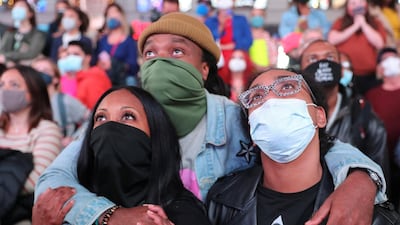
People gather to watch the speeches in Times Square in New York City. Reuters -
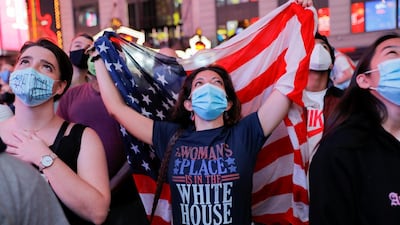
Gabriella Ziccarelli, 32, from Arizona, holds a US flag as she watches a speech by vice president-elect Kamala Harris, in Times Square in New York City. Reuters -
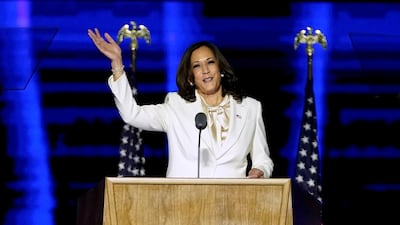
Vice president-elect Kamala Harris speaks in Wilmington, Delaware, November 7, 2020. Reuters -

US president-elect Joe Biden and vice president-elect Kamala Harris gesture during their post-election rally in Wilmington, Delaware. Reuters -
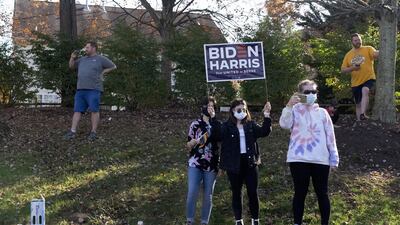
A person wearing a protective mask holds a 'Biden Harris' campaign sign outside Trump National Golf Club in Sterling, Virginia. Bloomberg -

The presidential motorcade, with US President Donald Trump, travels through Reston, Virginia, after President Trump played golf at his International golf club. AFP -
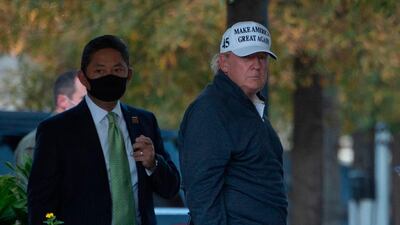
President Donald Trump returns to the White House from playing golf in Washington, after Joe Biden was declared the winner of the 2020 presidential election. AFP -
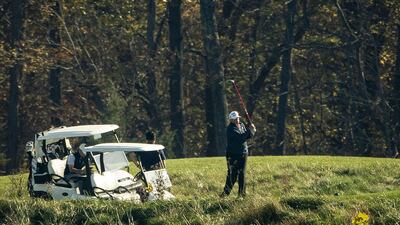
President Donald Trump plays golf at Trump National Golf Club in Sterling, Virginia. AFP -
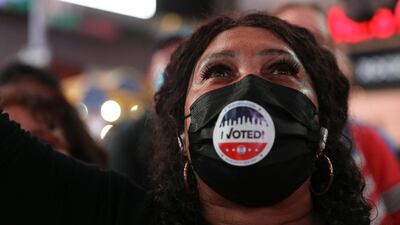
A woman reacts as she watches speeches by Joe Biden and Kamala Harris, in Times Square in New York City. Reuters -
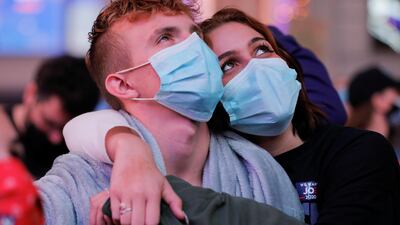
People watch the speeches by Joe Biden and Kamala Harris, at Times Square in New York City. Reuters -
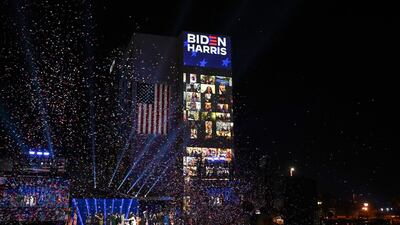
Confetti falls after US president-elect Joe Biden and vice president-elect Kamala Harris delivered speeches in Wilmington, Delaware. AFP -
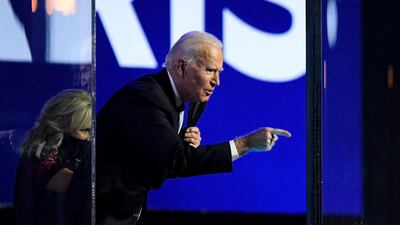
US president-elect Joe Biden with his wife Jill Biden, salute the crowd on stage after delivering a speech in Wilmington, Delaware. AFP -
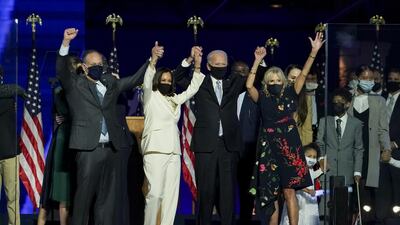
US president-elect Joe Biden, wife Jill Biden, vice president-elect Kamala Harris and husband Douglas Emhoff hold hands while wearing protective masks during a post-election event in Wilmington, Delaware. Bloomberg -

Vice president-elect Kamala Harris and president-elect Joe Biden stand on stage with family members in Wilmington, Delaware. AP Photo -
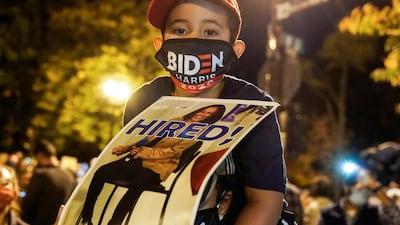
A boy carries a sign with vice president-elect Kamala Harris at Black Lives Matter Plaza in Washington. Reuters -
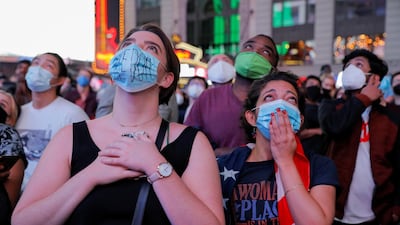
People watch a speech by Democratic vice presidential nominee Kamala Harris, at Times Square in New York City. Reuters -
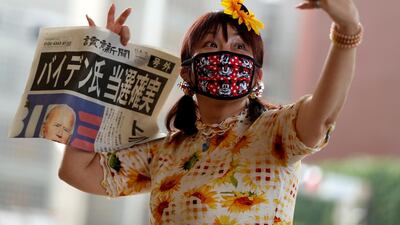
A woman takes selfie photo posing with an extra edition of a newspaper reporting that Democrat Joe Biden is projected to win the 2020 US presidential election, in Tokyo, Japan. Reuters


He cautioned that Mr Biden will be wary domestically on “appearing soft on China,” which could hinder possible co-operation with Beijing on the coronavirus and on climate change.
Coronavirus cases in the United States are nearing 10 million and more than 237,000 people have died from the pandemic, far outpacing other nations in the world.
Professor Kishore Mahbubani of the Asia Research Institute in Singapore said the coronavirus sits on top of “tsunami of problems in the United States of America”.
He said “structural problems” in American society are on the rise, in particular an increasing gap between the rich and pour that have contributed to turning the US into what he described as a plutocracy.
Mr Mahbubani pointed out the possibility that the Chinese economy could overtake that of the United States in 15 years, adding to pressures on US leaders to take measures to raise US competitiveness from now.
“It is a whole new ball game globally and, in some ways, Joe Biden got the job at the most difficult time in American history,” Mr Mahbubani said.
Cliff Kupchan, head of the Eurasia Group, said that a relatively close US election result shows that the “domestic landscape will be pretty much split down the middle for the foreseeable future.”
Mr Kupchan said Mr Biden “will be much more interested in global engagement” than Mr Trump but that almost “half of America is not celebrating.
“It is grieving,” Mr Biden’s election victory, he said.
“America is two nations right now,” Mr Kupchan said. “The most important issue for half of Americans is not the coronavirus but the economy.”

