


President Nayib Bukele won a landslide victory in El Salvador at the weekend, riding a wave of popularity over his strongman approach to security, despite criticism over human rights abuses.
Mr Bukele, 42, won with about 83 per cent of the vote, far surpassing his closest competitor, who received 7 per cent.
The self-proclaimed “world's coolest dictator” was first elected in 2019, presenting himself and his New Ideas party as the younger, hipper alternatives to the stale, corrupt traditional parties and leaders.
His youth and social media savvy were paired with a vow to eliminate gang violence and fix the economy – but who is Mr Bukele and has he delivered on his promises?
Palestinian heritage
The streets of the capital San Salvador were thronged with supporters on Sunday night, with many wearing the blue and white of the national flag and others sporting keffiyehs, in a nod to Mr Bukele's Palestinian heritage.
His paternal grandparents were Palestinian Christians, but his father, a businessman, converted to Islam and became a champion of the Palestinian cause.
Palestinian immigrants began moving to Central America in the early 20th century, right around the collapse of the Ottoman Empire, with later waves coming after the Nakba in 1948 and the 1967 Arab-Israeli war.

The Palestinian community thrived in El Salvador, successful not only commercially but also politically – a number of the country's high-ranking politicians, including two presidents so far, have been of Arab descent.
Although Mr Bukele routinely expresses pride in his roots, he has mostly toed the line when it comes to El Salvador's relations with Israel – that is, friendly, while also maintaining diplomatic relations with Palestine.
While serving as mayor of San Salvador, he visited Israel for an international mayoral conference. After the Hamas attacks of October 7, he expressed strong support for Israel.
“As a Salvadoran with Palestinian ancestry, I'm sure the best thing that could happen to the Palestinian people is for Hamas to completely disappear,” he wrote on X.
“Those savage beasts do not represent the Palestinians. Anyone who supports the Palestinian cause would make a great mistake siding with those criminals.”
Violence
Over the course of his mandate, Mr Bukele has intensified the government's approach to security in the country, which had one of the highest murder rates in the world.
The government claims El Salvador now has a murder rate equal to those of the US states of Maine or New Hampshire, although analysts have questioned those figures.
“We … changed the murder capital of the world, the world's most dangerous country, into the safest country in the Western Hemisphere,” the President said on Sunday.
Street gangs have long terrorised the country, with groups such as MS-13 engaging in kidnapping, extortion and murder.
The high level of insecurity has pushed tens of thousands of Salvadoreans out of the country in search of a better life in the US and elsewhere.
In 2022, after the national murder rate hit a record high, Mr Bukele announced a war on gangs and a state of emergency.
About 100,000 people have been swept up in police raids and jailed since, according to Insight Crime, many of them held in the so-called Terrorism Confinement Centre, a new maximum-security prison with capacity for tens of thousands of inmates.
-
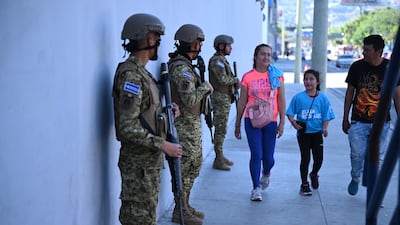
Soldiers stand guard during the presidential and legislative elections in San Salvador, El Salvador. AFP -
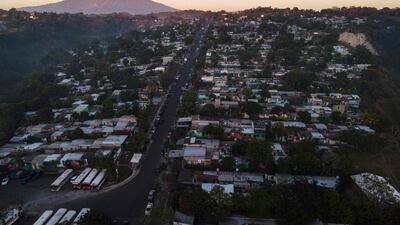
Aerial view of the Campanera neighbourhood in Soyapango, a stronghold of the Barrio 18 gang for decades. AFP -
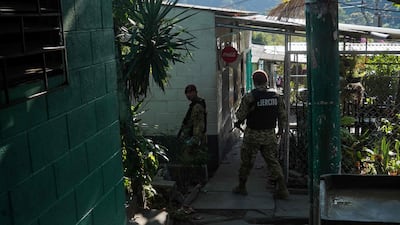
Soldiers patrol the Campanera neighbourhood during the presidential and legislative elections. AFP -
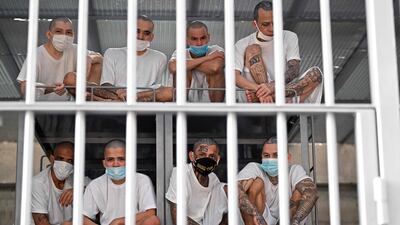
Inmates inside a cell at the Terrorism Confinement Centre mega-prison in Tecoluca. AFP -
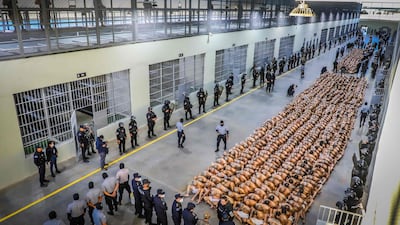
Inmates belonging to the MS-13 and Barrio 18 gangs arrive at the mega-prison. AFP / El Salvador's Presidency -
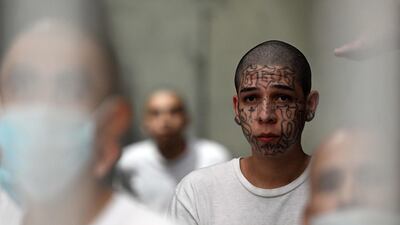
Gang members inside a cell at the mega-prison. AFP -
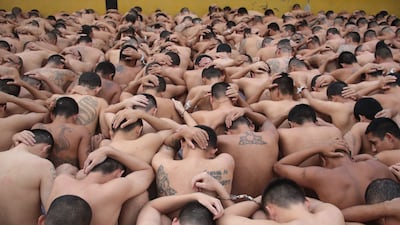
Members of the MS-13 and Barrio 18 gangs in custody at a prison in Ciudad Barrios. AFP / El Salvador Presidency -
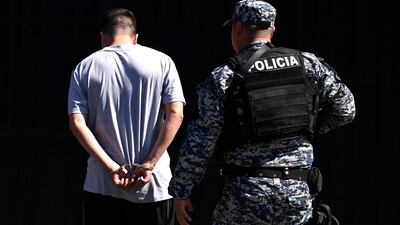
A man detained over alleged gang links is escorted by an officer of the National Civil Police at the San Salvador penal centre. AFP -
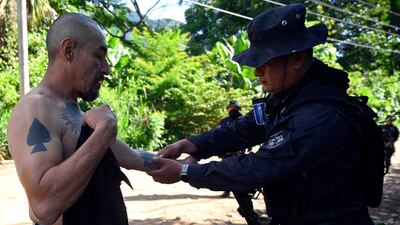
A police officer checks a man with tattoos during an operation to find gang members in Santa Ana. AFP -
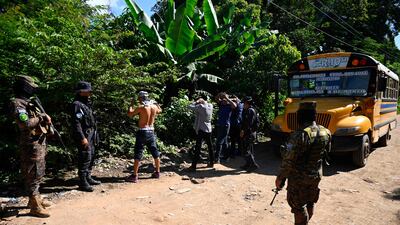
Soldiers and police frisk transport users in an operation in search of gang members in Santa Ana. AFP -
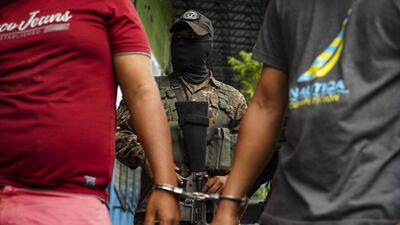
A member of the military stands guard behind two alleged gang members in San Salvador. Bloomberg -
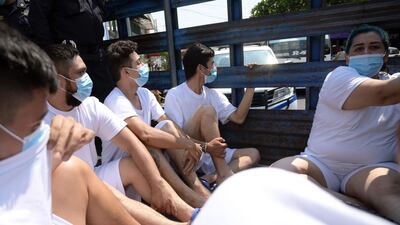
People detained over alleged gang links are escorted to the San Salvador penal centre. AFP -
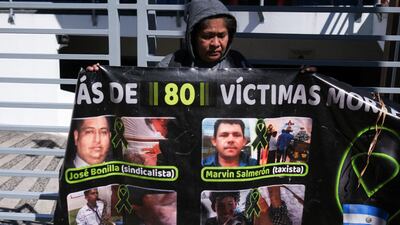
A woman holds a poster with pictures of people who died in detention during a protest outside the Attorney General's Office in Antiguo Cuscatlan. Reuters -
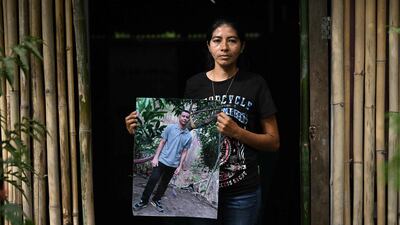
A woman poses with a picture of her husband who was captured under the state of emergency and later died in prison. AFP -
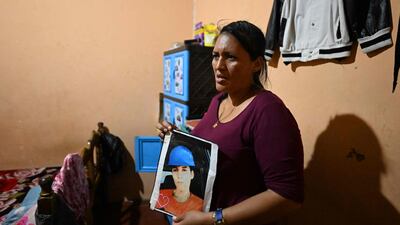
A woman shows a photo of her son who was detained during the state of emergency. AFP


Critics say the emergency measures have eroded human rights in the country, with police free from having to inform people of their rights or the reason for their arrest, and detainees allowed to be held for up to 15 days without seeing a judge.
Mr Bukele's election is “a clear sign that the cost in respect for human rights and checks on executive power has become secondary for Salvadoreans, compared to the dramatic gains in public safety”, said Gustavo Flores-Macias, professor of government and policy at Cornell University.
Mr Bukele has also made major political reforms that some say have led the country farther down the path towards authoritarianism.
Much like Donald Trump in the US, he has occasionally ruled by Twitter fiat, firing a number of officials through the social platform after he was elected.
And he used his New Ideas party's supermajority in the Legislative Assembly to pack the courts with supporters and reform state institutions, with the top court circumventing the constitution to allow him to run for a second consecutive term.
The Bitcoin gamble
While achieving success in bringing violence under control, Mr Bukele was not as fortunate in fixing the economy, as he came into power right at the onset of the Covid-19 pandemic.
About a third of the population of El Salvador lives in poverty, although rates have been declining over the past several years.
El Salvador, like many other countries, was hit hard by the pandemic and many more people slipped below the poverty line.
And while it came back strongly after the pandemic-driven decline, growth over the past year has mostly stagnated.
The country continues to register the slowest economic growth in Central America.
Mr Bukele has taken a unique approach to fostering economic growth and attracting investment. In 2021, El Salvador became the first country to adopt Bitcoin as legal tender.
The government bought $6.4 billion worth of the cryptocurrency and made a $1.5 billion in profit after the decision, according to DailyCoin.
What is Bitcoin and how did it start? – video
The Chivo Wallet app, released alongside the decision to adopt Bitcoin, aimed to bring the digital currency to the masses, with the incentive of $30 in Bitcoin available to all those who downloaded the app.
But the cryptocurrency experiment has largely been viewed as a failure, with the government losing about 37 per cent of its investment, according to El Pais.
Hundreds of Chivo accounts were hacked and the incentive money was stolen, along with the account owners' identities, after the introduction.
A year after its advent, “usage of Bitcoin for everyday transactions is low and is concentrated among the banked, educated, young and male population”, researchers at the University of Chicago's Becker Friedman Institute wrote in a 2022 working paper.
Despite the setbacks, however, Mr Bukele seems dedicated to making El Salvador a cryptocurrency haven.
His landslide re-election – along with his party again clinching the majority of seats in the Legislative Assembly – means he will be able to take another shot at making the country run on Bitcoin.

