

Days before the outbreak of mass demonstrations in Syria’s rural south nine years ago, a small group of women organised a protest demanding the release of political prisoners.
It was unthinkable under the iron rule of President Bashar Al Assad.
Among those arrested on March 16, 2011, was Dana Jawabra, an engineer from Deraa.
Her jailing and rough treatment helped to spark anti-regime marches in her home city two days later, cascading into events that made Syria one of the most devastating conflicts since the Second World War.
The south was already seething with anger over the arrest and torture of 15 pupils in Deraa.
They had scribbled graffiti on walls that said “the people want the downfall of the regime”, inspired by the uprisings in Tunisia and Egypt.
The authorities got word of the planned action in Marjeh Square in Damascus and hundreds of secret police carrying concealed guns and batons were posted in front of the interior ministry, the site of the planned silent protest.
A few of the protesters gathered as a decoy in front of the main entrance of the Ottoman-era building, while most, up to 200 men and women, assembled at the side entrance.

The momentary security lapse allowed them to briefly raise photos of some of the thousands of political prisoners languishing in Mr Al Assad’s jails before the regime’s agents charged at them with batons.
One of the pictures was of Muhannad Al Hassani, a human rights lawyer who had devoted his career to the cause of freedom of consciousness in Syria, defending dissidents before he was jailed in 2009 for “undermining national morale”.
One of the regime’s officers, swinging his baton with two hands, hit a protester’s head as the man had his hands up to signal his surrender. His skull fractured and blood gushed out.
Plainclothes operatives dragged activist Suhair Al Atassi from her hair into a blackened van.
She was released in April and fled Syria, later becoming a senior figure in the National Coalition for Syrian Revolution and Opposition Forces.
The Marjeh Square protest was preceded the day before by a group of young protesters running among shoppers through the Hamidya Souq in old Damascus while shouting anti-regime slogans. Some consider it the start of the Syrian revolt.
The opposition coalition entered peace talks in Geneva with the regime on a transitional governing body in January, 2014.
A Russian takeover of the Syria file in international diplomacy circles ensured the withering of any transition western powers would consider credible, and the opposition coalition is now practically defunct.
France, Germany, the UK and the US said on Sunday that a “credible political process” required “the Assad regime stop the ruthless killing”, a nationwide ceasefire, a reformed constitution, the release of arbitrarily detained people, and free and fair elections.
The regime, dominated by Syria’s Alawite minority, had already killed, tortured and made to disappear thousands of Syrians in the 1980s.
The regime regarded the societies who rose against the current leader's father, former president Hafez Al Assad, in Idlib, Aleppo and Hama comprised "untrustworthy elements".
The army massacred an estimated 20,000 in Hama alone in the 1980s, and millions of Sunnis who left the country since 2011 do not have much better status.
But the regime linked up with Sunni merchants in the cities, subsidised agriculture and paid thousands of informants in its Stasi-modelled system of control, and offered membership to the Baath Party in return for loyalty.
These policies gradually became unworkable in the decade before the revolt as mismanagement and corruption destroyed the water table, ruined agriculture and caused near famine in eastern Syria.
Hundreds of thousands of Sunni and Kurdish farmers and their families were displaced to what became slums around Damascus, Aleppo, Hama and Deraa.
Young, educated Sunnis who had sought to benefit from the lifting of restrictions on freeenterprise in the mid-2000s hit a system of corruption linked to the security apparatus.
Traumatised by the 1980s, Sunni opponents of the regime developed their own armed response to the regime’s crackdown the second time around.
It is virtually impossible to gauge independent opinion in Syria, but an indeterminate proportion of Sunnis, particularly in Aleppo and Damascus, still regarded Bashar Al Assad as the best option.
The militarisation of the revolt, which began in the second half of 2011, was different in scale and spread to the localised insurgency of the Fighting Vanguard, and received limited support from regional heavyweights.
-
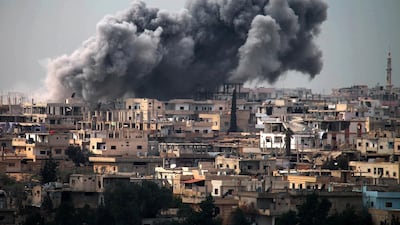
Smoke billows following air strikes on a rebel-held area in the southern city of Daraa on March 16, 2017. AFP -
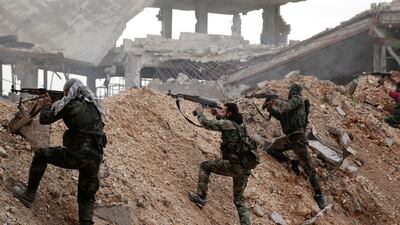
Syrian army soldiers fire their weapons during a battle with rebel fighters at the Ramouseh front line, east of Aleppo, on December 5, 2016. AP Photo -

Russians, Syrians and others gather next to an American military convoy stuck in the village of Khirbet Ammu, east of Qamishli city, on February 12, 2020. AP Photo -
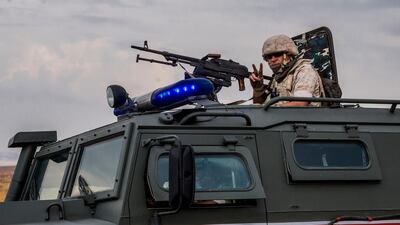
A Russian soldier mans a machine gun during a patrol near the Syrian and Turkish border in north Syria on October 25, 2019. AP Photo -
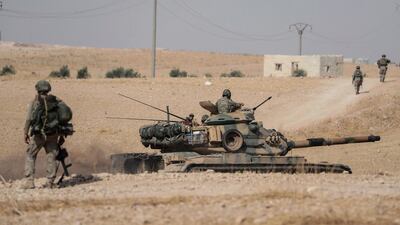
Turkish tanks and troops stationed near Syrian town of Manbij. AP -
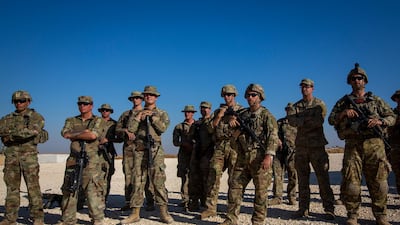
Crew of Bradley fighting vehicles stand at a US military base in north-eastern Syria on November 11, 2019. AP Photo -
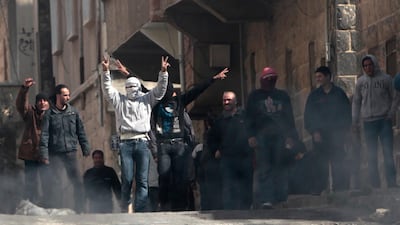
Anti-government protesters flash victory signs as they protest in the southern Syrian city of Daraa on March 23, 2011. AP Photo -
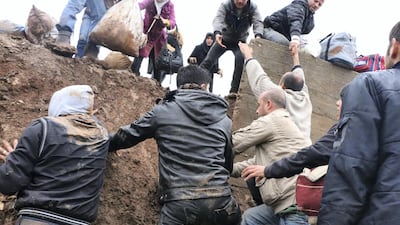
Syrians climb up a mud bank as they flee across fields to reach the Syrian-Turkish border on March 10, 2014. AFP -
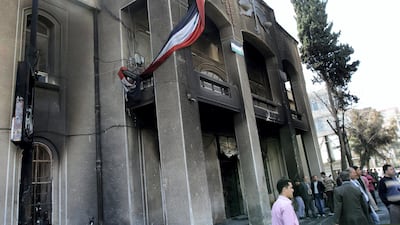
Syrian men gather outside the courthouse in Daraa that was torched a day earlier by angry protesters on March 21, 2011. AFP -
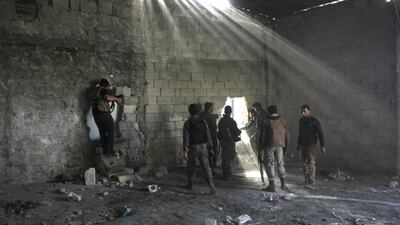
Rebel fighters inside a building during clashes with pro-government forces in the Sheikh Al Said neighbourhood of Aleppo city on November 28, 2013. AFP -
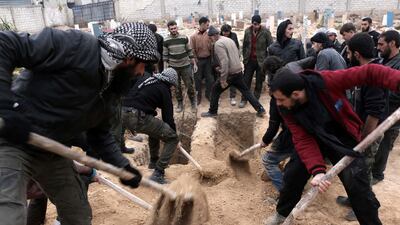
Syrians bury victims in a group funeral following air strikes in the rebel-held city of Douma on January 7, 2016. AFP -
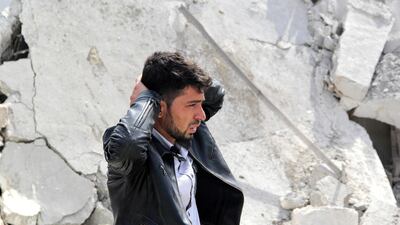
A man reacts to the destruction of his home in an air strike by government forces on the northern Syrian city of Aleppo on February 22, 2014. AFP -
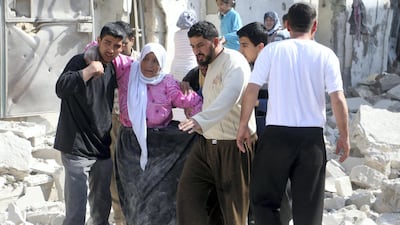
A woman is helped through the rubble of buildings hit by a reported Syrian government air strike in Al Sakhour district of Aleppo city on April 4, 2014. AFP -
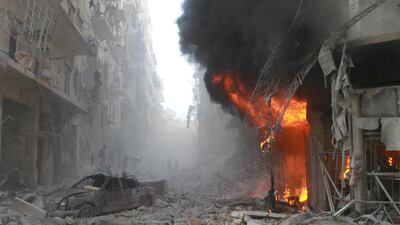
Debris fills a street and flames rise from a building following an air strike by Syrian government forces in the Sukkari neighborhood of Aleppo on March 7, 2014. AFP -
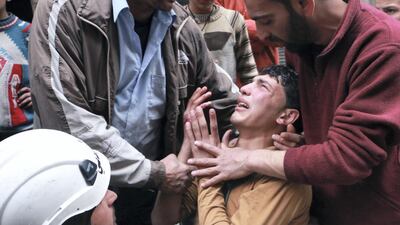
A man is comforted following an air strike by government forces that killed a rescue worker in Aleppo city on March 9, 2014. AFP -
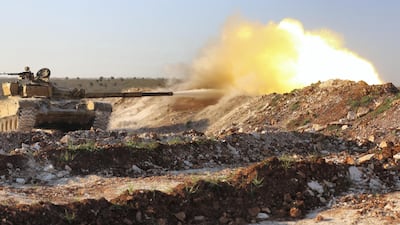
A tank seized by rebel fighters fires at a pro-government position near the Syrian city of Hama on February 19, 2014. AFP -
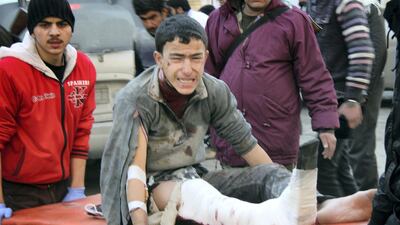
An injured Syrian youth cries as he is carried on a gurney following an air strike in the Maadi neighbourhood of Aleppo city on December 17, 2013. AFP -
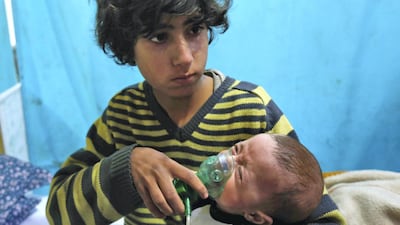
A Syrian boy holds an oxygen mask to an infant's face following a reported gas attack in Douma on January 22, 2018, when the town near Damascus was held by rebels. AFP -
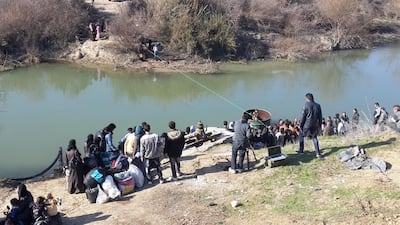
Displaced Syrians wait to enter Turkey from Idlib province across the Orontes river on February 5, 2014. AFP


That support diminished after the Russian intervention in late 2015, which all but assured the perpetuation of the regime.
Hafez, 18, Mr Al Assad’s son named after his grandfather, is making public appearances that signal he is being groomed for eventual succession.
Almost from day one, Mr Al Assad’s survival strategy depended on finishing off the civic core of revolt through violence.
In May 2011, he also released from Saidnaya prison 1,500 mostly Sunni militants, many of whom became after their release commanders in the Syrian subsidiary of Al Qaeda and other groups, as well as ISIS.
The regime supported the militants to undermine the US-imposed order in Iraq after the fall of Saddam Hussein in 2003, before cracking down on the same militias under pressure from Washington.
But paramount to the Women of Marjeh Square, as the organisers of the March 16 protest came to be known, was peaceful disobedience.
Their call to maintain non-violence was not heeded in the months that ensued.
Security forces shot outright, or imprisoned then killed, thousands of protesters, sparking a violent Sunni backlash that cost the lives of many Alawites enrolled in Mr Al Assad’s army and loyalist militia.
Razan Zaitouna, a prominent lawyer who defended some of the 36 protesters arrested on that day in Marjeh Square, was later forced into hiding to escape imprisonment.

In October, as popular Sunni momentum to take up arms against Mr Al Assad picked up, Ms Zaitouna said as she hid in the Damascus suburb of Douma: “Maintaining a peaceful uprising is the best guarantee for its victory.
“It is normal that after seven months of bloody repression, lack of unity among the opposition and lack of international action that we see the surfacing of a militarisation of the revolution.
“Our role as activists is to work on stopping these leanings.”
In December 2013, Ms Zaitouna, her husband Wael Hamadeh and two other dissidents, known as the Douma Four, disappeared.
Jaish Al Islam, a rebel formation then led by the late Zahran Alloush, one of the top militants released from Saidnaya, is widely suspected of having kidnapped them.
While Mr Al Assad is relatively safe in his seat of power in Damascus, and still possesses many tools of repression, Syria’s war is dragging on and its economic collapse has intensified with the financial meltdown in Lebanon.
Poor living conditions are hitting the president’s Alawite base, and the government is insisting that that no coronavirus cases exist in the country, for apparent fear of undermining the image of Iran.
US sanctions are intensifying and western countries have resisted Russian pressure to pay for reconstruction without any serious political change in the country.
Syria’s oil, the main source of government cash before 2011, had mostly fallen to US-backed Kurdish militia.
Despite having Turkey as a common enemy, Mr Al Assad and the militia have failed to reach a permanent agreement.
But the regime has recalibrated its business base to integrate many of the war economy figures under a revamped patronage system whose members owe loyalty to Mr Al Assad or his close relatives.
Regardless of the costs of the war to his opponents or to his loyalists, the well-being of the inner circle has been the driver of 50 years of the blood-forged rule of the Assad dynasty.

