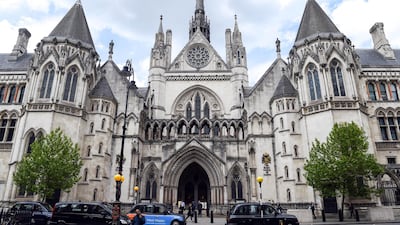
The Royal Courts of Justice in London, where a case for damages was lodged by Syrian refugees. i-Images.

Qatar's Doha Bank asks British court to dismiss intimidation and bribery claims in terror financing case


Nicky Harley
  • English
  • Arabic

Qatar's Doha Bank asked Britain's High Court to dismiss some of the allegations against the state, including intimidation and attempted bribing of witnesses, in a terrorism financing case.

Four Syrian refugees have lodged a case for damages at the London court against Doha Bank and two wealthy brothers, Moutaz and Ramez Al Khayyat.

The brothers were described as two "prominent Syrian/Qatari businessmen" who allegedly used accounts at Doha Bank to channel funds to the Al Nusra Front, an Al Qaeda affiliate.

The Syrians said they suffered “severe physical and psychiatric injuries” at the hands of the terrorist group.

The claimants said Qatar threatened, tried to bribe and intimidated them in an effort to get them to drop their cases.

A hearing to decide whether the trial should be held in the UK, where some of the refugees now live, or in Qatar is set for October.

On Monday, Doha Bank’s legal team asked for the allegation of perverting the course of justice to be limited to a “snapshot” of alleged events which happened between October and November last year and unsuccessfully applied for the hearing to be held in private.

The bank is challenging the claimants' request for permission to cross-examine the Al Khayyat brothers at the October hearing.

“What’s happened since is in short an abuse of process,” said Hannah Brown QC, for Doha Bank.

She said there was no evidence of intimidation of witnesses or of Qatar acting unlawfully on British soil.

Last November, the claimants contacted the UK's SO15 counter-terrorism unit to make claims of threats, bribery and intimidation by the state of Qatar.

The court previously heard that people connected with the case were bugged in their cars, threatened in their homes and offered bribes to reveal the names of the claimants, who were granted anonymity by the court.

Eight refugees brought the case but last year four withdrew, claiming they were in "fear of their lives".

Ben Emmerson QC, for the claimants, told the court on Monday the case involved senior Qatari officials.

“These are allegations of high-ranking officials in Qatar involved in a terrorism financing conspiracy using the first and second defendants [the Al Khayyat brothers] who used a variety of overpricing of contracts to siphon off funds through Doha Bank,” he said.

Qatar's Doha Bank asked a British court to strike out accusations of intimidation. The National

“They have denied any involvement in terrorism financing. The claimants will not receive justice in Qatar. If we can prove that the state of Qatar is sending emissaries, it will give you a strong indication that no justice will be received in Qatar.

"If Qatar is attempting to derail proceedings in England, how can a judge possibly conclude they will get justice in Qatar?

“Truthful allegations are being made and they are trying to hide them from public view to avoid public scrutiny.”

Mr Justice Chamberlain said he would consider their arguments and deliver his decision at a later date.

“It goes to the safety of Qatar for a trial of this kind to go ahead,” he said.

“There are two topics. Was Qatar funding terrorism … and have there been recent attempts by individuals associated with Qatar to intimidate witnesses or evidence that amounts to perverting the course of justice in relation to this case? The judge wanted the claimants to be able to put it in evidence and that is why she adjourned it last time.”

A spokesman for the Al Khayyat brothers told The National they deny the "bizarre and baseless allegations".

“Any suggestion that they have any involvement with these appalling allegations is wholly false. These baseless and increasingly outlandish claims do not stand up to even the slightest scrutiny," he said.

“They have no knowledge of what has apparently been alleged at these hearings. They have seen no credible evidence whatsoever in support of these claims. They were not represented at the hearing and have not been validly served with any court proceedings.

“Questions must now be asked as to who the claimants’ anonymous backers actually are. For such a campaign to seek to exploit the genuine suffering of Syrian refugees for financial or political gain is deplorable.

"They [the Al Khayyat brothers] remain unshakeable in their commitment to humanitarian causes across the Middle East and to playing their part in delivering social and economic development for all.”


Classification of skills

A worker is categorised as skilled by the MOHRE based on nine levels given in the International Standard Classification of Occupations (ISCO) issued by the International Labour Organisation. 

A skilled worker would be someone at a professional level (levels 1 – 5) which includes managers, professionals, technicians and associate professionals, clerical support workers, and service and sales workers.

The worker must also have an attested educational certificate higher than secondary or an equivalent certification, and earn a monthly salary of at least Dh4,000. 

Uefa Nations League: How it works

The Uefa Nations League, introduced last year, has reached its final stage, to be played over five days in northern Portugal. The format of its closing tournament is compact, spread over two semi-finals, with the first, Portugal versus Switzerland in Porto on Wednesday evening, and the second, England against the Netherlands, in Guimaraes, on Thursday.

The winners of each semi will then meet at Porto’s Dragao stadium on Sunday, with the losing semi-finalists contesting a third-place play-off in Guimaraes earlier that day.

Qualifying for the final stage was via League A of the inaugural Nations League, in which the top 12 European countries according to Uefa's co-efficient seeding system were divided into four groups, the teams playing each other twice between September and November. Portugal, who finished above Italy and Poland, successfully bid to host the finals.

Biog

Age: 50

Known as the UAE’s strongest man

Favourite dish: “Everything and sea food”

Hobbies: Drawing, basketball and poetry

Favourite car: Any classic car

Favourite superhero: The Hulk original

The specs
Engine: 77.4kW all-wheel-drive dual motor
Power: 320bhp
Torque: 605Nm
Transmission: Single-speed automatic
Price: From Dh219,000
On sale: Now
'The Batman'

Stars:Robert Pattinson

Director:Matt Reeves

Rating: 5/5

Mercer, the investment consulting arm of US services company Marsh & McLennan, expects its wealth division to at least double its assets under management (AUM) in the Middle East as wealth in the region continues to grow despite economic headwinds, a company official said.

Mercer Wealth, which globally has $160 billion in AUM, plans to boost its AUM in the region to $2-$3bn in the next 2-3 years from the present $1bn, said Yasir AbuShaban, a Dubai-based principal with Mercer Wealth.

Within the next two to three years, we are looking at reaching $2 to $3 billion as a conservative estimate and we do see an opportunity to do so,” said Mr AbuShaban.

Mercer does not directly make investments, but allocates clients’ money they have discretion to, to professional asset managers. They also provide advice to clients.

“We have buying power. We can negotiate on their (client’s) behalf with asset managers to provide them lower fees than they otherwise would have to get on their own,” he added.

Mercer Wealth’s clients include sovereign wealth funds, family offices, and insurance companies among others.

From its office in Dubai, Mercer also looks after Africa, India and Turkey, where they also see opportunity for growth.

Wealth creation in Middle East and Africa (MEA) grew 8.5 per cent to $8.1 trillion last year from $7.5tn in 2015, higher than last year’s global average of 6 per cent and the second-highest growth in a region after Asia-Pacific which grew 9.9 per cent, according to consultancy Boston Consulting Group (BCG). In the region, where wealth grew just 1.9 per cent in 2015 compared with 2014, a pickup in oil prices has helped in wealth generation.

BCG is forecasting MEA wealth will rise to $12tn by 2021, growing at an annual average of 8 per cent.

Drivers of wealth generation in the region will be split evenly between new wealth creation and growth of performance of existing assets, according to BCG.

Another general trend in the region is clients’ looking for a comprehensive approach to investing, according to Mr AbuShaban.

“Institutional investors or some of the families are seeing a slowdown in the available capital they have to invest and in that sense they are looking at optimizing the way they manage their portfolios and making sure they are not investing haphazardly and different parts of their investment are working together,” said Mr AbuShaban.

Some clients also have a higher appetite for risk, given the low interest-rate environment that does not provide enough yield for some institutional investors. These clients are keen to invest in illiquid assets, such as private equity and infrastructure.

“What we have seen is a desire for higher returns in what has been a low-return environment specifically in various fixed income or bonds,” he said.

“In this environment, we have seen a de facto increase in the risk that clients are taking in things like illiquid investments, private equity investments, infrastructure and private debt, those kind of investments were higher illiquidity results in incrementally higher returns.”

The Abu Dhabi Investment Authority, one of the largest sovereign wealth funds, said in its 2016 report that has gradually increased its exposure in direct private equity and private credit transactions, mainly in Asian markets and especially in China and India. The authority’s private equity department focused on structured equities owing to “their defensive characteristics.”

Dubai Bling season three

Cast: Loujain Adada, Zeina Khoury, Farhana Bodi, Ebraheem Al Samadi, Mona Kattan, and couples Safa & Fahad Siddiqui and DJ Bliss & Danya Mohammed 

Rating: 1/5

Company profile

Name: Tratok Portal

Founded: 2017

Based: UAE

Sector: Travel & tourism

Size: 36 employees

Funding: Privately funded

How it works

1) The liquid nanoclay is a mixture of water and clay that aims to convert desert land to fertile ground

2) Instead of water draining straight through the sand, it apparently helps the soil retain water

3) One application is said to last five years

4) The cost of treatment per hectare (2.4 acres) of desert varies from $7,000 to $10,000 per hectare