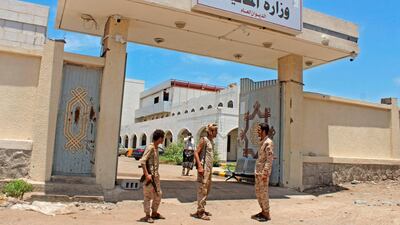
The Southern Transitional Council said late on Sunday it was taking control of the regional capital Aden, breaking a power-sharing deal with the internationally recognised government of Yemen.
The grouping that seeks autonomy for Yemen’s South, along pre-1990 lines, ordered a state of emergency to be imposed all over the provinces in South Yemen.
In its statement, it declared self-determination for South Yemen, and assigned the council’s economic, legal, military and security committees to manage the south.
The statement issued by the presidency of the STC followed an urgent meeting for the council’s presidency along with military and security commanders in Aden.
The new development comes months after a power-sharing deal was signed by the Yemen government and the STC after a two months-long dialogue sponsored by Saudi Arabia. The agreement was signed by the two parties to end a dispute between them and unified the efforts to resume the battle against the Houthis.
That deal has now been broken. There are now fears that this move could hamper the month-long ceasefire ordered by the Arab Coalition, and potentially allow terrorist organisations like ISIS and Al Qaeda to exploit the situation.
The move was quickly denounced by the Yemeni government. Yemen’s Minister of Foreign Affairs wrote on Twitter that the move made by the STC in declaring self-rule for the south is a continuation of the rebellion led by the STC in August 2018, and is considered a full withdrawal from the Riyadh Agreement.
“The STC only will be held responsible for the serious consequences for its declaration,” Mr Mohmmed Al Hadrami said.
The statement was preceded by public protests, as flocks of protesters in Aden and Hadramawt took to the streets on Saturday night, protesting power and water shortages and sharp hikes in the prices of the food stuffs as well as the absence of the other basic needs.
"We won't allow the government in exile to be back again to Aden. We have no power and no water in Aden since the severe flooding struck the city," Nafea bin Kuleib, a protester in Aden, told The National.
“Thousands of families lost their houses in the recent floods, they have been homeless, they need shelters and food,” Mr bin Kuleib said.
On the ground in Aden, troops from the army and the security forces were stationed all over the province. Troops from the Security Belt forces and other troops from the Al Asefa Brigade (The Storm Brigade) loyal with the STC were seen deploying hundreds of its personnel in the streets of Aden and near some state institutions in the city. The announcement risks renewed clashes between the two sides.
The governors of the provinces of Shabwa and Socotra condemned the STC’s declaration.
"The statement of the STC is a coup against the legitimate government and a sabotage of the Riyadh Agreement of November 2019," said the local authority of Socotra archipelago, the state owned Saba news agency reported on Sunday.
However, high ranking military commanders in the Yemeni army loyal to president Hadi said they supported the STC move and considered it an “expected" step.
"This was expected for a long time, I think the statement which was declared by the STC in the early morning is very crucial to rescue the starving people in Aden and the other liberated provinces in South Yemen," a high ranking commander in the Yemeni army in Aden told The National.

