The aftershocks of last week’s Beirut blast have hit the country’s fragile political balance. Prime Minister Hassan Diab, faced with a drip-feed of resignation letters from his cabinet, announced his departure on Monday night.
The move collapses government and raises the very real question of what comes next for a country beset by economic, financial and refugee crises and reeling from an explosion that has left untold damage.
President Michel Aoun has asked Mr Diab to remain as caretaker prime minister. His ministers – even those who resigned before him – will also be caretakers.
Cabinet will rarely meet now, and they will do so only to pass urgent bills to keep the state functioning but will not look to pass new policy.
-

Lebanese anti-government protesters clash with security forces in the area close to the parliament in Beirut. EPA -

Demonstrators march past a damaged building holding candles and flashlights honouring the victims. AP -
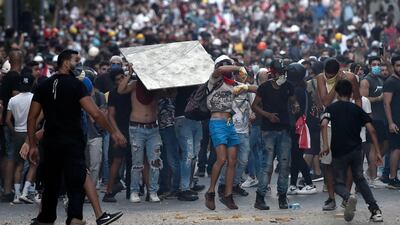
Lebanese anti-government protesters clash with security forces in the area close to the parliament in Beirut. EPA -
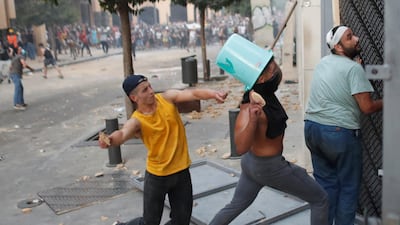
Demonstrators throw stones during a protest following Tuesday's blast in Beirut's port area, in Beirut. Reuters -
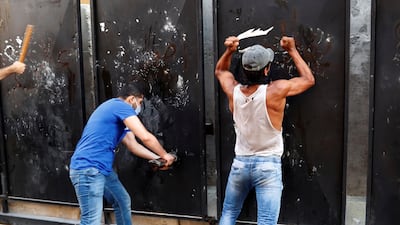
Demonstrators try to break a fence during a protest following Tuesday's blast in Beirut's port area. Reuters -
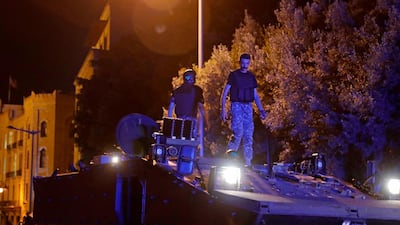
Lebanese anti-riot police stand guard atop an armoured vehicle during anti-government protests in central Beirut. AFP -
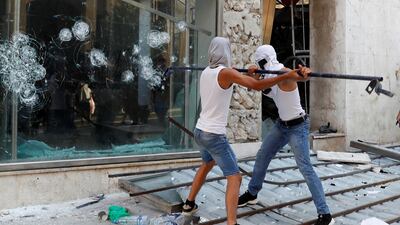
Demonstrators try to break a glass with a metal bar during a protest following Tuesday's blast in Beirut's port area. Reuters -
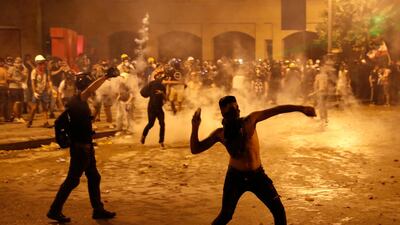
A protester throws stones against the Lebanese riot police. AP -
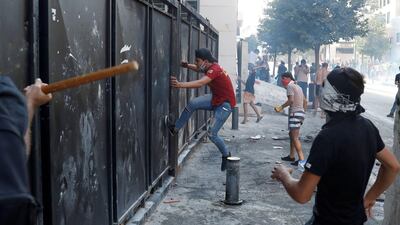
Demonstrators try to break a fence during a protest following Tuesday's blast in Beirut's port area. Reuters -
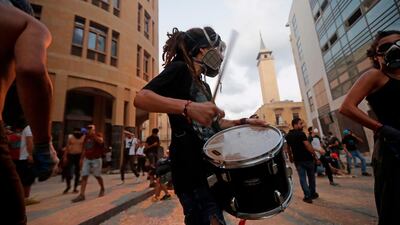
A Lebanese protester beats a drum amid clashes with security forces near an access street to the parliament in central Beirut. AFP -
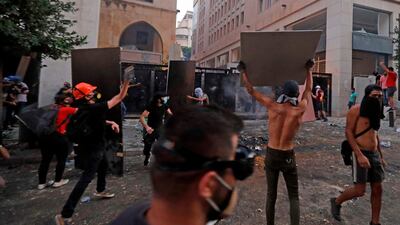
Lebanese protesters, enraged by a deadly explosion blamed on government negligence, clash with police. AFP -
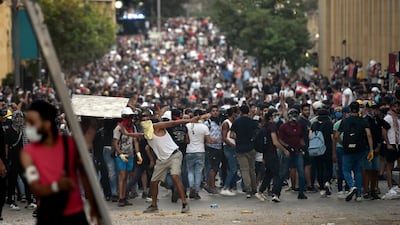
Lebanese anti-government protesters clash with security forces in the area close to the parliament in Beirut. EPA -
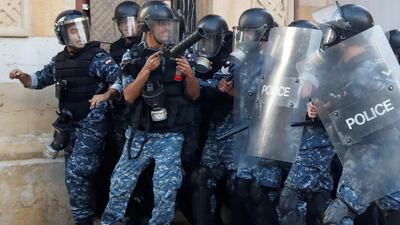
Policemen withdraw as demonstrators throw stones during a protest following Tuesday's blast in Beirut's port area, in Beirut. Reuters -
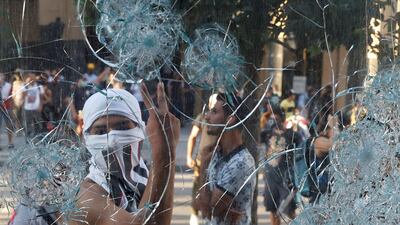
A demonstrator gestures during a protest following Tuesday's blast in Beirut's port area, in Beirut. Reuters


They will be unlikely to try to pass more reforms needed to tap into international aid.
In the background, President Aoun will begin consultations with parties, former presidents and prime ministers and others on who should replace Mr Diab as prime minister.
One political source told The National that the three most likely names at this stage are former Prime Minister Saad Hariri; diplomat Nawaf Salam, who is considered close to the United States and former central bank vice-governor Mohammad Baasiri, also a close US ally.
Whoever has the most votes from the consultations is then tasked with forming a government. They will meet political factions and start trying to form a line-up and policy statement that can get a vote of confidence from parliament.
However, as the source pointed out that will take a minimum of 3 months and can often take over a year.
There are calls for early elections but these are – at least constitutionally – not needed for now. But, depending on political will, that could be the aim of a neutral technocratic government brought in to handle the current crisis and pave the way for an election.
This will then raise the perennial question in Lebanon of what electoral law to use. Although politicians expressed dissatisfaction with the hugely complex 2018 law as soon as the votes were cast, that bill took years of difficult negotiations to agree and it will be hard to replace in a hurry.
In the meantime, anger on the streets will probably grow, especially if politicians who are already accused of being detached and ineffectual, spend much of the rest of 2020 arguing over who is in charge.
It is unclear what will happen to the reconstruction of Beirut, the international aid pledged on Sunday or the investigation into those responsible.

