
The United States has created a special envoy for Africa's Sahel region, a State Department spokesman said on Friday, to counter rising violence from groups linked to Al Qaeda and ISIS which are expanding their foothold.
Envoy Peter Pham started his new role earlier this week, the spokesman said. He has been serving as US Special Envoy for the Great Lakes Region of Africa since November 2018.
"Sahel is one of the places where the situation is getting worse in the continent," the spokesman said.
Security has progressively worsened in the Sahel, an arid region of West Africa, just below the Sahara desert, with militants linked to Al Qaeda and ISIS strengthening their foothold across the region, making large swathes of territory ungovernable and stoking ethnic violence.
Former colonial power France intervened in 2013 to drive back militants who had seized northern Mali the previous year. Fighters have since regrouped and spread. Over the past year, militants have stepped up attacks in Mali, Burkina Faso and Niger.
Particularly worrying for Europeans has been possible US troop cuts. The Pentagon is considering withdrawing the personnel as part of a global troop review meant to free up more resources to address challenges from China's military, after nearly two decades of prioritizing counter-terrorism operations around the world.
Such a potential move has alarmed France, which relies on US intelligence and logistics for its 4,500-strong mission in the Sahel. The deaths of 13 French soldiers in a helicopter crash during a combat mission in Mali in November increased France’s determination to secure more support in the zone.
-
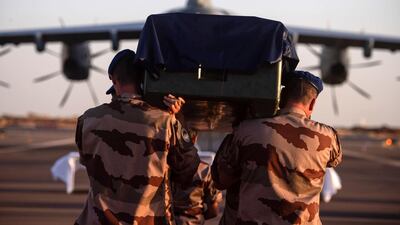
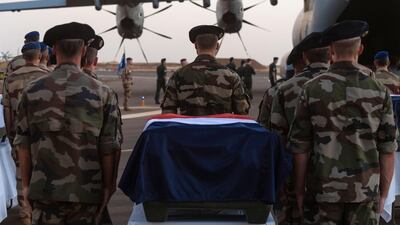
French soldiers of the Barkhane force carrying the coffin of a soldier who died when two French military helicopters collided in Mali. AFP -
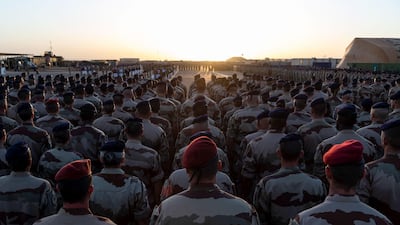
Troops at the French Army base in Gao, Mali, remember the 13 killed in the collision. AFP -
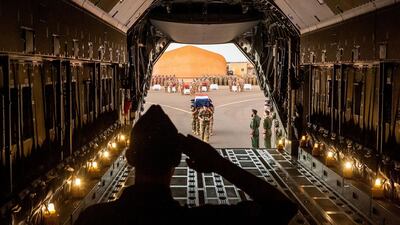
The crash occurred late on November 25, 2020, during an operation in the Liptako region, near the borders with Burkina Faso and Niger. AFP -

It was the heaviest single loss for the French military in nearly four decades. AFP -
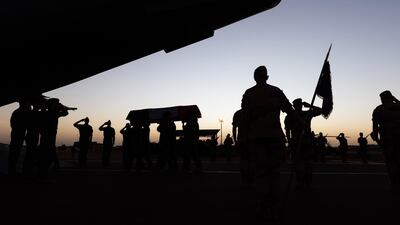
President Emmanuel Macron is considering reducing the number of French troops in the Sahel region. AFP -
President Macron is this week joining a Sahel G5 summit by video link. AFP


The US currently has around 6,000 military personnel in Africa. Although some experts say a repositioning of forces is overdue, many US officials share French concerns about relieving pressure on militants in Africa.
State Department's latest counter terrorism report, which was published in November 2019, said attacks by militant groups in the region have been on the rise.
"In the Sahel, terrorist groups – including affiliates and adherents of Al Qaeda and ISIS as well as non-aligned groups – have expanded their operations in north and central Mali and the Tri-Border Region of Burkina Faso, Mali, and Niger," the report said.
US Secretary of State Mike Pompeo in November warned that there was growing concern over ISIS in West Africa and called on the global coalition against ISIS to focus on the Sahel.
Officials have also warned that evidence suggests ISIS and Al Qaeda have been coordinating in the region to carve up spheres of influence.

