


Britain and the US have warned that aid to Houthi-controlled Yemen could be axed within weeks amid fears from the UN and aid agencies that the Iran-aligned group seeks to exploit humanitarian supplies and funds.
The UN Security Council heard this week that Houthi militants had sought to levy a tax on aid workers, compel them to sign false documents and impede humanitarian work in Yemen’s north and the rebel-held capital, Sanaa.
The Houthis have blocked half of the UN aid delivery programmes to try to take control over a huge aid operation and earn a slice of billions of dollars in foreign assistance, AP reported on Wednesday.
They have made access to areas under their control contingent on conditions that aid agencies reject, partly because it would give the rebels greater sway over who receives aid.
“Houthi restrictions have grown significantly over recent weeks with intimidation of UN and NGO humanitarian workers becoming more severe,” Karen Pierce, Britain’s ambassador to the UN, told the council on Tuesday.
“Unless these obstructions are lifted and intimidation ceases, there is a real risk that UN agencies and NGOs will not be able to deliver life-saving aid over the coming months.”
US ambassador Kelly Craft said Houthi militiamen had prevented deliveries of life-saving supplies to millions of Yemenis and US taxpayers should not pay for aid that does not reach the needy.
“We may be forced to consider suspending or reducing our assistance in northern Yemen as early as March unless undue Houthi interference ceases immediately and access to vulnerable populations improves,” Ms Craft said.
Along with Saudi Arabia and the UAE, Britain and the US are among the biggest donors to Yemen.
Last year, Washington and London donated a combined $1.2 billion (Dh4.41bn) to operations in the Arab world's poorest nation.
Tension has increased between the Houthis and the aid agencies and major donors this year.
They came to a head at talks in Brussels this month at which delegates said humanitarian work in Yemen had reached a “breaking point”.
Mark Lowcock, the UN’s head of humanitarian affairs, said aid teams face setbacks across the country.
But while about 30 per cent of projects are stopped in the south, aid workers say 40 per cent of schemes stalled in Houthi-run north.
“Last year, the Houthis issued more than 200 regulations on humanitarian action," Mr Lowcock told envoys in New York.
"By the end of the year, the number of reported incidents disrupting assistance had risen by a factor of six.
“About half of these incidents constrained movements of relief supplies or staff, and about a quarter involved attempts to influence decisions on who receives help or otherwise interfere with programmes.”
-
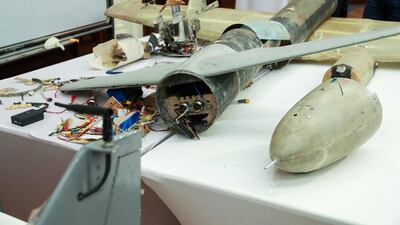
An Iranian-built Qasef-1 drone used by Houthi rebels in Yemen. -

A shot down drone on display. All photos by Victor Besa / The National -
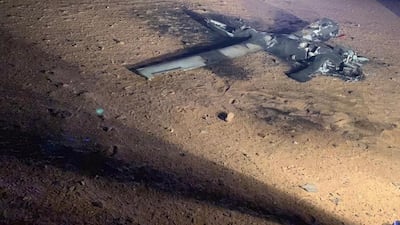
The remains of a Houthi drone intercepted by the Saudi Arabian Air Force. @SPAregions -
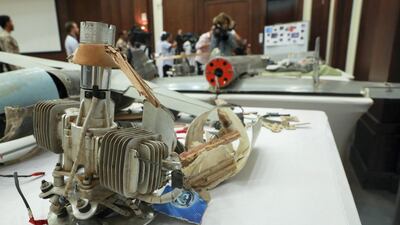
The engine of a Qasef-1 drone shot down by Arab Coalition forces in Yemen. -

A drone used by Houthi rebels to launch attacks on Saudi Arabia. AP -
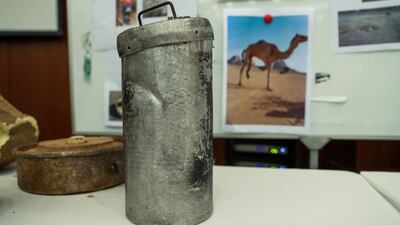
An IED built with Iranian components and camouflaged as a cooking pot recovered by Arab Coalition forces in Yemen. -
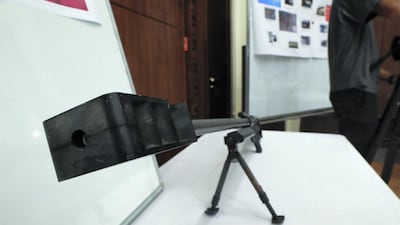
An Iranian-supplied STEYR .50 Calibre sniper riffle being used by the Houthi rebels in Yemen. -
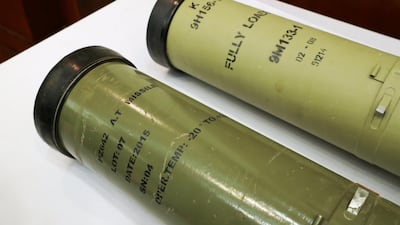
Two anti-tank guided missiles (ATGM). The one on the right is a Russian-made Kornet, and on the left is an Iranian imitation. Markings show they were built in 2015 indicating they were smuggled to Yemen after the UN arms embargo. -
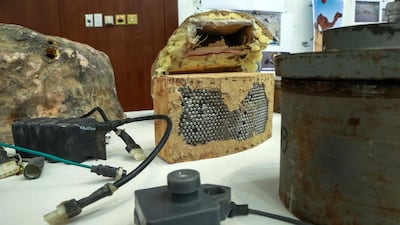
IEDs camouflaged inside a fake rock. Arab Coalition officials estimate they have defused up to 30,000 such devices since the war began. -
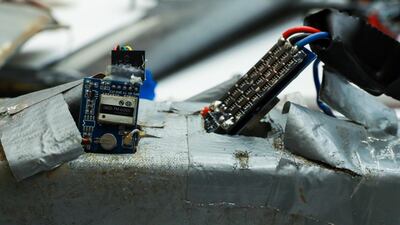
Farsi language was found enscribed on the wiring of this drone battery from a Qasef-1 UAV indicating its Iranian origins. -

Limpet mines. -
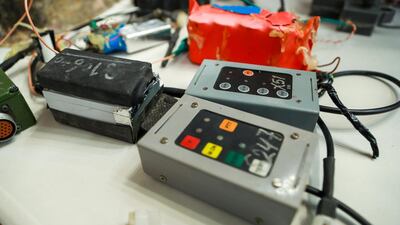
Electronics of an IED. -
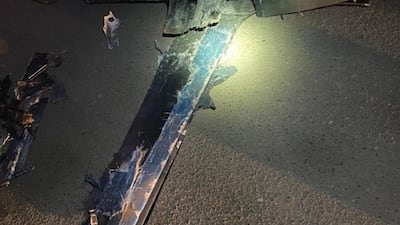
Remains of Houthi drone which the coalition shot down. @SPAregions -
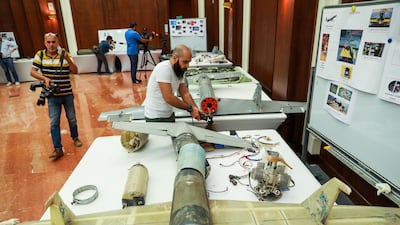
Weapons supplied by Iran to the Houthi militias in Yemen were put on display at a press conference by the Saudi-led Arab coalition. Victor Besa / The National


Mr Lowcock and Ms Craft condemned a 2 per cent tax Houthi officials sought to levy on aid work – a demand the rebels withdrew this month when faced with opposition from aid workers.
But problems with access to Houthi-held areas and other issues persist.
The UN has been tightening monitoring of about $370 million a year that it provides to Houthi-run ministries, AP reported.
That money is supposed to pay salaries and other costs, but more than a third of last year’s funding was not audited, a leaked document showed.
The Houthis have hindered programmes that feed the near-starving population and help those displaced by a nearly six-year civil war, a senior UN official said.
“Over two million beneficiaries are directly affected,” the official said.
The UN said there has been resurgent fighting in parts of Yemen including Marib, Jawf and Sanaa governorates, and the Houthi-held port at Hodeidah, which handles two thirds of Yemen’s imports.
The Iran-aligned Houthi rebel movement removed President Abdrabu Mansur Hadi’s government from Sanaa towards the end of 2014.
This prompted military intervention in 2015 by a coalition led by Saudi Arabia and the UAE, which sought to restore Mr Hadi’s internationally recognised government.
Fighting has left 24.1 million people, or 80 per cent of the population, reliant on aid.

