• A view of damages to the Al-Shahba Mall building on the Aleppo Gaziantep highway in the northern countryside of Aleppo, Syria. EPA
    A view of damages to the Al-Shahba Mall building on the Aleppo Gaziantep highway in the northern countryside of Aleppo, Syria. EPA
  • Syrian army soldiers advance on a road in the northern Aleppo countryside. AFP
    Syrian army soldiers advance on a road in the northern Aleppo countryside. AFP
  • Displaced Syrians are pictured in the Washukanni Camp for the internally displaced people near the predominantly Kurdish city of Hasakeh in northeastern Syria. AFP
    Displaced Syrians are pictured in the Washukanni Camp for the internally displaced people near the predominantly Kurdish city of Hasakeh in northeastern Syria. AFP
  • Syrian army units advance to the Aleppo Ghazi Aintab International Highway and the northern countryside of Aleppo, Syria. EPA
    Syrian army units advance to the Aleppo Ghazi Aintab International Highway and the northern countryside of Aleppo, Syria. EPA
  • Syrian army units advance to the Aleppo Ghazi Aintab International Highway and the northern countryside of Aleppo, Syria. EPA
    Syrian army units advance to the Aleppo Ghazi Aintab International Highway and the northern countryside of Aleppo, Syria. EPA
  • Syrian army units advance to the Aleppo Ghazi Aintab International Highway and the northern countryside of Aleppo, Syria. EPA
    Syrian army units advance to the Aleppo Ghazi Aintab International Highway and the northern countryside of Aleppo, Syria. EPA
  • People walk as Syrian army units advance to the Aleppo Ghazi Aintab International Highway and the northern countryside of Aleppo, Syria. EPA
    People walk as Syrian army units advance to the Aleppo Ghazi Aintab International Highway and the northern countryside of Aleppo, Syria. EPA
  • An elderly displaced Syrian woman carries a child in the Washukanni Camp for the internally displaced people near the predominantly Kurdish city of Hasakeh in northeastern Syria. AFP
    An elderly displaced Syrian woman carries a child in the Washukanni Camp for the internally displaced people near the predominantly Kurdish city of Hasakeh in northeastern Syria. AFP
  • A displaced Syrian woman is pictured in the Washukanni Camp for the internally displaced people near the predominantly Kurdish city of Hasakeh in northeastern Syria. AFP
    A displaced Syrian woman is pictured in the Washukanni Camp for the internally displaced people near the predominantly Kurdish city of Hasakeh in northeastern Syria. AFP
  • A picture taken during a guided tour organised by the Syrian army shows regime forces in the area of al-Lirmoun, north of Aleppo. AFP
    A picture taken during a guided tour organised by the Syrian army shows regime forces in the area of al-Lirmoun, north of Aleppo. AFP
  • Syrian army soldiers walk in the town of Kafr Hamra in the northern Aleppo countryside. AFP
    Syrian army soldiers walk in the town of Kafr Hamra in the northern Aleppo countryside. AFP
  • A handout picture released by the official Syrian Arab News Agency (SANA) shows Syrian government forces uncovering a mass grave containing bodies of people reportedly believed to have died between 2012 and 2014, in al-Ubb in the eastern Ghouta region about 20 kilometres east of the capital Damascus, which was formerly held by rebel forces until early 2018. The Syrian army has discovered a mass grave containing around 70 bodies in a former rebel bastion near Damascus, the state news agency reported on February 17. SANA said the victims found in the Eastern Ghouta region were "civilians and security personnel who were executed by terrorist groups". The densely-populated semi-urban area just east of Damascus was controled by rebel and jihadist factions for around six years until government forces retook it in 2018, following a long and bloody siege. The area of the mass grave, near Eastern Ghouta's main town of Douma, was controlled by rebel group Jaish al-Islam. AFP
    A handout picture released by the official Syrian Arab News Agency (SANA) shows Syrian government forces uncovering a mass grave containing bodies of people reportedly believed to have died between 2012 and 2014, in al-Ubb in the eastern Ghouta region about 20 kilometres east of the capital Damascus, which was formerly held by rebel forces until early 2018. The Syrian army has discovered a mass grave containing around 70 bodies in a former rebel bastion near Damascus, the state news agency reported on February 17. SANA said the victims found in the Eastern Ghouta region were "civilians and security personnel who were executed by terrorist groups". The densely-populated semi-urban area just east of Damascus was controled by rebel and jihadist factions for around six years until government forces retook it in 2018, following a long and bloody siege. The area of the mass grave, near Eastern Ghouta's main town of Douma, was controlled by rebel group Jaish al-Islam. AFP

Syria White Helmets leader: 'it is a genocide, not a war'


  • English
  • Arabic

The leader of Syria’s White Helmets search and rescue organisation on Tuesday said the conflict that has devastated the country for nearly nine years was not “a war”, but “a genocide” against civilians.

The organisation, also known as Syrian Civil Defence volunteer rescue group, comprises volunteers who operate in opposition-controlled Syria and in Turkey.

They help with medical and civilian evacuation, essential service delivery and search and rescue operations.

Syrian troops are continuing an assault on Idlib, the country's last major rebel stronghold, which has stoked fears of a humanitarian catastrophe as thousands of civilians flee their homes.

The UN estimates that the offensive in the north-western region has displaced about 900,000 people since the start of December.

Idlib and parts of its neighbouring Aleppo province are home to three million people. Half of them were already displaced from other parts of the country.

The regime "continue their crimes against civilians in Syria and the consciences of the world today are asleep", White Helmets leader Raed Al Saleh tweeted on Tuesday night.

“It seems that we need an electric shock to the consciences of the international community and the United Nations in order to wake up and carry out their mission in accordance with international laws to protect civilians in Syria."

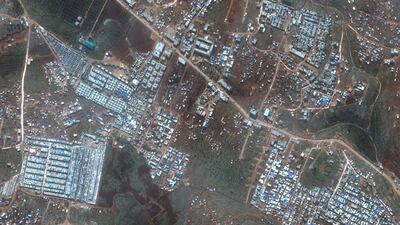
  • This satellite image provided by Maxar Technologies shows refugee camps for internally displaced people near Deir Hassan in northern Syria's Idlib province near the Turkish border on Feb. 16, 2020. AP
    This satellite image provided by Maxar Technologies shows refugee camps for internally displaced people near Deir Hassan in northern Syria's Idlib province near the Turkish border on Feb. 16, 2020. AP
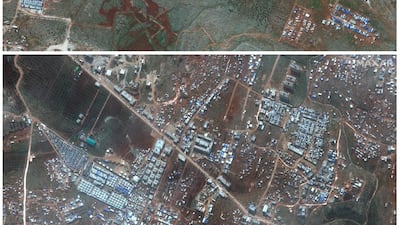
  • This combination of satellite images provided by Maxar Technologies shows an area near Deir Hassan in northern Syria's Idlib province near the Turkish border on Feb. 5, 2019, top, and the same area with a large number of refugee tents for internally displaced people on Feb. 16, 2020, bottom. The difference between the two images illustrates the rapid expansion of refugees as hundreds of thousands of civilians in the area are scrambling to escape a widening, multi-front offensive by Syrian President Bashar Assad's forces. AP
    This combination of satellite images provided by Maxar Technologies shows an area near Deir Hassan in northern Syria's Idlib province near the Turkish border on Feb. 5, 2019, top, and the same area with a large number of refugee tents for internally displaced people on Feb. 16, 2020, bottom. The difference between the two images illustrates the rapid expansion of refugees as hundreds of thousands of civilians in the area are scrambling to escape a widening, multi-front offensive by Syrian President Bashar Assad's forces. AP
  • This combination of satellite images provided by Maxar Technologies shows an area near Kafaldin in northern Syria's Idlib province near the Turkish border on Feb. 5, 2019, top, and the same area with a large number of refugee tents for internally displaced people on Feb. 16, 2020, bottom. AP
    This combination of satellite images provided by Maxar Technologies shows an area near Kafaldin in northern Syria's Idlib province near the Turkish border on Feb. 5, 2019, top, and the same area with a large number of refugee tents for internally displaced people on Feb. 16, 2020, bottom. AP
  • This satellite image provided by Maxar Technologies shows refugee camps for internally displaced people near Kafaldin in northern Syria's Idlib province near the Turkish border on Feb. 16, 2020. AP
    This satellite image provided by Maxar Technologies shows refugee camps for internally displaced people near Kafaldin in northern Syria's Idlib province near the Turkish border on Feb. 16, 2020. AP
  • An aerial view shows refugee tent camps near Tal Adeh, Syria, February 16, 2020. REUTERS
    An aerial view shows refugee tent camps near Tal Adeh, Syria, February 16, 2020. REUTERS
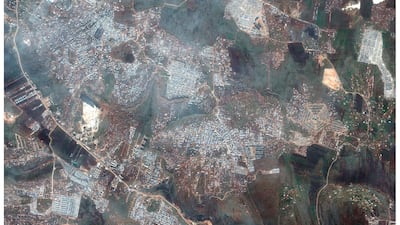
  • This Feb. 5, 2019, satellite image provided by Maxar Technologies shows an area near Deir Hassan in northern Syria's Idlib region near the Turkish border. AP
    This Feb. 5, 2019, satellite image provided by Maxar Technologies shows an area near Deir Hassan in northern Syria's Idlib region near the Turkish border. AP

Mr Al Saleh said the international community’s aid and donations had done little to benefit the Syrian people, who are “threatened by the largest massacre in history”.

“All the world's money will not stop killing one child with barrel bombs,” he said.

Mr Al Saleh called the international community to move to pressure politicians to take “a moral stance by protecting our people in Syria” before it is too late.

“What is happening in Syria is not war, as the media portray it. It is a genocide against the Syrian people,” he said.

Earlier on Tuesday, Michelle Bachelet, the UN High Commissioner for Human Rights, called for the creation of humanitarian corridors in north-western Syria.