• Employees of a Lebanese public health company pose with their protective gear on in Beirut as Lebanon calls in the army and security forces to ensure people stay at home to slow the spread of coronavirus. AFP
    Employees of a Lebanese public health company pose with their protective gear on in Beirut as Lebanon calls in the army and security forces to ensure people stay at home to slow the spread of coronavirus. AFP
  • Artist Aziz al-Asmar paints a mural wishing for the well-being of German Chancellor Angela Merkel, who is in quarantine after being treated by a doctor who tested positive for coronavirus, inside a damaged building in the town of Binnish in Syria's northwestern Idlib province. AFP
    Artist Aziz al-Asmar paints a mural wishing for the well-being of German Chancellor Angela Merkel, who is in quarantine after being treated by a doctor who tested positive for coronavirus, inside a damaged building in the town of Binnish in Syria's northwestern Idlib province. AFP
  • People wearing face masks walk in Damascus, Syria. EPA
    People wearing face masks walk in Damascus, Syria. EPA
  • A policeman mans a checkpoint near the Tigris River in Baghdad, Iraq. AP Photo
    A policeman mans a checkpoint near the Tigris River in Baghdad, Iraq. AP Photo
  • Palestinian children look on as their neighborhood is sprayed with disinfectant as a precaution against the spread of coronavirus, in the streets of the Al Nusairat refugee camp in the central Gaza Strip. EPA
    Palestinian children look on as their neighborhood is sprayed with disinfectant as a precaution against the spread of coronavirus, in the streets of the Al Nusairat refugee camp in the central Gaza Strip. EPA
  • The closed entrance to a disco is seen in Kadikoy in Istanbul, Turkey. Getty Images
    The closed entrance to a disco is seen in Kadikoy in Istanbul, Turkey. Getty Images
  • Lebanese intelligence officers deploy on a street to urge people to stay home unless they have an emergency, in central Beirut's commercial Hamra Street, Lebanon. AP Photo
    Lebanese intelligence officers deploy on a street to urge people to stay home unless they have an emergency, in central Beirut's commercial Hamra Street, Lebanon. AP Photo
  • An employee checks the body temperature of customers at the entrance of a fish shop in the Lebanese capital Beirut. AFP
    An employee checks the body temperature of customers at the entrance of a fish shop in the Lebanese capital Beirut. AFP
  • Palestinian teacher Jihad Abu Sharar presents an online class from her home in the village of Dura near Hebron in the occupied West Bank, after schools were closed as a preventive measure. AFP
    Palestinian teacher Jihad Abu Sharar presents an online class from her home in the village of Dura near Hebron in the occupied West Bank, after schools were closed as a preventive measure. AFP
  • A Palestinian sprays disinfectant as a precaution against the spread of coronavirus, in the streets of the Al Nusairat refugee camp in the central Gaza Strip. EPA
    A Palestinian sprays disinfectant as a precaution against the spread of coronavirus, in the streets of the Al Nusairat refugee camp in the central Gaza Strip. EPA
  • A general view of the almost deserted closed main public bus station in Damascus, Syria. EPA
    A general view of the almost deserted closed main public bus station in Damascus, Syria. EPA
  • A dog wears a face mask while being walked by its owner near the landmark martyrs monument in Algiers, Algeria. AP Photo
    A dog wears a face mask while being walked by its owner near the landmark martyrs monument in Algiers, Algeria. AP Photo
  • A view of deserted streets after curfew was imposed amid the outbreak of coronavirus, in Jeddah, Saudi Arabia. EPA
    A view of deserted streets after curfew was imposed amid the outbreak of coronavirus, in Jeddah, Saudi Arabia. EPA

Syria ceasefire urgently needed to battle pandemic, say UN and ICRC


  • English
  • Arabic

An immediate nationwide ceasefire is needed across Syria to enable an “all-out effort” to stamp out the coronavirus and prevent it from ravaging a beleaguered population, the United Nations and the International Committee of the Red Cross said on Tuesday.

Prisoners and millions of displaced people, especially those in rebel-held Idlib in the northwest, are especially vulnerable after nine years of war, they said.

Syrians are “acutely vulnerable to Covid-19,” Geir Pedersen, the UN special envoy for Syria, said in a statement, and he appealed on humanitarian grounds for “large-scale releases of detainees and abductees.”

Fabrizio Carboni, ICRC regional director for the Near and Middle East, echoed the call for a ceasefire “because to some extent we can’t fight two battles at the same time”.

In an interview with Reuters, he said: “We can’t dedicate time and energy to what the pandemic response requires and at the same time be addressing the emergency needs of people recently displaced or destitute.”

Mr Carboni disclosed that the Swiss-based aid agency has asked Syrian authorities to allow it to help with infection prevention measures and to provide hygiene supplies at nine central prisons.

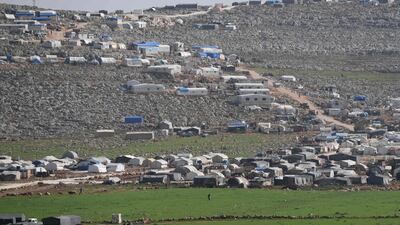
  • The camp for displaced Syrians at Kafr Lusin where Humanitarian Relief Foundation is building homes for people displaced by government offensive in Idlib province. AFP
    The camp for displaced Syrians at Kafr Lusin where Humanitarian Relief Foundation is building homes for people displaced by government offensive in Idlib province. AFP
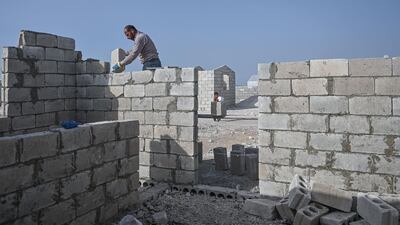
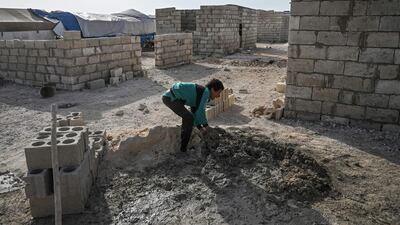
  • A construction worker at the site for new homes for displaced Syrians at Kafr Lusin. AFP
    A construction worker at the site for new homes for displaced Syrians at Kafr Lusin. AFP
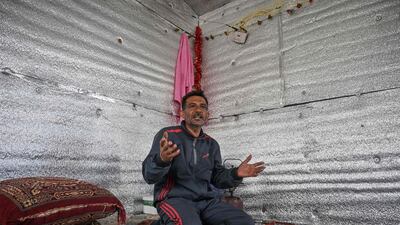
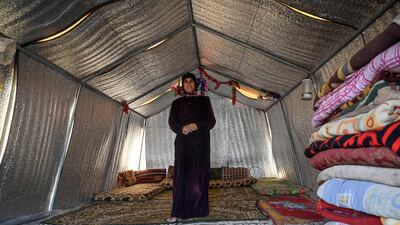
  • Hamad Al Abdallah in his new home built by the Turkish NGO Humanitarian Relief Foundation (IHH) at Kafr Lusin on the border with Turkey in Syria's north-western province of Idlib. AFP
    Hamad Al Abdallah in his new home built by the Turkish NGO Humanitarian Relief Foundation (IHH) at Kafr Lusin on the border with Turkey in Syria's north-western province of Idlib. AFP
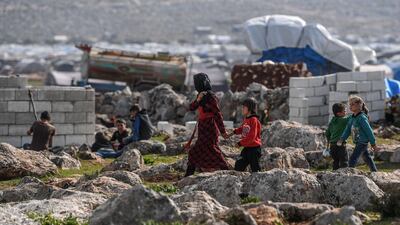
  • Resident of the camp at Kafr Lusin walk among concrete homes being built by Turkish NGOs. AFP
    Resident of the camp at Kafr Lusin walk among concrete homes being built by Turkish NGOs. AFP
  • Noora Al Ali, who fled regime attacks on the town of Maaret Al Numan with her son and eight grandchildren, stands inside her new concrete come at the Kafr Lusin camp. AFP
    Noora Al Ali, who fled regime attacks on the town of Maaret Al Numan with her son and eight grandchildren, stands inside her new concrete come at the Kafr Lusin camp. AFP
  • The construction site for new homes for displaced Syrians at Kafr Lusin near the border with Turkey. AFP
    The construction site for new homes for displaced Syrians at Kafr Lusin near the border with Turkey. AFP

“Now we hope that the authorities will answer positively very soon to our proposal,” he said. “We believe that people detained and displaced are even more vulnerable than the general population.”

The ICRC, whose largest humanitarian operation worldwide is in Syria, is the only agency allowed into its detention centres – where some experts estimate about 130,000 people are held.

The Assad government announced on Sunday its first coronavirus case after unconfirmed reports suggested the virus had been detected but covered up, a charge officials denied.

“Healthcare facilities have been destroyed or are degraded. There is a shortage of key medical equipment and health professionals,” Mr Pedersen said.

Mr Carboni said that while Syrian health officials say the number of cases is quite limited, quick action – including the provision of clean water – is needed to halt a spread.

“Even if there are five or 10 cases, our work would still be to focus on making sure that water reaches people because without water you can’t wash your hands,” he said.

In Hasakah, the largest city in the northeast, a pumping station providing water to 800,000 people has been out of operation for three days and needs repair, he said.

“We installed 45 water tanks all around the city and are water trucking until we can fix this pumping station and can have access,” Mr Carboni said.

The focus across Syria must be on prevention, he said, “because when they start having cases, and if it gets out of hand, it’s going to be very, very difficult to address, as we can see in many western countries where they have way more sophisticated health systems.”

Mr Carboni also noted the difficulties of putting in place general health guidance for containing the spread of the coronavirus.

“The way to address the pandemic is to stay home,” he said. “But when you are an IDP [internally displaced person], you don’t have a home. How do you do that? Certainly, social distancing becomes a luxury.”