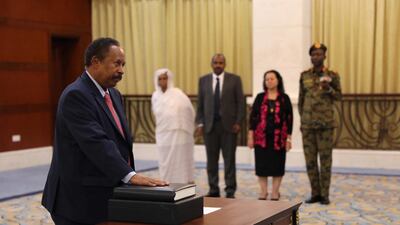
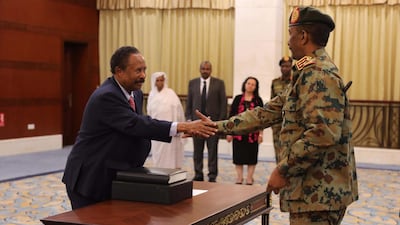
• Sudan's new Prime Minister Abdalla Hamdok is sworn in during a ceremony at the presidential palace in Khartoum, Sudan. EPA
    Sudan's new Prime Minister Abdalla Hamdok is sworn in during a ceremony at the presidential palace in Khartoum, Sudan. EPA
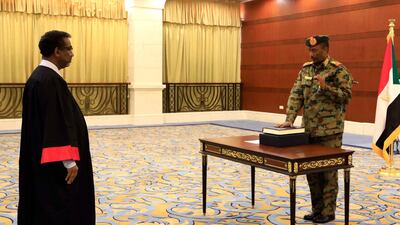
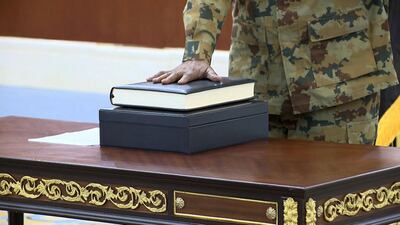
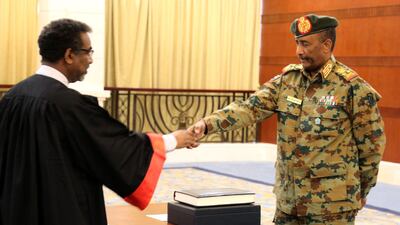
  • Leader of Sudan's transitional council, Lieutenant General Abdel Fattah Al-Abdelrahman Burhan is sworn in as the Head of the newly formed, the Sovereign Council, at the presidential palace in Khartoum, Sudan. Reuters
    Leader of Sudan's transitional council, Lieutenant General Abdel Fattah Al-Abdelrahman Burhan is sworn in as the Head of the newly formed, the Sovereign Council, at the presidential palace in Khartoum, Sudan. Reuters
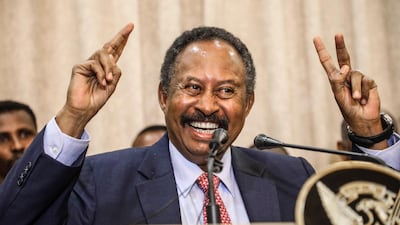
  • Sudan's new Prime Minister Abdalla Hamdok gives thumbs up as the presidential palace spokesman presents him to the media for a press conference following his swearing in at the presidential palace in Khartoum, Sudan. EPA
    Sudan's new Prime Minister Abdalla Hamdok gives thumbs up as the presidential palace spokesman presents him to the media for a press conference following his swearing in at the presidential palace in Khartoum, Sudan. EPA
  • Sudan's new Prime Minister Abdalla Hamdok speaks duringa press conference in Khartoum, Sudan. AP Photo
    Sudan's new Prime Minister Abdalla Hamdok speaks duringa press conference in Khartoum, Sudan. AP Photo
  • Sudan's new Prime Minister Abdalla Hamdok addresses the media following his swearing in at the presidential palace in Khartoum, Sudan. EPA
    Sudan's new Prime Minister Abdalla Hamdok addresses the media following his swearing in at the presidential palace in Khartoum, Sudan. EPA
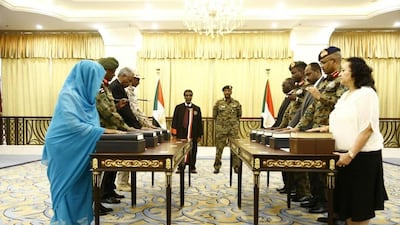
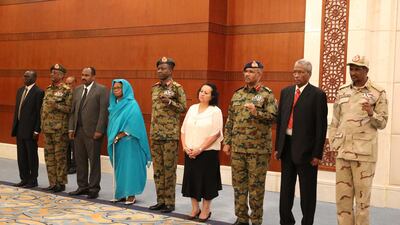
  • Leader of Sudan's transitional council, Lieutenant General Abdel Fattah Al-Abdelrahman Burhan looks on as military and civilian members of Sudan's new ruling body, the Sovereign Council, are sworn in at the presidential palace in Khartoum, Sudan. Reuters
    Leader of Sudan's transitional council, Lieutenant General Abdel Fattah Al-Abdelrahman Burhan looks on as military and civilian members of Sudan's new ruling body, the Sovereign Council, are sworn in at the presidential palace in Khartoum, Sudan. Reuters
  • Leader of Sudan's transitional council, Lieutenant General Abdel Fattah Al-Abdelrahman Burhan looks on as military and civilian members of Sudan's new ruling body, the Sovereign Council, are sworn in at the presidential palace in Khartoum, Sudan. Reuters
    Leader of Sudan's transitional council, Lieutenant General Abdel Fattah Al-Abdelrahman Burhan looks on as military and civilian members of Sudan's new ruling body, the Sovereign Council, are sworn in at the presidential palace in Khartoum, Sudan. Reuters
  • Leader of Sudan's transitional council, Lieutenant General Abdel Fattah Al-Abdelrahman Burhan looks on as military and civilian members of Sudan's new ruling body, the Sovereign Council, are sworn in at the presidential palace in Khartoum, Sudan. Reuters
    Leader of Sudan's transitional council, Lieutenant General Abdel Fattah Al-Abdelrahman Burhan looks on as military and civilian members of Sudan's new ruling body, the Sovereign Council, are sworn in at the presidential palace in Khartoum, Sudan. Reuters
  • Leader of Sudan's transitional council, Lieutenant General Abdel Fattah Al-Abdelrahman Burhan meets military and civilian members of Sudan's new ruling body, the Sovereign Council, after their swearing-in ceremony at the presidential palace in Khartoum, Sudan. Reuters
    Leader of Sudan's transitional council, Lieutenant General Abdel Fattah Al-Abdelrahman Burhan meets military and civilian members of Sudan's new ruling body, the Sovereign Council, after their swearing-in ceremony at the presidential palace in Khartoum, Sudan. Reuters

Sudan's new prime minister vows to work on economy and peace


  • English
  • Arabic

Hours after the new 11-member sovereign council took office in Sudan, the country’s new prime minister, Abdalla Hamdok, was sworn in and vowed to make achieving peace and solving the country's economic crisis a priority.

The appointment of the renowned economist came as Gen Abdel Fattah Al Burhan, the outgoing head of the military council, was sworn-in as leader of the new Sovereign Council that will run the country for three years until an election after decades of autocratic rule.

"The revolution's deep-rooted slogan, 'freedom, peace and justice,' will form the programme of the transitional period," Mr Hamdok told reporters at a news conference in Khartoum.

Gen Al Burhan and other military officers removed veteran leader Omar Al Bashir in April after months of growing protests at the dire economic situation and the years of dictatorship.

While Sudanese people celebrated Mr Al Bashir's fall, they also pressed for a handover of power to civilians during a turbulent period of protests and violence, including a crackdown on a protest camp outside the Defence Ministry that opposition medics say killed more than 100 people in June.

The United States, Britain and Norway welcomed Mr Hamdok's appointment, calling it a historic moment for Sudan.

"The appointment of a civilian-led government presents an opportunity to rebuild a stable economy and create a government that respects human rights and personal freedoms," the Troika, as the three countries are known, said in a joint statement.

The composition of the 11-member Sovereign Council that will run the country for the transition period, replacing the military council that has is now disbanded, was completed on Tuesday, consisting of five civilian and five military figures plus one consensus civilian picked by both sides.

Nine members of the council were sworn in about two hours after Gen Al Burhan took the oath on Wednesday. The final member, Mohamed Al Hassan Al Taishi, will be sworn in at a later, unspecified date, state news agency SUNA said.

  • Sudanese protesters run for cover from tear gas canisters fired by police outside the military headquarters in the capital Khartoum on April 6, 2019. AFP
    Sudanese protesters run for cover from tear gas canisters fired by police outside the military headquarters in the capital Khartoum on April 6, 2019. AFP
  • Sudanese protesters rally in front of the military headquarters in the capital Khartoum on April 8, 2019. AFP
    Sudanese protesters rally in front of the military headquarters in the capital Khartoum on April 8, 2019. AFP
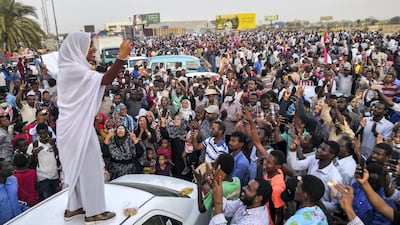
  • Alaa Salah, a Sudanese woman propelled to internet fame earlier this week after clips went viral of her leading powerful protest chants against President Omar Al Bashir, addresses protesters during a demonstration in front of the military headquarters in the capital Khartoum on April 10, 2019. AFP
    Alaa Salah, a Sudanese woman propelled to internet fame earlier this week after clips went viral of her leading powerful protest chants against President Omar Al Bashir, addresses protesters during a demonstration in front of the military headquarters in the capital Khartoum on April 10, 2019. AFP
  • Sudanese judges, dressed in their robes, gather for a "million-strong" march outside the army headquarters in the capital Khartoum on April 25, 2019. AFP
    Sudanese judges, dressed in their robes, gather for a "million-strong" march outside the army headquarters in the capital Khartoum on April 25, 2019. AFP
  • A Sudanese anti-regime protester kisses a soldier on the head during protests on April 11, 2019 in the area around the army headquarters in Sudan's capital Khartoum. AFP
    A Sudanese anti-regime protester kisses a soldier on the head during protests on April 11, 2019 in the area around the army headquarters in Sudan's capital Khartoum. AFP
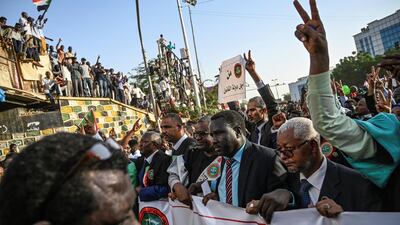
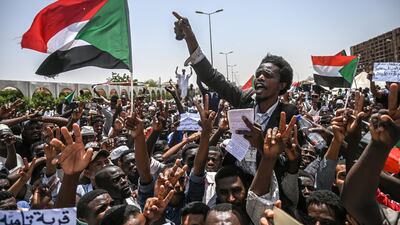
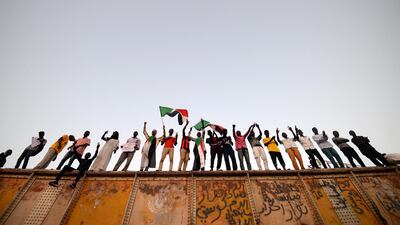
  • Sudanese demonstrators march with national flags as they gather during a rally demanding a civilian body to lead the transition to democracy. AFP
    Sudanese demonstrators march with national flags as they gather during a rally demanding a civilian body to lead the transition to democracy. AFP
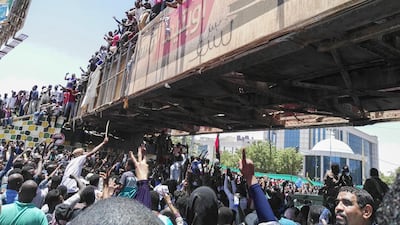
  • Protesters massed outside the army complex in central Khartoum on April 6, initially to demand the overthrow of longtime leader Omar Al Bashir. AFP
    Protesters massed outside the army complex in central Khartoum on April 6, initially to demand the overthrow of longtime leader Omar Al Bashir. AFP
  • Sudanese protesters gather outside the army headquarters in Khartoum on May 6, 2019. AFP
    Sudanese protesters gather outside the army headquarters in Khartoum on May 6, 2019. AFP
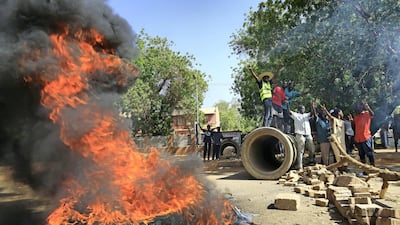
  • Sudanese protesters burn tyres as they block Nile Street for the second consecutive day during continuing protests in Sudan's capital Khartoum on May 13, 2019. AFP
    Sudanese protesters burn tyres as they block Nile Street for the second consecutive day during continuing protests in Sudan's capital Khartoum on May 13, 2019. AFP
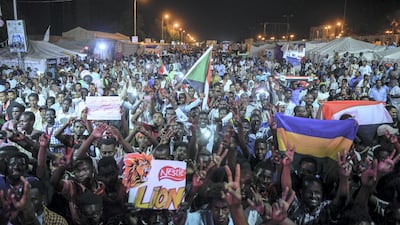
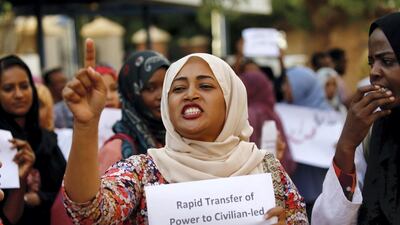
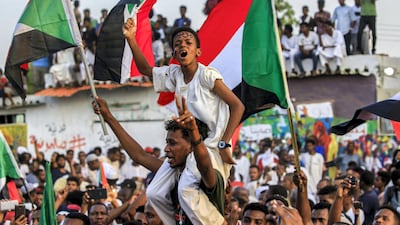
  • Sudanese protesters wave flags and flash victory signs as they gather for a sit-in outside the military headquarters in Khartoum on May 19, 2019. AFP
    Sudanese protesters wave flags and flash victory signs as they gather for a sit-in outside the military headquarters in Khartoum on May 19, 2019. AFP
  • A Sudanese health worker carries a placard as scores of medics hold a rally in front of a hospital in the capital Khartoum on May 23, 2019. AFP
    A Sudanese health worker carries a placard as scores of medics hold a rally in front of a hospital in the capital Khartoum on May 23, 2019. AFP
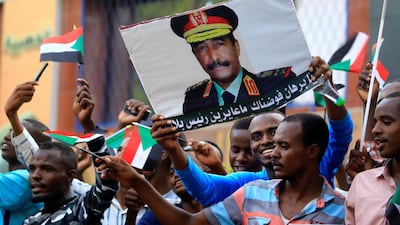
  • Sudanese supporters of the ruling Transitional Military Council (TMC) hold up a sign showing a portrait of its head General Abdel Fattah Al Burhan with a caption below reading in Arabic "we have delegated you Burhan, we want no president but you", during a rally in the centre of the capital Khartoum on May 31, 2019. AFP
    Sudanese supporters of the ruling Transitional Military Council (TMC) hold up a sign showing a portrait of its head General Abdel Fattah Al Burhan with a caption below reading in Arabic "we have delegated you Burhan, we want no president but you", during a rally in the centre of the capital Khartoum on May 31, 2019. AFP
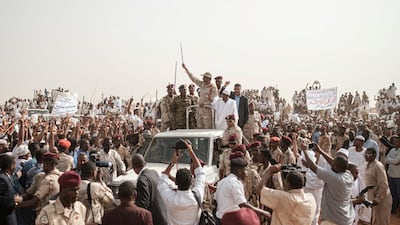
  • Mohamed Hamdan Dagalo, known as Himediti, deputy head of Sudan's ruling Transitional Military Council and commander of the Rapid Support Forces paramilitaries, waves a baton to supporters on a vehicle as he arrives for a rally in the village of Abraq, about 60 kilometres northwest of Khartoum, on June 22, 2019. AFP
    Mohamed Hamdan Dagalo, known as Himediti, deputy head of Sudan's ruling Transitional Military Council and commander of the Rapid Support Forces paramilitaries, waves a baton to supporters on a vehicle as he arrives for a rally in the village of Abraq, about 60 kilometres northwest of Khartoum, on June 22, 2019. AFP
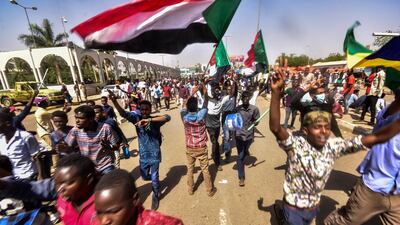
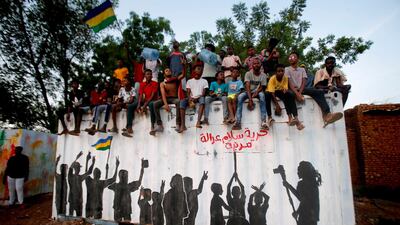
  • Sudanese protestors celebrate in the streets of Khartoum after ruling generals and protest leaders announced they have reached an agreement on the disputed issue of a new governing body on July 5, 2019. AFP
    Sudanese protestors celebrate in the streets of Khartoum after ruling generals and protest leaders announced they have reached an agreement on the disputed issue of a new governing body on July 5, 2019. AFP
  • Thousands went to the streets to welcome the agreement on Saturday. AFP
    Thousands went to the streets to welcome the agreement on Saturday. AFP
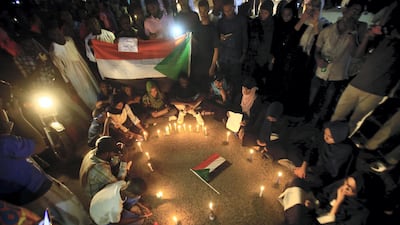
  • Sudanese protesters take part in a vigil in the capital Khartoum to mourn dozens of demonstrators killed last month in a raid on a Khartoum sit-in. AFP
    Sudanese protesters take part in a vigil in the capital Khartoum to mourn dozens of demonstrators killed last month in a raid on a Khartoum sit-in. AFP
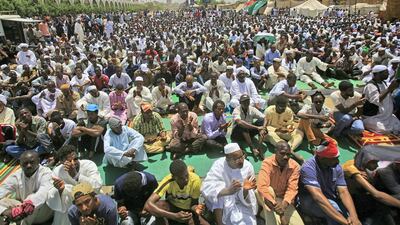
  • Sudanese protesters gather during Friday noon prayers outside the army headquarters in Khartoum on May 3, 2019, as they continue to protest demanding that the ruling military council hand power to a civilian administration. AFP
    Sudanese protesters gather during Friday noon prayers outside the army headquarters in Khartoum on May 3, 2019, as they continue to protest demanding that the ruling military council hand power to a civilian administration. AFP
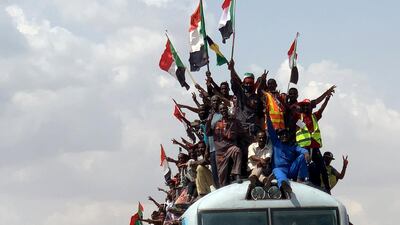
  • Sudanese civilians from other provinces ride on the train to join in the celebrations of the signing of Sudan's power-sharing deal. Reuters
    Sudanese civilians from other provinces ride on the train to join in the celebrations of the signing of Sudan's power-sharing deal. Reuters
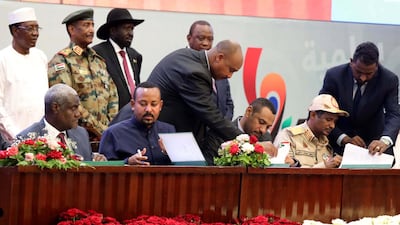
  • Sudan's Forces of Freedom and Change coalition leader Ahmad Rabiah (3-R) and Sudan's General and Vice President of Sudanese Transitional Military Council, Mohamed Hamdan Dagalo (2-R) sign power-sharing agreement,. EPA
    Sudan's Forces of Freedom and Change coalition leader Ahmad Rabiah (3-R) and Sudan's General and Vice President of Sudanese Transitional Military Council, Mohamed Hamdan Dagalo (2-R) sign power-sharing agreement,. EPA
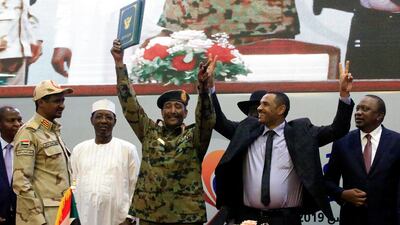
  • Sudan's Head of Transitional Military Council, Lieutenant General Abdel Fattah Al-Burhan, and Sudan's opposition alliance coalition's leader Ahmad Rabiah, celebrate the signing of the power-sharing deal, that paves the way for a transitional government, and eventual elections. Reuters
    Sudan's Head of Transitional Military Council, Lieutenant General Abdel Fattah Al-Burhan, and Sudan's opposition alliance coalition's leader Ahmad Rabiah, celebrate the signing of the power-sharing deal, that paves the way for a transitional government, and eventual elections. Reuters
  • epa07783624 Leader of Sudan's transitional council, Lieutenant General Abdel Fattah Abdelrahman Burhan (R) is sworn in as the Head of the newly formed transitional Council at the presidential palace in Khartoum, Sudan, 21 August 2019. The Sudanese opposition and military council signed on 17 August a power sharing agreement. The agreement sets up a sovereign council made of five generals and six civilians, to rule the country until general elections. Protests had erupted in Sudan at the end of 2018, culminating in a long sit-in outside the army headquarters which ended with more than one hundred people being killed and others injured. Sudanese President Omar Hassan al-Bashir stepped down on 11 April 2019. EPA/STRINGER
    epa07783624 Leader of Sudan's transitional council, Lieutenant General Abdel Fattah Abdelrahman Burhan (R) is sworn in as the Head of the newly formed transitional Council at the presidential palace in Khartoum, Sudan, 21 August 2019. The Sudanese opposition and military council signed on 17 August a power sharing agreement. The agreement sets up a sovereign council made of five generals and six civilians, to rule the country until general elections. Protests had erupted in Sudan at the end of 2018, culminating in a long sit-in outside the army headquarters which ended with more than one hundred people being killed and others injured. Sudanese President Omar Hassan al-Bashir stepped down on 11 April 2019. EPA/STRINGER
  • A pictured released by Sudan's Presidential Palace shows General Abdel Fattah al-Burhan, the head of Sudan's ruling military council, during a swearing in ceremony in Khartoum on August 21, 2019. Burhan was sworn today as chairman of Sudan's new sovereign council that will steer the country through a three-year transition to civilian rule. "General Abdel Fattah al-Burhan Abdel Rahman was sworn in as president of the sovereign council," the official SUNA news agency reported. / AFP / SUDAN PRESIDENTIAL PALACE / - / RESTRICTED TO EDITORIAL USE - MANDATORY CREDIT "AFP PHOTO / SUDAN PRESIDENTAIL PALACE" - NO MARKETING NO ADVERTISING CAMPAIGNS - DISTRIBUTED AS A SERVICE TO CLIENTS
    A pictured released by Sudan's Presidential Palace shows General Abdel Fattah al-Burhan, the head of Sudan's ruling military council, during a swearing in ceremony in Khartoum on August 21, 2019. Burhan was sworn today as chairman of Sudan's new sovereign council that will steer the country through a three-year transition to civilian rule. "General Abdel Fattah al-Burhan Abdel Rahman was sworn in as president of the sovereign council," the official SUNA news agency reported. / AFP / SUDAN PRESIDENTIAL PALACE / - / RESTRICTED TO EDITORIAL USE - MANDATORY CREDIT "AFP PHOTO / SUDAN PRESIDENTAIL PALACE" - NO MARKETING NO ADVERTISING CAMPAIGNS - DISTRIBUTED AS A SERVICE TO CLIENTS
  • A picture released by Sudan's Presidential Palace shows General Abdel Fattah al-Burhan, the head of Sudan's ruling military council, during a swearing in ceremony in Khartoum on August 21, 2019. Burhan was sworn today as chairman of Sudan's new sovereign council that will steer the country through a three-year transition to civilian rule. "General Abdel Fattah al-Burhan Abdel Rahman was sworn in as president of the sovereign council," the official SUNA news agency reported. / AFP / SUDAN PRESIDENTIAL PALACE / - / RESTRICTED TO EDITORIAL USE - MANDATORY CREDIT "AFP PHOTO / SUDAN PRESIDENTAIL PALACE" - NO MARKETING NO ADVERTISING CAMPAIGNS - DISTRIBUTED AS A SERVICE TO CLIENTS
    A picture released by Sudan's Presidential Palace shows General Abdel Fattah al-Burhan, the head of Sudan's ruling military council, during a swearing in ceremony in Khartoum on August 21, 2019. Burhan was sworn today as chairman of Sudan's new sovereign council that will steer the country through a three-year transition to civilian rule. "General Abdel Fattah al-Burhan Abdel Rahman was sworn in as president of the sovereign council," the official SUNA news agency reported. / AFP / SUDAN PRESIDENTIAL PALACE / - / RESTRICTED TO EDITORIAL USE - MANDATORY CREDIT "AFP PHOTO / SUDAN PRESIDENTAIL PALACE" - NO MARKETING NO ADVERTISING CAMPAIGNS - DISTRIBUTED AS A SERVICE TO CLIENTS
  • A picture released by Sudan's Presidential Palace shows General Abdel Fattah al-Burhan (C-R), the head of Sudan's ruling military council, standing during a swearing in of the new sovereign council, in Khartoum on August 21, 2019. Sudan took further steps in its transition towards civilian rule today with the swearing in of a new sovereign council, to be followed by the appointment of a prime minister. The body replaces the Transitional Military Council (TMC) that took charge after months of deadly street protests brought down longtime ruler Omar al-Bashir in April. Burhan, who already headed the TMC, was sworn in as the chairman of the new sovereign council in the morning. / AFP / SUDAN PRESIDENTIAL PALACE / - / RESTRICTED TO EDITORIAL USE - MANDATORY CREDIT "AFP PHOTO / SUDAN PRESIDENTAIL PALACE" - NO MARKETING NO ADVERTISING CAMPAIGNS - DISTRIBUTED AS A SERVICE TO CLIENTS
    A picture released by Sudan's Presidential Palace shows General Abdel Fattah al-Burhan (C-R), the head of Sudan's ruling military council, standing during a swearing in of the new sovereign council, in Khartoum on August 21, 2019. Sudan took further steps in its transition towards civilian rule today with the swearing in of a new sovereign council, to be followed by the appointment of a prime minister. The body replaces the Transitional Military Council (TMC) that took charge after months of deadly street protests brought down longtime ruler Omar al-Bashir in April. Burhan, who already headed the TMC, was sworn in as the chairman of the new sovereign council in the morning. / AFP / SUDAN PRESIDENTIAL PALACE / - / RESTRICTED TO EDITORIAL USE - MANDATORY CREDIT "AFP PHOTO / SUDAN PRESIDENTAIL PALACE" - NO MARKETING NO ADVERTISING CAMPAIGNS - DISTRIBUTED AS A SERVICE TO CLIENTS
  • epa07784051 Members of Sudan's newly formed transitional Council (R-L) General Mohamed Hamdan Dagalo, Hassan Sheikh Idris, Genereal Ibrahim Jaber, Raja Nicola Issa Abdul-Masseh, General Shams al-Din Kabashi, Aisha Moussa, Mohamed Alfaki, General Yasser al-Atta and Sadeek Tawer look on during their sweaing-in ceremony at the presidential palace in Khartoum, Sudan, 21 August 2019. The Sudanese opposition and military council signed on 17 August a power sharing agreement. The agreement sets up a sovereign council made of five generals and six civilians, to rule the country until general elections. Protests had erupted in Sudan at the end of 2018, culminating in a long sit-in outside the army headquarters which ended with more than one hundred people being killed and others injured. Sudanese President Omar Hassan al-Bashir stepped down on 11 April 2019. EPA/MORWAN ALI
    epa07784051 Members of Sudan's newly formed transitional Council (R-L) General Mohamed Hamdan Dagalo, Hassan Sheikh Idris, Genereal Ibrahim Jaber, Raja Nicola Issa Abdul-Masseh, General Shams al-Din Kabashi, Aisha Moussa, Mohamed Alfaki, General Yasser al-Atta and Sadeek Tawer look on during their sweaing-in ceremony at the presidential palace in Khartoum, Sudan, 21 August 2019. The Sudanese opposition and military council signed on 17 August a power sharing agreement. The agreement sets up a sovereign council made of five generals and six civilians, to rule the country until general elections. Protests had erupted in Sudan at the end of 2018, culminating in a long sit-in outside the army headquarters which ended with more than one hundred people being killed and others injured. Sudanese President Omar Hassan al-Bashir stepped down on 11 April 2019. EPA/MORWAN ALI
  • Demonstrators march with banners and the old (L) and current (R) flags of Sudan outside a courthouse complex in the capital's twin city of Omdurman on August 21, 2019 during the trial of 40 members of Sudan's now-dissolved National Intelligence and Security Service facing charges over the death in custody of Ahmed al-Kheir, a teacher from the eastern town of Khashma el-Girba, in the early days of the wave of nationwide protests that eventually brought longtime ruler Omar al-Bashir. / AFP / Ahmed Mustafa
    Demonstrators march with banners and the old (L) and current (R) flags of Sudan outside a courthouse complex in the capital's twin city of Omdurman on August 21, 2019 during the trial of 40 members of Sudan's now-dissolved National Intelligence and Security Service facing charges over the death in custody of Ahmed al-Kheir, a teacher from the eastern town of Khashma el-Girba, in the early days of the wave of nationwide protests that eventually brought longtime ruler Omar al-Bashir. / AFP / Ahmed Mustafa
  • epa07784904 Sudan's new Prime Minister Abdalla Hamdok (L) swears in during a ceremony at the presidential palace in Khartoum, Sudan, 21 August 2019. The Sudanese opposition and military council signed on 17 August a power sharing agreement. The agreement sets up a sovereign council made of five generals and six civilians, to rule the country until general elections. Protests had erupted in Sudan in December 2018, culminating in a long sit-in outside the army headquarters which ended with more than one hundred people being killed and others injured. Sudanese President Omar Hassan al-Bashir stepped down on 11 April 2019. EPA/MARWAN ALI
    epa07784904 Sudan's new Prime Minister Abdalla Hamdok (L) swears in during a ceremony at the presidential palace in Khartoum, Sudan, 21 August 2019. The Sudanese opposition and military council signed on 17 August a power sharing agreement. The agreement sets up a sovereign council made of five generals and six civilians, to rule the country until general elections. Protests had erupted in Sudan in December 2018, culminating in a long sit-in outside the army headquarters which ended with more than one hundred people being killed and others injured. Sudanese President Omar Hassan al-Bashir stepped down on 11 April 2019. EPA/MARWAN ALI
  • epa07784903 Sudan's new Prime Minister Abdalla Hamdok (L) shakes hands with Abdel Fattah Abdelrahman Burhan (R) after being sworn in during a ceremony at the presidential palace in Khartoum, Sudan, 21 August 2019. The Sudanese opposition and military council signed on 17 August a power sharing agreement. The agreement sets up a sovereign council made of five generals and six civilians, to rule the country until general elections. Protests had erupted in Sudan in December 2018, culminating in a long sit-in outside the army headquarters which ended with more than one hundred people being killed and others injured. Sudanese President Omar Hassan al-Bashir stepped down on 11 April 2019. EPA/MARWAN ALI
    epa07784903 Sudan's new Prime Minister Abdalla Hamdok (L) shakes hands with Abdel Fattah Abdelrahman Burhan (R) after being sworn in during a ceremony at the presidential palace in Khartoum, Sudan, 21 August 2019. The Sudanese opposition and military council signed on 17 August a power sharing agreement. The agreement sets up a sovereign council made of five generals and six civilians, to rule the country until general elections. Protests had erupted in Sudan in December 2018, culminating in a long sit-in outside the army headquarters which ended with more than one hundred people being killed and others injured. Sudanese President Omar Hassan al-Bashir stepped down on 11 April 2019. EPA/MARWAN ALI
  • Sudan's new Prime Minister Abdalla Hamdok speaks duringa press conference in Khartoum, Sudan, Wednesday, Aug. 21, 2019. (AP Photo)
    Sudan's new Prime Minister Abdalla Hamdok speaks duringa press conference in Khartoum, Sudan, Wednesday, Aug. 21, 2019. (AP Photo)

"With the start of the transition period, we have entered the most complex phase, the phase of building and reform," said Al-Rashed Saeed, spokesman for the Sudanese Professionals Association, a key part of the Forces for Freedom and Change coalition that negotiated with the military council.

Among the military men sworn in were Gen Mohamed Hamdan Dagalo, commonly known as Hemedti. The outgoing deputy head of the military council, Gen Dagalo has become a growing political force in Sudan.

He heads the Rapid Support Forces, a paramilitary group that has a heavy presence in Khartoum whose genesis is in a tribal militia that fought rebels in the western Darfur region in the 2000s’.

Civilian representatives on the council are mostly little-known figures, including Rajaa Nicola Abdel Maseeh, a Christian, who was the civilian member jointly chosen by the military and the opposition coalition.

Gen Al Burhan, dressed in military uniform, was sworn in before the head of the judiciary at the presidential palace in Khartoum. The other members were sworn in before the judiciary head and Gen Al Burhan in the afternoon.

The Sovereign Council, which held its first meeting shortly after the members' swearing-in, is now the highest authority in the country but will largely delegate executive powers to a Cabinet of ministers led by the prime minister.

The nomination of Mr Hamdok to the role underlines the daunting task of repairing an economy battered by years of US sanctions and government mismanagement during Mr Al Bashir's 30-year rule.

A shortage of foreign currency, resulting in a cash crunch and long lines for fuel and bread, triggered the protests that helped push Mr Al Bashir out.