

Saudi Arabia’s foreign minister accused Iran and its Lebanese proxy, Hezbollah, of being behind Sunday’s ballistic missile attacks on the kingdom, saying that the country has the right to respond at the “appropriate time and place”.
“The position of the Kingdom of Saudi Arabia is very clear on the Iranian ballistic missiles that were launched from Houthi territory in Yemen by Iranian agents and agents of Hezbollah towards the kingdom, and it is a stark violation of international law,” said Adel Al Jubeir at the UN headquarters in New York following a meeting between Crown Prince Mohammed bin Salman and UN chief Antonio Guterres.
“The kingdom has the right to respond to this hostile Iranian act in the appropriate way at the right time and place.”
-

UN Secretary-General Antonio Guterres, left, escorts Saudi Arabia's Crown Prince Mohammed bin Salman, right, into a meeting at the United Nations, on Tuesday, March 27, 2018. Eskinder Debebe / United Nations via AP -
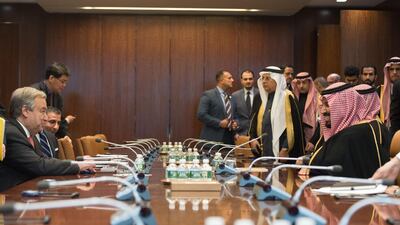
United Nations Secretary-General Antonio Guterres (L) meets with Prince Mohammed bin Salman at the United Nations on March 27, 2018 in New York. Bryan R Smith / AFP -

Saudi Arabia's Crown Prince Mohammed bin Salman, far right, speaks to United Nations Secretary-General Antonio Guterres, far left, during a signing ceremony at UN headquarters on Tuesday, March 27, 2018. Eskinder Debebe / United Nations via AP -

UN Secretary-General Antonio Guterres, right rear, and Saudi Arabia's Crown Prince Mohammed bin Salman, left rear, watch as their representatives sign a voluntary financial contribution memo for the Yemeni humanitarian response plan, on Tuesday, March 27, 2018, at the UN headquarters. Eskinder Debebe / United Nations via AP -
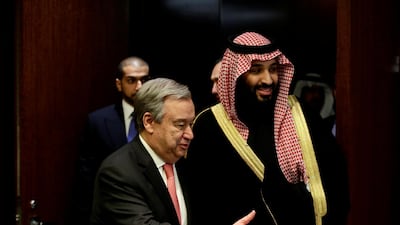
Saudi Arabia's Crown Prince Mohammed bin Salman walks into a room with UN Secretary- General Antonio Guterres before a photo opportunity at the United Nations headquarters in the Manhattan borough of New York City. Amir Levy / Reuters -

Saudi Arabia's Crown Prince Mohammed bin Salman is seen during a meeting with UN Secretary-General Antonio Guterres at the United Nations headquarters in the Manhattan borough of New York City. Amir Levy / Reuters -
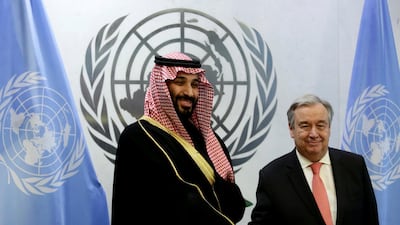
Saudi Arabia's Crown Prince Mohammed bin Salman shakes hands with UN Secretary-General Antonio Guterres during a photo opportunity at the United Nations headquarters in the Manhattan borough of New York City. Amir Levy / Reuters -

Prince Mohammed bin Salman attends a meeting with the United Nations Secretary-General Antonio Guterres (out of frame) at the United Nations on March 27, 2018 in New York. Bryan R Smith / AFP


Saudi forces said they intercepted seven missiles late Sunday, including one over the capital Riyadh. One Egyptian man died when burning shrapnel struck his room in the capital.
_______________
Read more:
Analysis: Houthis' military posturing could derail political talks
_______________
Mr Al Jubeir reiterated that the Saudi-led coalition fighting in Yemen on behalf of the internationally recognised government has presented evidence that ballistic missiles found in the country were smuggled from Iran.
“We have objected to it, and we have presented it to the world and to our allies to reaffirm they are Iranian missiles, and they are, no doubt,” he said in his first comments since the attack.
The Houthi rebels have fired dozens of missiles into Saudi Arabia since last year, all of which Saudi forces have intercepted.
A major attack targeted Riyadh international airport on November 4, and another strike on December 19 targeted Riyadh's Yamamah palace — the official residence of the king.
Mr Al Jubeir said that Tehran was in clear violation of international law and of UN resolution 2216 – which imposes an arms embargo on the rebels. He added, however, the UN efforts to address arms smuggling into Yemen are improving.
Mr Al Jubeir also said that Saudi Arabia and the UAE — which is also part of the Arab coalition fighting in Yemen — will present a $930 million (Dh3.4bn) cheque to the UN for humanitarian aid in Yemen during Tuesday’s UN conference.
The kingdom will provide an additional $70m that would go towards the war-torn country’s infrastructure, he added.
-

The Um Al-Hammam district in Riyadh. The pierced ceiling of a home hit by falling shrapnel from Yemeni rebel missiles that were intercepted over the Saudi Arabian capital. Fayez Nureldine / AFP -

An Egyptian labourer stands outside a home hit by falling shrapnel from Yemeni rebel missiles that were intercepted over Riyadh. Fayez Nureldine / AFP -

A woman uses her mobile phone to take picture of the damage created by debris from ballistic missiles fired by Yemen's Houthi militia, at a house in Riyadh. Faisal Al Nasser / Reuters -
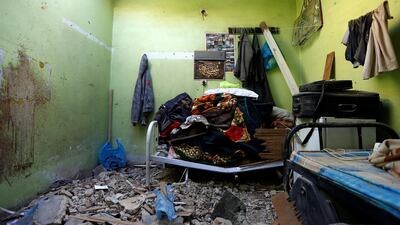
More damage caused by the ballistic missiles in Riyadh, Saudi Arabia, in March. Faisal Al Nasser / Reuters -
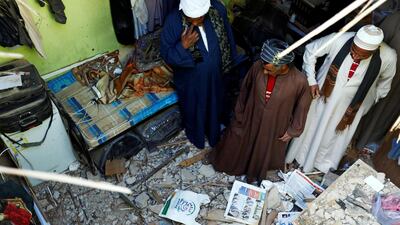
People check the damage created by debris. Faisal Al Nasser / Reuters -

Ballistic missiles fired by Yemen's Houthi militia caused destruction in Riyadh, Saudi Arabia. Faisal Al Nasser / Reuters


Meanwhile, Mr Guterres expressed in a statement following a two-hour meeting with Saudi’s Mohammed bin Salman “his deep gratitude to the crown prince for delivering today on the generous pledge".
The two men discussed the war in Yemen and the need for all parties to adhere to international humanitarian law, said the UN statement, adding they also addressed “the critical need for humanitarian access across the country and for all of Yemen’s ports to remain open to both humanitarian and commercial movement”.
Mr Guterres and Crown Prince Mohammed also talked about the need for a “political settlement through inclusive intra-Yemeni dialogue”.
In Washington, US Secretary of Defence James Mattis said on Tuesday that "the Iranian support to the Houthis that gives them this capability is clearly being countered".
He credited "in part the American systems that they [Saudi Arabia] bought and, more importantly right now, to the advisers we brought in to assist them in defence of the kingdom.”
The Yemen war was triggered when the Houthis seized the capital, Sanaa, in September 2014 and later advanced south, taking large swathes of the country.
After entering the war at the request of President Abdrabu Mansur Hadi on March 26, 2015, the Saudi-led coalition has helped pro-government forces to retake much of the territory captured by the rebels. However, Sanaa remains under rebel control.
The UN says living conditions in the war-scarred country have reached catastrophic levels and that 8.4 million people face imminent famine.

