

US Secretary of State Mike Pompeo urged the UN Security Council on Tuesday to renew an arms embargo on Iran, saying that not doing so will allow Iran to "hold a sword of Damocles" over economic stability in the Middle East.
Mr Pompeo, speaking at a Security Council video meeting on non-proliferation, called on the global body to extend a the five-year ban on arms trade with Iran due to expire in October.
"This chamber has a choice: stand for international peace and security, as the United Nations' founders intended, or let the arms embargo on the Islamic republic of Iran expire, betraying the UN's mission and its finest ideals, which we have all pledged to uphold," Mr Pompeo said.
Warning of Iran's ability to purchase jets from Russia and China and arm its regional proxies, he said renewing the embargo was a national security issue and not a partisan one.
Addressing Russia and China, Mr Pompeo mentioned the instability that could hit energy markets if the embargo is not renewed.
“Iran will hold a sword of Damocles over the economic stability of the Middle East, endangering nations like Russia and China that rely on stable energy prices,” Mr Pompeo said. Russia has publicly opposed renewing the measure.
Mr Pompeo did not close the door to other options if the Security Council fails to act.
The US's "overwhelming preference is to work with this council to extend the arms embargo, to protect human life, to protect our national security, and to protect yours", he said.
-
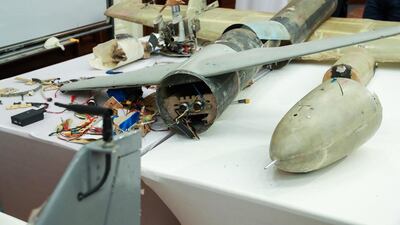
An Iranian-built Qasef-1 drone used by Houthi rebels in Yemen. -

A shot down drone on display. All photos by Victor Besa / The National -
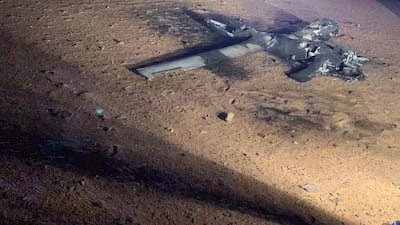
The remains of a Houthi drone intercepted by the Saudi Arabian Air Force. @SPAregions -
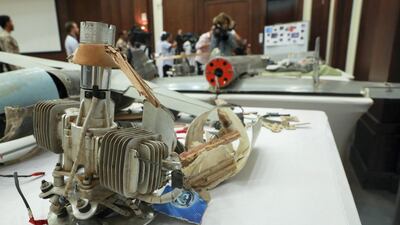
The engine of a Qasef-1 drone shot down by Arab Coalition forces in Yemen. -

A drone used by Houthi rebels to launch attacks on Saudi Arabia. AP -
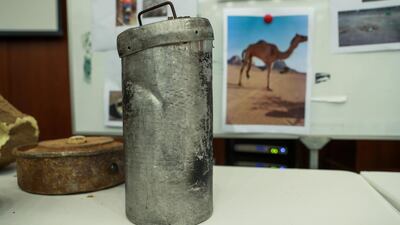
An IED built with Iranian components and camouflaged as a cooking pot recovered by Arab Coalition forces in Yemen. -
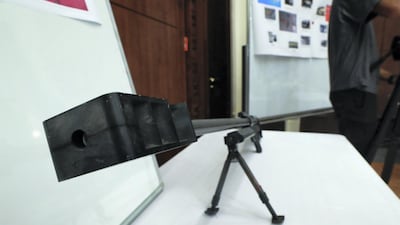
An Iranian-supplied STEYR .50 Calibre sniper riffle being used by the Houthi rebels in Yemen. -
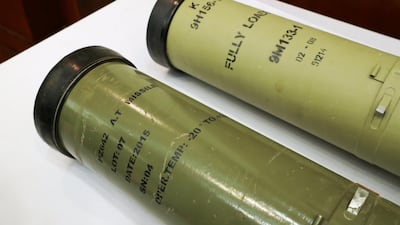
Two anti-tank guided missiles (ATGM). The one on the right is a Russian-made Kornet, and on the left is an Iranian imitation. Markings show they were built in 2015 indicating they were smuggled to Yemen after the UN arms embargo. -
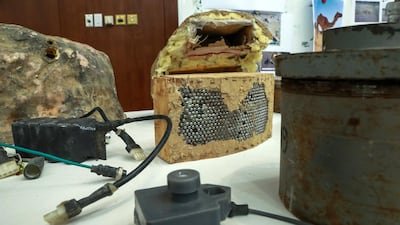
IEDs camouflaged inside a fake rock. Arab Coalition officials estimate they have defused up to 30,000 such devices since the war began. -
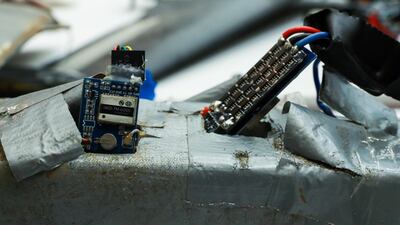
Farsi language was found enscribed on the wiring of this drone battery from a Qasef-1 UAV indicating its Iranian origins. -

Limpet mines. -
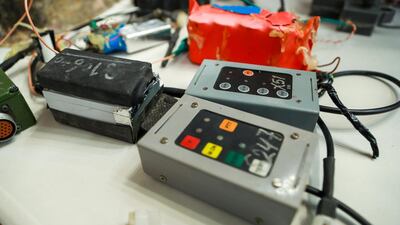
Electronics of an IED. -
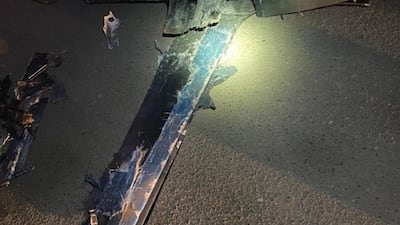
Remains of Houthi drone which the coalition shot down. @SPAregions -
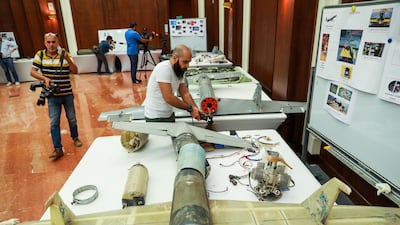
Weapons supplied by Iran to the Houthi militias in Yemen were put on display at a press conference by the Saudi-led Arab coalition. Victor Besa / The National


Last week, the US threatened to impose multilateral sanctions if the embargo is not renewed.
“If at any time the United States believes Iran has failed to meet its commitments, no other state can block our ability to snap back those multilateral sanctions,” Mr Pompeo said from the State Department.
But that would require the Trump administration to return to the Iran nuclear deal that it abandoned in 2018. Such a move would all but guarantee that the agreement collapses.
At Tuesday's meeting, the EU's ambassador to the UN Olof Skoog called for "preserving the agreement" as a cornerstone for global security. He expressed concern, however, over Iran's breaches of the deal.
“It is deeply worrying that Iran has decreased its nuclear-related JCPOA commitments," he said. "We remain particularly concerned about Iran’s continued accumulation of low-enriched uranium in excess of the JCPOA stockpile and enrichment level thresholds, its continued expansion of R&D [research and development] with advanced centrifuges, and the enrichment activities in Fordow.”
Britain’s representative at the UN Jonathan Allen warned against letting the embargo expire.
“We believe the planned lifting of arms restrictions on Iran in October would have major implications for regional security and stability,” he said.
US-Iran tensions were on display in other ways – Iranian Foreign Minister Javad Zarif joined the video meeting only after US Secretary of State Mike Pompeo had left the session.

