


Palestinians are marking the 72nd anniversary of Nakba Day online, commemorating their losses in the 1948 Arab-Israeli war via apps and video chats rather than rallies as coronavirus restrictions remain in place.
More than 700,000 Palestinians were driven from their homes and over 500 towns and villages destroyed during the Nakba – the Arabic word for catastrophe – which culminated in the creation of Israel on May 14, 1948.
Last year, at least 60 people were injured in clashes with Israeli troops after thousands gathered for demonstrations across the Israeli-occupied West Bank and the Gaza Strip.
In a speech on Wednesday reported by The Jerusalem Post, Palestinian Authority President Mahmoud Abbas said "those who created our catastrophe wanted Palestine to be land without people or territories and were betting that the name of Palestine would be erased from the records of history.
“Despite all the obstacles, and despite all the aggressive occupation policies, measures and violations, we are proceeding with confident steps towards the restoration of our full rights and the removal of this hateful occupation.”
His comments came as US Secretary of State Mike Pompeo visited Israel on Wednesday to discuss West Bank annexation plans with Prime Minister Benjamin Netanyahu.

Mr Pompeo, making his first foreign trip since the coronavirus crisis began, arrived as Israel prepared to swear in a new government following 18 months of political stalemate.
Mr Netanyahu and his rival-turned-ally Benny Gantz agreed to form a coalition to avoid yet another parliamentary election after three inconclusive polls since April last year.
The new government, which is due to be sworn in on Sunday, will clear the way for Mr Netanyahu to implement parts of a controversial US peace plan unveiled in January. The proposal gives a green light from Washington for Israel to annex swathes of the occupied West Bank.
The Palestinians, who cut ties with the Trump administration in 2017, rejected the plan and Arab states have warned that it could lead to further conflict in the region.
Jordan's Foreign Minister Ayman Safadi said on Wednesday that "any Israeli decision to annex the settlements, the Jordan Valley and the north of the Dead Sea in occupied Palestine will be a disastrous step".
In a phone conversation with Spain's foreign minister, Mr Safadi warned that it would "kill chances for a just peace and push the region towards more conflict".
The West Bank was captured by Israel during the 1967 Arab-Israeli war. Nearly three million Palestinians live in the territory alongside more than 400,000 Israelis residing in settlements that are considered illegal under international law.
Former US president Barack Obama's ambassador to Israel, Daniel Shapiro, said he believes the "Trump administration very much wants this annexation to happen".
The new Israeli government plans to begin implementing Mr Trump's plan as early as July.
Mr Pompeo said the issue was complex but refused to clarify whether the US administration backs Israel's timetable for annexation. "This is a decision that the Israelis will make," he told the Israel Hayom newspaper. "I want to understand how the new leadership, the soon-to-be new government, is thinking about that."
His visit coincided with an upsurge in violence in the West Bank as Israeli troops shot dead a 15-year-old Palestinian near the flashpoint city of Hebron. On Tuesday, a Palestinian stone-thrower killed an Israeli soldier during an arrest operation near Jenin in the army's first fatality of the year.
____________
Nakba Day: artworks that reflect on Palestinian identity and occupation
-
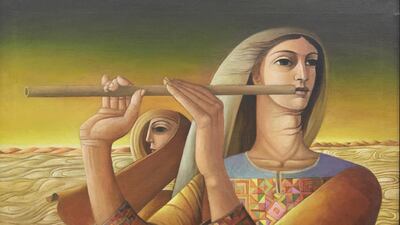
Sliman Mansour, 'Sad Tunes', 1977. Image courtesy of Barjeel Art Foundation, Sharjah -
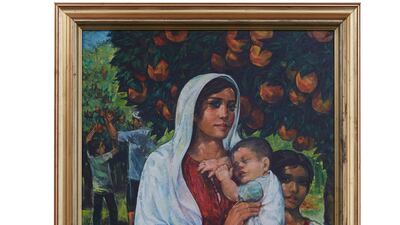
Ismail Shammout, 'Madonna of the Oranges', 1997. Image courtesy of Barjeel Art Foundation, Sharjah -
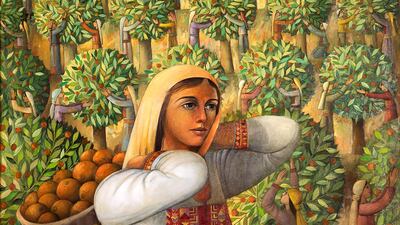
Suleiman Mansour, 'Yaffa', 1979. Courtesy of the artist and Yvette and Mazen Qupty Collection -
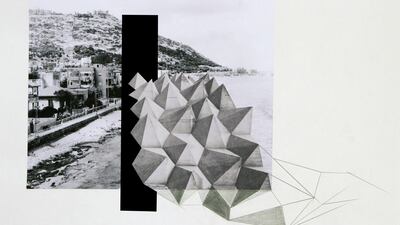
Hazem Harb, 'Untitled #16' from the 'Archaeology of Occupation' series, 2015. In the collage series, Harb juxtaposes pre-Nakba (1948) photographs of Palestinian landscapes with concrete forms. Courtesy of the artist and Tabari Artspace -
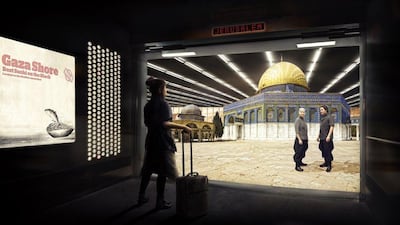
Larissa Sansour's 'Jerusalem Floor' (2012), a photograph inspired by her film 'Nation Estate', which depicts the state of Palestine housed in a single building. Courtesy of the artist and Lawrie Shabibi -
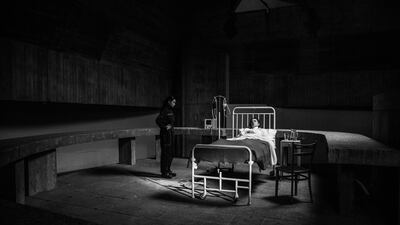
Still from Larissa Sansour's 'In Vitro' (2019) film. Courtesy of the artist and Lawrie Shabibi -

'We Are Palestinians', a poster published by the Australian Union of Students, circa 1970. Courtesy Palestinian Museum -
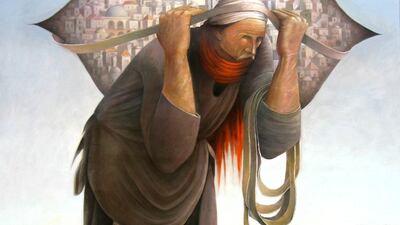
Sliman Mansour's 'Jamal Al-Mahamel' to the 'Camel of Harship'. Courtesy Alhoush -
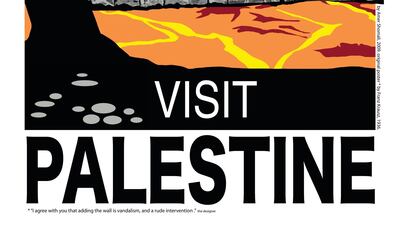
Amer Shomali's satirical work, 'Post “Visit Palestine”' from 2009. Courtesy of the artist and George Al Ama -
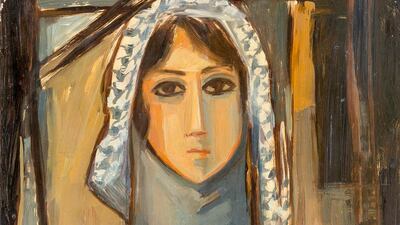
Yasser Dweik, Untitled, 1978, Oil on board, 50 x 35.5 cm. Courtesy of Barjeel Art Foundation, Sharjah -
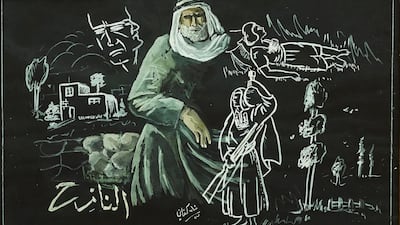
Ghassan Kanafani, 'The Displaced', 1957, Mixed media on carton, 36 x 50 cm. Image courtesy of Barjeel Art Foundation, Sharjah



