• Members of Iraq's Kataib Hezbollah militia hold a picture of Iranian general Qassem Suleimani before his funeral procession in Baghdad on January 4, 2020. Reuters
    Members of Iraq's Kataib Hezbollah militia hold a picture of Iranian general Qassem Suleimani before his funeral procession in Baghdad on January 4, 2020. Reuters
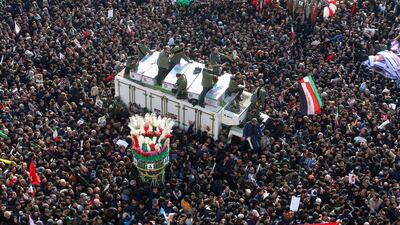
  • People attend a funeral procession for Iranian Major General Qassem Suleimani, head of the elite Quds Force, and Iraqi militia commander Abu Mahdi Al Muhandis, who were killed in an air strike at Baghdad airport. WANA via Reuters
    People attend a funeral procession for Iranian Major General Qassem Suleimani, head of the elite Quds Force, and Iraqi militia commander Abu Mahdi Al Muhandis, who were killed in an air strike at Baghdad airport. WANA via Reuters
  • Qassem Suleimani former commander of the Quds Force, one of five branches of Iran's Islamic Revolutionary Guard Corps (IRGC). AP
    Qassem Suleimani former commander of the Quds Force, one of five branches of Iran's Islamic Revolutionary Guard Corps (IRGC). AP
  • A picture published by the media office of the Iraqi military's joint operations forces on their official Facebook page shows a destroyed vehicle on fire following a US strike on January 3, 2020 on Baghdad international airport road in which top Iranian commander Qasem Soleimani was killed along with eight others, including the deputy head of Iraq's powerful Hashed al-Shaabi paramilitary force. Early Friday, a volley of US missiles hit Baghdad's international airport, striking a convoy belonging to the Hashed al-Shaabi, an Iraqi paramilitary force with close ties to Iran. Soleimani was killed in the US strike on the Iraqi capital's airport, according to Hashed, in a dramatic escalation of tensions between Washington and Tehran. AFP
    A picture published by the media office of the Iraqi military's joint operations forces on their official Facebook page shows a destroyed vehicle on fire following a US strike on January 3, 2020 on Baghdad international airport road in which top Iranian commander Qasem Soleimani was killed along with eight others, including the deputy head of Iraq's powerful Hashed al-Shaabi paramilitary force. Early Friday, a volley of US missiles hit Baghdad's international airport, striking a convoy belonging to the Hashed al-Shaabi, an Iraqi paramilitary force with close ties to Iran. Soleimani was killed in the US strike on the Iraqi capital's airport, according to Hashed, in a dramatic escalation of tensions between Washington and Tehran. AFP
  • A file handout picture released by the office of Iran's Supreme Leader Ayatollah Ali Khamenei on October 1, 2019, shows Qasem Soleimani, Iranian Revolutionary Guards Corps (IRGC) Major General and commander of the Quds Force, speaking during an interview with members of the Iranian leader's bureau in Tehran. A US strike killed top Iranian commander Qasem Soleimani and the deputy head of Iraq's Hashed al-Shaabi military force at Baghdad's airport early on January 3, 2019, the Hashed announced. AFP
    A file handout picture released by the office of Iran's Supreme Leader Ayatollah Ali Khamenei on October 1, 2019, shows Qasem Soleimani, Iranian Revolutionary Guards Corps (IRGC) Major General and commander of the Quds Force, speaking during an interview with members of the Iranian leader's bureau in Tehran. A US strike killed top Iranian commander Qasem Soleimani and the deputy head of Iraq's Hashed al-Shaabi military force at Baghdad's airport early on January 3, 2019, the Hashed announced. AFP
  • Iran's supreme leader Ayatollah Ali Khamenei and president Hassan Rouhani pray near the coffin of Qassem Suleimani in Tehran. Reuters
    Iran's supreme leader Ayatollah Ali Khamenei and president Hassan Rouhani pray near the coffin of Qassem Suleimani in Tehran. Reuters
  • Iraqi cleric and Iranian-backed militia leader Moqtada Al Sadr with Qassem Suleimani in Tehran in September 2019. Mr Sadr said Iraqi militias must refrain from military action after Iran attacked US targets in Iraq with missiles on Wednesday in retaliation for Suleimani's killing. EPA
    Iraqi cleric and Iranian-backed militia leader Moqtada Al Sadr with Qassem Suleimani in Tehran in September 2019. Mr Sadr said Iraqi militias must refrain from military action after Iran attacked US targets in Iraq with missiles on Wednesday in retaliation for Suleimani's killing. EPA
  • (FILES) This file handout photo released on March 27, 2015 by the official website of the Centre for Preserving and Publishing the Works of Iran's supreme leader, shows the commander of the Iranian Revolutionary Guard's Quds Force, Gen. Qassem Soleimani, attending a religious ceremony in Tehran to commemorate the anniversary of the death of the daughter of Prophet Mohammed. Top Iranian commander Qasem Soleimani was killed in a US strike on Baghdad's international airport on January 3, 2019, Iraq's powerful Hashed al-Shaabi paramilitary force has said, in a dramatic escalation of tensions between Washington and Tehran. AFP
    (FILES) This file handout photo released on March 27, 2015 by the official website of the Centre for Preserving and Publishing the Works of Iran's supreme leader, shows the commander of the Iranian Revolutionary Guard's Quds Force, Gen. Qassem Soleimani, attending a religious ceremony in Tehran to commemorate the anniversary of the death of the daughter of Prophet Mohammed. Top Iranian commander Qasem Soleimani was killed in a US strike on Baghdad's international airport on January 3, 2019, Iraq's powerful Hashed al-Shaabi paramilitary force has said, in a dramatic escalation of tensions between Washington and Tehran. AFP
  • A funeral procession for General Suleimani in Iran. The general who also fought in the Iran-Iraq War received a multi-city commemoration. Office of the Iranian Supreme Leader via AP
    A funeral procession for General Suleimani in Iran. The general who also fought in the Iran-Iraq War received a multi-city commemoration. Office of the Iranian Supreme Leader via AP
  • Iranian commander Qassem Suleimani, centre, was killed in an air strike near Baghdad airport raising tensions in the Middle East. AP
    Iranian commander Qassem Suleimani, centre, was killed in an air strike near Baghdad airport raising tensions in the Middle East. AP
  • A file photo of the commander of Iranian Revolutionary Guard's Quds Force, Major General Qassem Suleimani. AFP
    A file photo of the commander of Iranian Revolutionary Guard's Quds Force, Major General Qassem Suleimani. AFP

A year after Qassem Suleimani's killing, can the US-Iraq relationship be repaired?


Mina Aldroubi
  • English
  • Arabic

The killing of top Iranian general Qassem Suleimani a year ago placed a heavy strain on relations between Iraq and the US.

But as president-elect Joe Biden prepares to take office next month there is room for improvement, experts said.

Suleimani was killed alongside top Iraqi militia leader Abu Mahdi Al Muhandis by a US air strike at Baghdad airport on January 3. This gave renewed impetus to Iranian allies in Iraq, raising the spectre of civil strife in a country torn by years of sectarian conflict

"There is mistrust between both sides, the US feels that Iraqi political leaders are not doing enough to protect its troops and diplomatic missions in the country and accusing some sides of conducting these attacks," Sajad Jiyad, a Baghdad-based fellow with the Century Foundation, told The National.

Washington breached Baghdad’s sovereignty by killing a senior official without permission, Mr Jiyad said. “There is still mistrust between them.”

The US embassy in Baghdad, as well as American troops stationed around the country, have faced dozens of attacks since then, seen as part of an extended response to the killing.

The relationship between the two, and the US presence in the country, is based on an agreement signed in 2008. It called for close defence co-operation to deter threats to Iraqi “sovereignty, security and territorial integrity".

In 2011, Washington withdrew its forces from Iraq, eight years after leading the invasion that toppled dictator Saddam Hussein and set off a bitter sectarian conflict.

Thousands of American soldiers were redeployed to the country from 2014 onwards as part of a coalition battling ISIS.

A year of tensions - in pictures 

  • An exhibition, calling for an end to executions in Iran, in Trafalgar Square on October 10, 2020 in London, England. The exhibition, held by Anglo-Iranian communities in the UK, marked the World Day against the Death Penalty. Getty Images
    An exhibition, calling for an end to executions in Iran, in Trafalgar Square on October 10, 2020 in London, England. The exhibition, held by Anglo-Iranian communities in the UK, marked the World Day against the Death Penalty. Getty Images
  • Qassem Suleimani, Iranian Revolutionary Guards Corps (IRGC) Major General and commander of the Quds Force. A US strike killed the top Iranian commander and the deputy head of Iraq's PMU military force at Baghdad's airport early on January 3, 2019. AFP
    Qassem Suleimani, Iranian Revolutionary Guards Corps (IRGC) Major General and commander of the Quds Force. A US strike killed the top Iranian commander and the deputy head of Iraq's PMU military force at Baghdad's airport early on January 3, 2019. AFP
  • A destroyed vehicle on fire following a US strike on January 3, 2020 on Baghdad international airport road in which top Iranian commander Qassem Suleimani was killed along with eight others, including the deputy head of Iraq's powerful PMU paramilitary force. AFP
    A destroyed vehicle on fire following a US strike on January 3, 2020 on Baghdad international airport road in which top Iranian commander Qassem Suleimani was killed along with eight others, including the deputy head of Iraq's powerful PMU paramilitary force. AFP
  • Iranian people attend a funeral procession for Iranian Major-General Qassem Suleimani, head of the elite Quds Force, and Iraqi militia commander Abu Mahdi al-Muhandis, in Tehran, Iran January 6, 2020. Reuters
    Iranian people attend a funeral procession for Iranian Major-General Qassem Suleimani, head of the elite Quds Force, and Iraqi militia commander Abu Mahdi al-Muhandis, in Tehran, Iran January 6, 2020. Reuters
  • Mourners attend a funeral ceremony for Iranian General Qassem Suleimani. The processions mark the first time Iran honoured a single man with a multi-city ceremony. Not even Ayatollah Ruhollah Khomeini, who founded the Islamic Republic, received such a processional with his death in 1989. AP
    Mourners attend a funeral ceremony for Iranian General Qassem Suleimani. The processions mark the first time Iran honoured a single man with a multi-city ceremony. Not even Ayatollah Ruhollah Khomeini, who founded the Islamic Republic, received such a processional with his death in 1989. AP
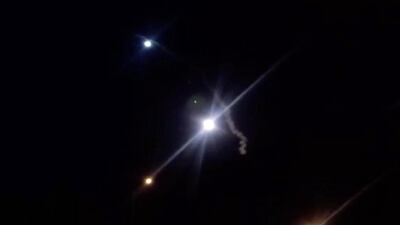
  • Rockets launched from Iran against the US military base in Ein-al Asad in Iraq, on January 8, 2020, days after the General Qassem Suleimani was killed by a US drone strike in Baghdad. EPA
    Rockets launched from Iran against the US military base in Ein-al Asad in Iraq, on January 8, 2020, days after the General Qassem Suleimani was killed by a US drone strike in Baghdad. EPA

Ties between Baghdad and Washington were tense, in what became known as post-ISIS Iraq.  The question looming was “to which extent was the US going to use Iraq as a battleground for regional politics, in particular with Iran”, said Renad Mansour, senior research fellow and Iraq expert at Chatham House.

In recent years, especially after President Donald Trump assumed office in 2016, Iraq has been vital to Washington’s strategy of containing the expansion and power of the Iranian regime.

The Trump administration’s “maximum pressure” campaign on Iran weakened its economy but did not stop Tehran from pushing its agenda in the region, including supporting its proxies in Yemen and Syria.

"It put Iraq in the line of fire," Mr Mansour told The National.

"Baghdad felt stuck between its powerful neighbour – which it could not alienate – and the US, the most powerful external actor [apart from] Iran,” he said.

“It strained Baghdad-Washington relations."

Shortly after the attack Iraq’s parliament voted for the departure of foreign troops from Iraq, and the US and other coalition troops have been leaving as part of a drawdown.

Looking ahead

With the new administration to take office in January, experts say the US will not increase its engagement with Iraq to the level it once was.

“I believe 2021 will be a different year for US-Iraqi relations, the change of administration in Washington will have a big effect on that,” said Abbas Kadhim, director of the Iraq initiative at the Atlantic Council.

There will be an increase in diplomatic co-operation between the two. Baghdad will receive less demands and threats from Washington, he said.

Political leaders in Baghdad face many challenges and would need to figure a way to sort out the country's internal issues, and to determine what kind of relationship it would have with Washington.

“The government needs to sort out the relations with political and non-state actors, who are using arms and not showing strong co-ordination with the commander in chief, while getting its act together economically, financially, and politically,” Mr Abbas said.

Mr Biden’s administration will clarify what the US wants from Iraq and vice versa.

“There will be a change with Biden, which will be more positive going forward. The potential to improve ties is there but 2020 has been a difficult year,” Mr Jiyad said.

Leaders in Baghdad are "optimistic that relations will improve with Biden with the support he has promised with the economic crisis and reducing tensions with Iran," he said.


How to help

Send “thenational” to the following numbers or call the hotline on: 0502955999
2289 – Dh10
2252 – Dh 50
6025 – Dh20
6027 – Dh 100
6026 – Dh 200

German intelligence warnings
  • 2002: "Hezbollah supporters feared becoming a target of security services because of the effects of [9/11] ... discussions on Hezbollah policy moved from mosques into smaller circles in private homes." Supporters in Germany: 800
  • 2013: "Financial and logistical support from Germany for Hezbollah in Lebanon supports the armed struggle against Israel ... Hezbollah supporters in Germany hold back from actions that would gain publicity." Supporters in Germany: 950
  • 2023: "It must be reckoned with that Hezbollah will continue to plan terrorist actions outside the Middle East against Israel or Israeli interests." Supporters in Germany: 1,250 

Source: Federal Office for the Protection of the Constitution

Global state-owned investor ranking by size

1.

United States

2.

China

3.

UAE

4.

Japan

5

Norway

6.

Canada

7.

Singapore

8.

Australia

9.

Saudi Arabia

10.

South Korea