


The way the US tells it, the drone strike that killed Iranian general Qassem Suleimani a year ago this week was a military operation to eliminate the linchpin of Tehran’s regional web of proxy militias.
Twelve months after the drone strike at Baghdad airport, US generals still discuss the grave threat Tehran poses to the region, including the repeated rocket attacks on the US embassy in the Iraqi capital, with the latest on December 20.
On the first anniversary of Suleimani’s death, it is clear that Iran suffered the loss of a canny military hero, but the killing was no game-changer in the four-decade struggle between Washington and Tehran.
A year of tensions - in pictures
-

An exhibition, calling for an end to executions in Iran, in Trafalgar Square on October 10, 2020 in London, England. The exhibition, held by Anglo-Iranian communities in the UK, marked the World Day against the Death Penalty. Getty Images -

Qassem Suleimani, Iranian Revolutionary Guards Corps (IRGC) Major General and commander of the Quds Force. A US strike killed the top Iranian commander and the deputy head of Iraq's PMU military force at Baghdad's airport early on January 3, 2019. AFP -

A destroyed vehicle on fire following a US strike on January 3, 2020 on Baghdad international airport road in which top Iranian commander Qassem Suleimani was killed along with eight others, including the deputy head of Iraq's powerful PMU paramilitary force. AFP -
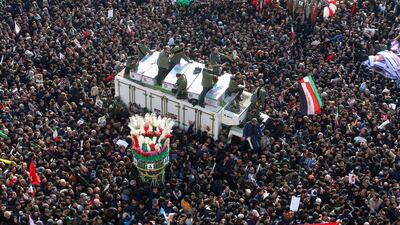
Iranian people attend a funeral procession for Iranian Major-General Qassem Suleimani, head of the elite Quds Force, and Iraqi militia commander Abu Mahdi al-Muhandis, in Tehran, Iran January 6, 2020. Reuters -

Mourners attend a funeral ceremony for Iranian General Qassem Suleimani. The processions mark the first time Iran honoured a single man with a multi-city ceremony. Not even Ayatollah Ruhollah Khomeini, who founded the Islamic Republic, received such a processional with his death in 1989. AP -

Rockets launched from Iran against the US military base in Ein-al Asad in Iraq, on January 8, 2020, days after the General Qassem Suleimani was killed by a US drone strike in Baghdad. EPA


"The assassination punctured the mystique of Suleimani as impenetrable and his Quds Force as undefeated," Behnam Ben Taleblu, an Iran expert at the Foundation for Defence of Democracies think tank, told The National.
“He was not replaced by anyone with comparable charisma or connections. But Suleimani’s success was the creation of relatively self-sufficient armed militias that are still capable and aligned with Tehran.
“These grass roots military operations will remain until they are tackled on the battlefield.”
Suleimani, 62, was killed in a US drone strike at Baghdad International Airport on January 3, 2020. He Tled the Quds Force, a branch of Iran's Islamic Revolutionary Guard Corps that ran foreign intelligence and unconventional warfare operations.
He was widely viewed as the second most powerful man in Iran after supreme leader Ayatollah Ali Khamenei and was credited with co-opting and co-ordinating militias in Lebanon, Syria, Iraq and beyond, forging a Shiite axis of influence across the Middle East.
Suleimani’s detractors blame him for the deaths of hundreds of American servicemen in Iraq, waves of attacks on Israel and a plot to murder a Saudi envoy to the US. To many Iranians, he was a patriotic warrior-philosopher.
US Gen Kenneth McKenzie described Suleimani as “cut-throat and ruthless” and the “magnetic, charismatic leader” who “pulled all the threads together” in a web of armed groups.
Tehran was weakened by the death of a “strong battlefield personality” from the early years of its revolution, said Gen McKenzie. His loss “unhinged Iran’s ability to direct” far-flung proxy forces, which carry out fewer attacks nowadays.
Still, Gen McKenzie said, those “Iranian-backed rogue militia groups” in Iraq and elsewhere have plenty more rockets to launch and Iran still yearns to avenge”Suleimani’s death and could step up attacks.
The US was ready for salvos on the anniversary and would react, he warned.
The true effect of Sulemani’s death is hard to measure. In the past year Iran’s economy was battered by Washington’s “maximum pressure” sanctions campaign, low oil prices and the coronavirus pandemic.
Suleimani was replaced by the deputy commander of the expeditionary Quds Force, Gen Esmail Qaani, who lacked his predecessor’s connections with leaders of Hezbollah, the Lebanese militia, and other proxies.
For Ali Alfoneh, an analyst at the Arab Gulf States Institute in Washington, a think tank, the Quds Force is a “highly institutionalised organisation” within the 125,000-strong IRGC and its “operations were not disrupted by the assassination”.
But much has changed this past year, he said.
After the 2003 US-led invasion of Iraq, Suleimani used his growing notoriety in the US and his social media profile as a “mobilisation force for a holy cause”, Mr Alfoneh said. Gen Qaani has dodged the limelight.
"Lacking charisma, Qaani, who is an effective manager more familiar with Excel charts than delivering rousing speeches to the masses, has turned the clock back to the pre-2003 era, when the Quds Force operated in the shadows," Mr Alfoneh said.
Nima Mina, an Iran expert at the School of Oriental and African Studies in London, sees problems for the Quds Force under Gen Qaani, who lacks the “political weight, charisma, communication skills and authority to fill Suleimani’s shoes”.
Whereas Suleimani and Khamenei had a close connection, Gen Qaani lacks this "personal relationship and trust" with the supreme leader, with worrying implications for the top of the revolutionary regime, Mr Mina said.
"The absence of real political parties and the weakness of political institutions make the role of individual political and military figures in Iranian politics and in the Islamic republic's zone of influence outside the country all the more important," Mr Mina said.
Without Suleimani’s network of contacts in the Levant, Gen Ghaani is struggling to bring together the leaders of Iraq’s Shiite faction and steer politics in Baghdad, contributing to a wave of anti-Iran protests in Iraq this past year, Mr Mina said.
Worse still, Gen Ghaani failed to effectively replace Abu Mahdi Al Muhandis, the founder of Kataib Hezbollah and deputy head of the Hashd Al Shaabi Iraqi paramilitary group, who was killed alongside Suleimani in last year's US drone strike.
"The Quds Force has not been able to react and push back against the Trump administration's aggressive approach against it and its allies in Iraq," Mr Mina said. "US bombings of Kataib Hezbollah bases remained unanswered."

