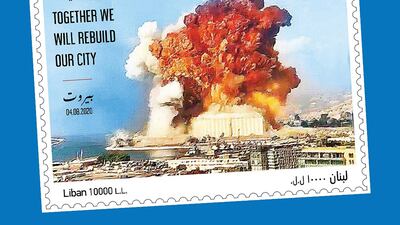
LibanPost has released a new Lebanese postage stamp commemorating the explosion in Beirut. LibanPost

LibanPost draws ire over Beirut blast stamp


  • English
  • Arabic

Lebanon’s national post office is under fire for launching a commemorative postage stamp showing the August 4 Beirut blast.

The new stamp from LibanPost will be sold for 10,000 Lebanese pounds ($6.50) and features a photograph of the blast as it ripped through the capital, along with the caption “together we will rebuild our city” and the date of the explosion.

The huge blast, felt as far away as Cyprus, killed at least 191 people and injured more than 6,500 others as buildings collapsed and windows shattered.

“The needs for reconstructing the infrastructure, for equipment and for first necessities remain so massive, that help should not be suspended,” LibanPost’s managing director Khalil Daoud wrote announcing the new stamp.

“To be of service, LibanPost decided to issue a “postal bloc/stamp” commemorating the dramatic Beirut Port blast,” he wrote.

All proceeds would go to the Lebanese Civil Defence, he added.

Although seemingly well-meant, the gesture was met with consternation.

“Someone needs to get fired over this tasteless LibanPost Beirut Blast stamp,” one user wrote on Twitter, sharing a photo of the stamp.

Underneath the Facebook post announcing the new stamp, one user wrote: “This is not right. Commemorating mass trauma and murder. Shame.”

“Very disrespectful, even if the intention is good!!” wrote another.

Others were in enthusiastic support of the initiative. "At least someone thought of the civil defence!" one commenter wrote.

Some agreed the idea of raising money for the Civil Defence was positive, but suggested a different photo would have been a more sensitive choice.

“The remnants of the silos would have been acceptable,” a Twitter user wrote. “This is insensitive to all Beirutis who have suffered. It is symptomatic of the apathy and lack of responsibility displayed since August 04. Shame!”

The large grain silos at the port likely shielded parts of Beirut from the worst of the explosion and remain a twisted and shattered shell.

LibanPost said the stamp was an effort to "confront our history".

"We respect all opinions and we consider that they are all different point of views whether regarding the timing or the design," Ronnie Richa, head of marketing at LibanPost, told The National.

"History is written through the stamps and important events are immortalised on stamps in order to keep remembering and move forward and beyond," he added.

"The picture of the blast is important to illustrate this dramatic event for the future generations' perception."

It is not the first time that LibanPost has drawn questions over its decision to issue collectables. Earlier this year, at the height of the banking crisis and as the unofficial rate of the Lebanese lira dropped from 1,507 to more than 9,000 against the dollar, the company announced that it was selling uncut sheets of freshly minted bills.

The five notes by eight notes sheet of 50,000 lira bills sold for 2,200,000 lira ($33), a markup of 200,000 lira.

Many asked why the postal company was making such a move during a financial crisis.

Mercer, the investment consulting arm of US services company Marsh & McLennan, expects its wealth division to at least double its assets under management (AUM) in the Middle East as wealth in the region continues to grow despite economic headwinds, a company official said.

Mercer Wealth, which globally has $160 billion in AUM, plans to boost its AUM in the region to $2-$3bn in the next 2-3 years from the present $1bn, said Yasir AbuShaban, a Dubai-based principal with Mercer Wealth.

Within the next two to three years, we are looking at reaching $2 to $3 billion as a conservative estimate and we do see an opportunity to do so,” said Mr AbuShaban.

Mercer does not directly make investments, but allocates clients’ money they have discretion to, to professional asset managers. They also provide advice to clients.

“We have buying power. We can negotiate on their (client’s) behalf with asset managers to provide them lower fees than they otherwise would have to get on their own,” he added.

Mercer Wealth’s clients include sovereign wealth funds, family offices, and insurance companies among others.

From its office in Dubai, Mercer also looks after Africa, India and Turkey, where they also see opportunity for growth.

Wealth creation in Middle East and Africa (MEA) grew 8.5 per cent to $8.1 trillion last year from $7.5tn in 2015, higher than last year’s global average of 6 per cent and the second-highest growth in a region after Asia-Pacific which grew 9.9 per cent, according to consultancy Boston Consulting Group (BCG). In the region, where wealth grew just 1.9 per cent in 2015 compared with 2014, a pickup in oil prices has helped in wealth generation.

BCG is forecasting MEA wealth will rise to $12tn by 2021, growing at an annual average of 8 per cent.

Drivers of wealth generation in the region will be split evenly between new wealth creation and growth of performance of existing assets, according to BCG.

Another general trend in the region is clients’ looking for a comprehensive approach to investing, according to Mr AbuShaban.

“Institutional investors or some of the families are seeing a slowdown in the available capital they have to invest and in that sense they are looking at optimizing the way they manage their portfolios and making sure they are not investing haphazardly and different parts of their investment are working together,” said Mr AbuShaban.

Some clients also have a higher appetite for risk, given the low interest-rate environment that does not provide enough yield for some institutional investors. These clients are keen to invest in illiquid assets, such as private equity and infrastructure.

“What we have seen is a desire for higher returns in what has been a low-return environment specifically in various fixed income or bonds,” he said.

“In this environment, we have seen a de facto increase in the risk that clients are taking in things like illiquid investments, private equity investments, infrastructure and private debt, those kind of investments were higher illiquidity results in incrementally higher returns.”

The Abu Dhabi Investment Authority, one of the largest sovereign wealth funds, said in its 2016 report that has gradually increased its exposure in direct private equity and private credit transactions, mainly in Asian markets and especially in China and India. The authority’s private equity department focused on structured equities owing to “their defensive characteristics.”

UAE tour of the Netherlands

UAE squad: Rohan Mustafa (captain), Shaiman Anwar, Ghulam Shabber, Mohammed Qasim, Rameez Shahzad, Mohammed Usman, Adnan Mufti, Chirag Suri, Ahmed Raza, Imran Haider, Mohammed Naveed, Amjad Javed, Zahoor Khan, Qadeer Ahmed
Fixtures:
Monday, 1st 50-over match
Wednesday, 2nd 50-over match
Thursday, 3rd 50-over match

UAE currency: the story behind the money in your pockets

THE SPECS

Engine: 2.0-litre 4-cylinder turbo

Power: 275hp at 6,600rpm

Torque: 353Nm from 1,450-4,700rpm

Transmission: 8-speed dual-clutch auto

Top speed: 250kph

Fuel consumption: 6.8L/100km

On sale: Now

Price: Dh146,999

Kandahar%20
%3Cp%3E%3Cstrong%3EDirector%3A%3C%2Fstrong%3E%20Ric%20Roman%20Waugh%3C%2Fp%3E%0A%3Cp%3E%3Cstrong%3EStars%3A%C2%A0%3C%2Fstrong%3EGerard%20Butler%2C%20Navid%20Negahban%2C%20Ali%20Fazal%3C%2Fp%3E%0A%3Cp%3E%3Cstrong%3ERating%3A%3C%2Fstrong%3E%202.5%2F5%3C%2Fp%3E%0A
