

Lebanon has registered its first death of a baby from Covid-19.
The baby girl was admitted to Beirut’s Rafic Hariri Hospital only 25 days after her birth, the hospital said on Wednesday. Once at the hospital a congenital heart condition and a case of coronavirus were confirmed.
Al Rassoul Al Azam hospital sent specialist open heart surgery team to operate on the child at Rafic Hariri Hospital “in the coronavirus emergency room under strict precautionary measures to avoid the transmission of the virus to staff,” a statement from Rafic Hariri Hospital read.
But the girl suffered from “acute inflammations” adding to the effect of coronavirus on her lungs, weakening her immune system, the statement added.
Al Rassoul Al Azam is one of two hospitals managed by Lebanese party Hezbollah in Beirut.
“Feeling sad. May her soul Rest in Peace. Our thoughts are with her family” tweeted the director of Rafic Hariri Hospital, Firass Abiad, on Wednesday.
With 33 deaths and 1622 cases since the pandemic was first detected in Lebanon in late February, the small Mediterranean country has escaped the swell in cases of some of its neighbours, but has seen a spike in cases over the last few days.
On Wednesday morning, local media reported that 19 new cases of Covid-19 had been detected, including seven among people repatriated back to Lebanon.
Syrian authorities announced that 12 Syrian students living in Lebanon who had returned to Syria to take exams had also tested positive for Covid-19.
-
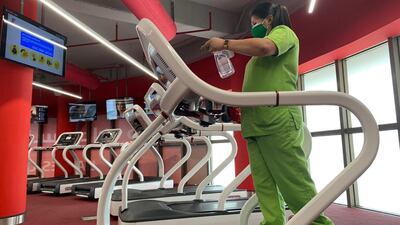
A woman, wearing a protective face mask, sanitises a machine before a training session at a gym in Saudi Arabia's capital Riyadh. AFP -
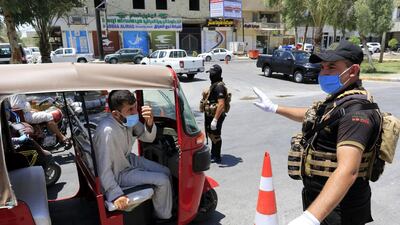
Iraqi policemen stand at a checkpoint during curfew in Karbala, south of Baghdad, Iraq. EPA -
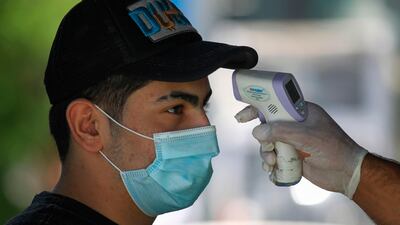
A customer, wearing a protective mask, gets his temperature checked before entering a supermarket in the Iraqi capital Baghdad. AFP -
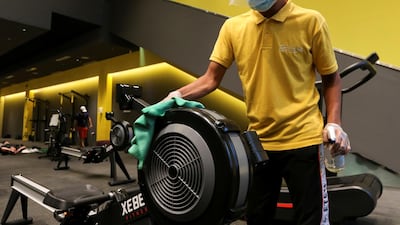
A worker wearing a protective face mask disinfects the training equipment at a gym in Riyadh, Saudi Arabia. Reuters -

A customer, wearing a protective mask, gets his temperature checked after passing through an automatic disinfection booth at the entrance of a supermarket in the Iraqi capital Baghdad. AFP -
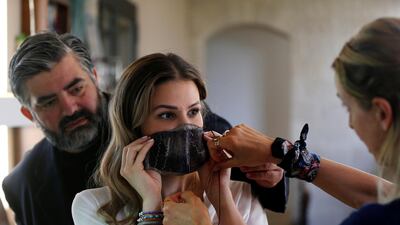
Jordanian chef Omar Sartawi and designers Princess Nejla Asem and Salam Dajani work to design sustainable face masks using eggplant skin at Dajani's workshop in Amman, Jordan. Reuters -
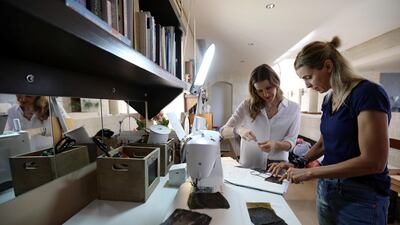
Jordanian designers Princess Nejla Asem and Salam Dajani work to design sustainable face masks using eggplant skin at Dajani's workshop in Amman, Jordan. Reuters -
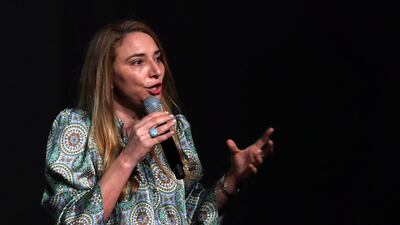
Tunisian Minister of Culture Chiraz Latiri speaks during a press conference in Tunis, Tunisia. Latiri said that the cultural sector was the most affected in the country by the Covid-19 crisis, as several hundred cultural activities were postponed until next year, and cultural venues and centres, as well as libraries, had to be closed due to the pandemic. EPA -

A ship coming from Morocco is seen as it enters the port in Algeciras, southern Spain. EPA



