Sara Jaafar was with a group of political activists on August 4, discussing strategies to challenge Lebanon’s rulers, when their building was shaken and the windows blown out by the explosion that rocked Beirut.
Ms Jaafar took cover from the flying debris, with thoughts rushing through her head of past political assassinations in Lebanon.
Her immediate reaction was that Hezbollah, the militant group that dominates power there, had attacked the dissidents’ meeting.
The blast was at the port of Beirut, caused by a stockpile of ammonium nitrate stored there for years.
So far, it appears to be a result of longtime government mismanagement.
No direct connection to Hezbollah has emerged in the explosion that wreaked destruction across the city and killed at least 190 people.
But theories abound about what sparked the explosion.
Ms Jaafar’s initial reaction reflected the fear that Hezbollah has instilled among many Lebanese and the power it has projected over the past decade.
For many, the Iran-backed Hezbollah now stands at the top of Lebanon’s sectarian-based system of power, and so is complicit in the corruption many blame for the port disaster and driving the country into near bankruptcy.
“Who controls most of everything?” asked Ms Jaafar, a secular Shiite. Hezbollah and its ally, President Michel Aoun, “are the people in charge. They bear the responsibility".
-
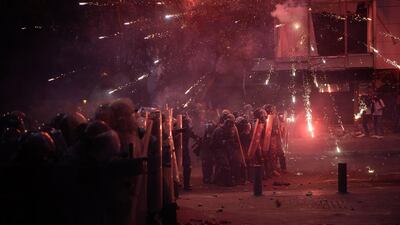
Fireworks thrown at riot police by anti-government protesters explode during clashes near the parliament building following last Tuesday's massive explosion in the seaport which devastated Beirut, Lebanon. AP Photo -
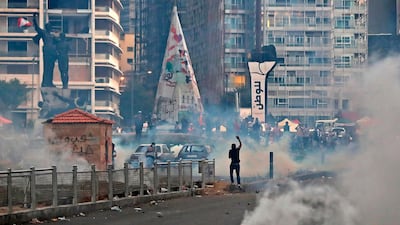
Lebanese protesters, enraged by a deadly explosion, clash with security forces at Martyrs' Square in Beirut. Lebanon's Prime Minister Hassan Diab stepped down amid fury within and outside his government over the deadly Beirut port blast he blamed on the incompetence and corruption of a decades-old ruling class. AFP -
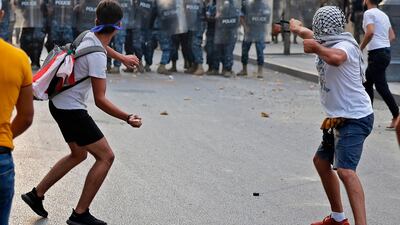
Lebanese protesters, enraged by a deadly explosion, hurl stones at security forces amid clashes in central Beirut. Lebanon's Prime Minister Hassan Diab stepped down amid fury within and outside his government over the deadly Beirut port blast he blamed on the incompetence and corruption of a decades-old ruling class. AFP -
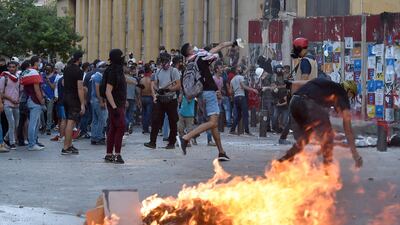
Lebanese anti-government protesters throw stones at security forces at one of the roads leading to the parliament building in Beirut, Lebanon. EPA -
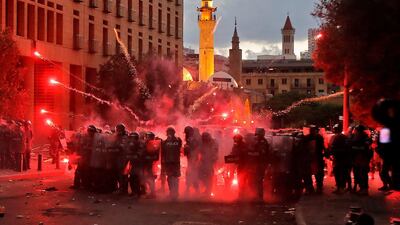
Lebanese security forces clash with protesters near the parliament building in central Beirut following a huge chemical explosion that devastated large parts of the Lebanese capital. AFP -
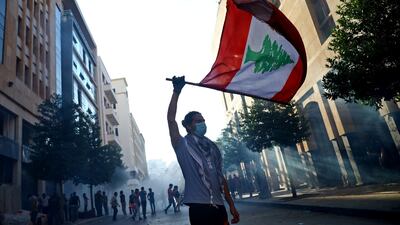
A demonstrator waves a Lebanese flag during anti-government protests that have been ignited by a massive explosion in Beirut, Lebanon. Reuters -
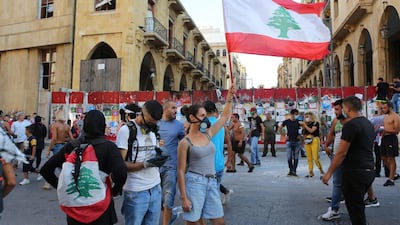
Protesters wave a Lebanese flag during demonstrations near the parliament building in Beirut, Lebanon. EPA -
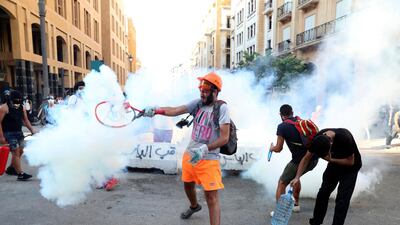
An anti-government protester uses a tennis racket to hit back a tear gas canister towards riot policemen during a protest following last Tuesday's massive explosion, which devastated Beirut, Lebanon. AP Photo -
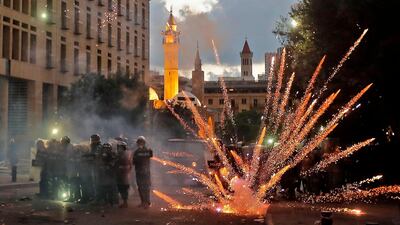
Lebanese security forces clash with protesters near the parliament in central Beirut following a huge chemical explosion that devastated large parts of the Lebanese capital. AFP -
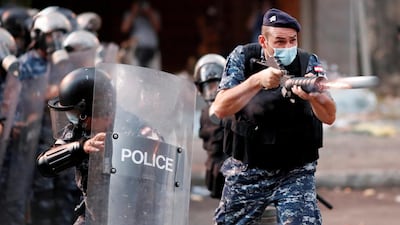
A member of Lebanese riot police fires a weapon during anti-government protests that have been ignited by a massive explosion in Beirut, Lebanon. Reuters -
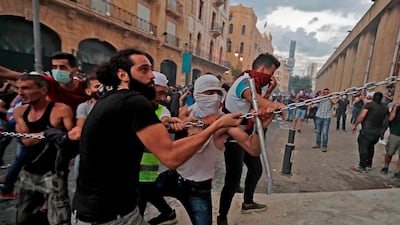
Lebanese protesters try to storm the vicinity of the parliament in central Beirut following a huge chemical explosion that devastated large parts of the Lebanese capital. AFP -
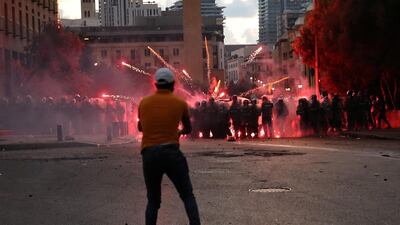
A demonstrator throws fireworks at riot police during anti-government protests that have been ignited by a massive explosion in Beirut, Lebanon. Reuters


After the blast, Hezbollah has come under unprecedented public criticism and its role in Lebanese politics under intense scrutiny.
Cardboard effigies of Hezbollah’s leader, Hassan Nasrallah, and other politicians were hung on nooses at a rally after the blast.
Some accused Hezbollah of storing weapons at the port, a claim it denies. Hezbollah’s political rivals seized the opportunity to fan hostilities against it and its allies.
Social media posts mocked Nasrallah’s speeches.
One noted how the US killing of Iranian commander Qassem Suleimani in Iraq in January left Nasrallah to weep and threaten revenge, while in his first speech after the blast he was smiling and calm.
“There is a paradox there with Hezbollah,” said Nicholas Blanford, a Hezbollah expert in Beirut.
"They have never been more powerful, politically and militarily. But they have never faced such an array of challenges."
The discontent with Hezbollah comes as Lebanese suffer an economic crash that has driven nearly half of the population into poverty.
Rather than push for reform, critics say, Hezbollah has stood by its political allies who resist change.
It also denied support to nationwide protests that erupted in October, demanding the end of the dysfunctional political structure.
US sanctions against Iran and Hezbollah made things harder.
For years, Hezbollah maintained a clean reputation and distance from Lebanon’s political elite.
It developed its power and resources as a resistance movement against Israel and became virtually a state within a state, heading a powerful military force and a welfare network for Shiite supporters.
Hezbollah remains Lebanon’s only armed force outside the military. It controls the borders and plays a crucial role in Iranian-backed wars in the region, including Syria’s.
In 2005, an explosion killed former Prime Minister Rafik Hariri and changed Lebanon’s political course.
The lorry bomb, blamed on Hezbollah, sent nearly a million people on to the streets and forced the militants' ally Syria to end its occupation of Lebanon.
After that, Hezbollah began to infiltrate the system, from having a handful of parliament members to becoming Lebanon’s most powerful political faction.
It and its allies formed the last cabinet, the failures of which came to be seen as Hezbollah’s, Mr Blanford said.
And they were many. The government failed to enact reforms, stem the financial meltdown or negotiate a rescue package with the International Monetary Fund.
It finally resigned after the explosion.
Hezbollah plays a significant role in forming the new government.
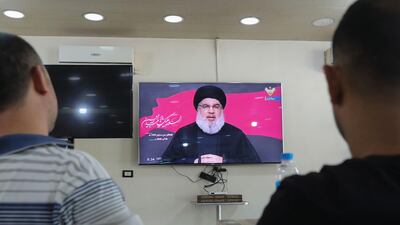
To deflect criticism, Nasrallah addressed supporters several times, denying Hezbollah had anything to do with the port blast.
He made thinly veiled warnings to critics. In an August 14 speech, Nasrallah warned repeatedly against pushing Lebanon toward civil war.
He urged supporters to “hold on to their anger” over criticism, hinting that it would be unleashed against opponents.
In Hezbollah’s stronghold in the Beirut suburb Dahiyeh, supporters regarded the explosion as a conspiracy to weaken Lebanon and the group.
“We had two places to bring money and assistance from: the port and the airport,” said Issam Kaeen, 42, a coffee shop owner.
"Something had to happen somewhere so that the siege is tightened and so that these people rise against their rulers."
Mohammed Abi Shakra, who owns a women’s clothes shop, said an Israeli attack on the port could not be ruled out.
“This is a conspiracy against the Lebanese people to make them poor, to incite civil war,” Mr Abi Chakri said.
Meanwhile, social tension is on the rise. Opponents of Hezbollah clashed twice with the group’s supporters, including in a gunfight on Thursday that killed two bystanders and wounded several.
Gunmen reportedly opened fire over religious banners raised by Hezbollah supporters.
“There is no god but God, and Nasrallah is the enemy of God,” mourners chanted at a funeral for one of the killed.
After the explosion, Hezbollah made some internal changes, part of a shift inwards after the nationwide protests and its receding role in Syria’s war, an official with the group said.
The group’s security chief was given a bigger portfolio and the head of an agency that co-ordinates with allies was replaced.
Media operations are also changing, the official said.
After the blast, Ms Jaafar and other victims demanded an international investigation.
“We lost our homes, our kids, our fathers and our city,” she said in an angry speech at a gathering near the port. "We lost everything."
“All of them means all of them,” the small crowd chanted, naming Nasrallah among other leaders they want out of power.
An architect, Ms Jaafar is considering leaving the destruction as a reminder of how it all went wrong.
Active since the October protests, she is frustrated by the small turnout in rallies since the blast but recognises an outpouring of public anger is only one requisite for change.
Ms Jaafar, like many in Lebanon, sees her country’s political crisis as a product of rivalry between Hezbollah’s patron, Iran, and the US and Gulf states.
Only a resolution to that conflict will force change, she said.
“I understand why they exist," Ms Jaafar said. "They filled the gap where the state failed.
“But we want a real nation, a real country. This is a jungle.”
She said activists are realising that they must work with allies within the system for change – push for early elections and challenge Hezbollah and its allies in Parliament.
“We won’t get rid of them in one election,” Ms Jaafar said.

