Lebanon's Foreign Minister Nassif Hitti, a veteran diplomat and former Lebanese ambassador to the Arab League, resigned on Monday saying he could not continue given the poor performance of the government.
After meeting Prime Minister Hassan Diab on Monday morning at the Grand Serail he urged those in charge to change course.
“Lebanon today is not the Lebanon that we loved and wanted as a beacon and a model,” the resigned minister said. “Lebanon today is slipping into a failed state.”
He blamed an absence of vision as well as historical circumstances for the present crisis.
“In the absence of an effective will to achieve the required comprehensive structural reforms that our nation demands, I decided to resign from my duties as Minister of Foreign Affairs. I hope the government and those in charge of the state administrations reconsider many policies and practices in order to give priority to the people and the country over all other considerations and divisions.”
Lebanon in crisis
He said that instead of a clear will to fix the country's ills, he found a government and politicians with competing interests.
"What is required in the state-building process are creative minds, a clear vision, sincere intentions, a culture of institutions and the rule of law, accountability and transparency," he said.
"I participated in this government to work for one employer called Lebanon, but I found in my country (different) employers and contradictory interests. They did not agree on the interest to rescue the Lebanese people."
President Michel Aoun’s diplomatic adviser Charbel Wahbi was appointed as the new foreign minister later on Monday afternoon.
Before the announcement, a senior official confirmed that Mr Hitti would resign over the government's lack of achievements.
"He is mainly not happy with the performance of the government," the senior official told The National. But the source pushed back on media speculation that Mr Hitti was angered by Mr Diab's treatment of French Foreign Affairs Minister Jean-Yves Le Drian during a recent trip to Lebanon and that he felt overshadowed by the head of one of Lebanon's most powerful intelligence agencies, Maj Gen Abbas Ibrahim, who travelled to Kuwait and Qatar in July as President Michel Aoun's personal envoy.
The source dismissed the reasons being put forward by the press, saying these "are not serious”.
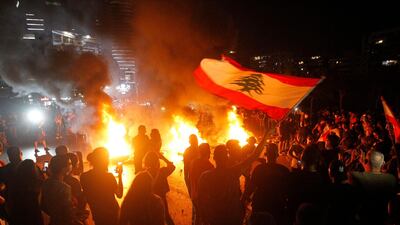
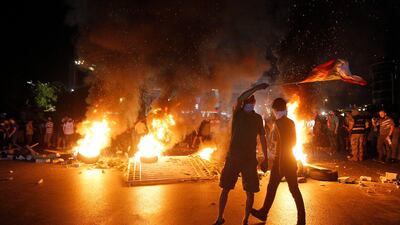
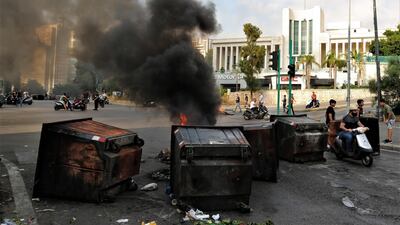
The government has made little progress in passing needed reforms or tackling pressing problems like the mounting piles of rubbish, lengthening daily power cuts and rising poverty.
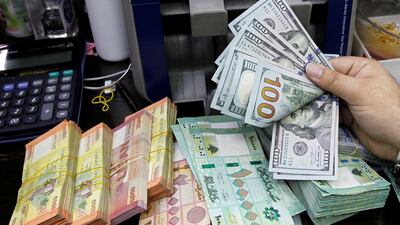
Put together in late January to address Lebanon’s worst-ever economic crisis after months of social unrest, the government has failed to implement the required reforms to receive financial aid from the international community. Negotiations with the International Monetary Fund, which began in May, have stalled.
During a two-day visit to Lebanon in late July, Mr Le Drian stated that Lebanon would not receive any support from the international community, including France, if it did not “wrap up negotiations with the IMF”, reform the electricity sector and increase the independence of the judiciary. He urged the Lebanese “to help us help you.”
In what was widely criticised as a blunder by Lebanese politicians, Mr Diab said a few days later that Mr Le Drian “lacked information” about government reforms.

Dubai Bling season three
Cast: Loujain Adada, Zeina Khoury, Farhana Bodi, Ebraheem Al Samadi, Mona Kattan, and couples Safa & Fahad Siddiqui and DJ Bliss & Danya Mohammed
Rating: 1/5
if you go
The flights
Air Astana flies direct from Dubai to Almaty from Dh2,440 per person return, and to Astana (via Almaty) from Dh2,930 return, both including taxes.
The hotels
Rooms at the Ritz-Carlton Almaty cost from Dh1,944 per night including taxes; and in Astana the new Ritz-Carlton Astana (www.marriott) costs from Dh1,325; alternatively, the new St Regis Astana costs from Dh1,458 per night including taxes.
When to visit
March-May and September-November
Visas
Citizens of many countries, including the UAE do not need a visa to enter Kazakhstan for up to 30 days. Contact the nearest Kazakhstan embassy or consulate.
Mercer, the investment consulting arm of US services company Marsh & McLennan, expects its wealth division to at least double its assets under management (AUM) in the Middle East as wealth in the region continues to grow despite economic headwinds, a company official said.
Mercer Wealth, which globally has $160 billion in AUM, plans to boost its AUM in the region to $2-$3bn in the next 2-3 years from the present $1bn, said Yasir AbuShaban, a Dubai-based principal with Mercer Wealth.
“Within the next two to three years, we are looking at reaching $2 to $3 billion as a conservative estimate and we do see an opportunity to do so,” said Mr AbuShaban.
Mercer does not directly make investments, but allocates clients’ money they have discretion to, to professional asset managers. They also provide advice to clients.
“We have buying power. We can negotiate on their (client’s) behalf with asset managers to provide them lower fees than they otherwise would have to get on their own,” he added.
Mercer Wealth’s clients include sovereign wealth funds, family offices, and insurance companies among others.
From its office in Dubai, Mercer also looks after Africa, India and Turkey, where they also see opportunity for growth.
Wealth creation in Middle East and Africa (MEA) grew 8.5 per cent to $8.1 trillion last year from $7.5tn in 2015, higher than last year’s global average of 6 per cent and the second-highest growth in a region after Asia-Pacific which grew 9.9 per cent, according to consultancy Boston Consulting Group (BCG). In the region, where wealth grew just 1.9 per cent in 2015 compared with 2014, a pickup in oil prices has helped in wealth generation.
BCG is forecasting MEA wealth will rise to $12tn by 2021, growing at an annual average of 8 per cent.
Drivers of wealth generation in the region will be split evenly between new wealth creation and growth of performance of existing assets, according to BCG.
Another general trend in the region is clients’ looking for a comprehensive approach to investing, according to Mr AbuShaban.
“Institutional investors or some of the families are seeing a slowdown in the available capital they have to invest and in that sense they are looking at optimizing the way they manage their portfolios and making sure they are not investing haphazardly and different parts of their investment are working together,” said Mr AbuShaban.
Some clients also have a higher appetite for risk, given the low interest-rate environment that does not provide enough yield for some institutional investors. These clients are keen to invest in illiquid assets, such as private equity and infrastructure.
“What we have seen is a desire for higher returns in what has been a low-return environment specifically in various fixed income or bonds,” he said.
“In this environment, we have seen a de facto increase in the risk that clients are taking in things like illiquid investments, private equity investments, infrastructure and private debt, those kind of investments were higher illiquidity results in incrementally higher returns.”
The Abu Dhabi Investment Authority, one of the largest sovereign wealth funds, said in its 2016 report that has gradually increased its exposure in direct private equity and private credit transactions, mainly in Asian markets and especially in China and India. The authority’s private equity department focused on structured equities owing to “their defensive characteristics.”
On the menu
First course
▶ Emirati sea bass tartare Yuzu and labneh mayo, avocado, green herbs, fermented tomato water
▶ The Tale of the Oyster Oyster tartare, Bahraini gum berry pickle
Second course
▶ Local mackerel Sourdough crouton, baharat oil, red radish, zaatar mayo
▶ One Flew Over the Cuckoo’s Nest Quail, smoked freekeh, cinnamon cocoa
Third course
▶ Bahraini bouillabaisse Venus clams, local prawns, fishfarm seabream, farro
▶ Lamb 2 ways Braised lamb, crispy lamb chop, bulgur, physalis
Dessert
▶ Lumi Black lemon ice cream, pistachio, pomegranate
▶ Black chocolate bar Dark chocolate, dates, caramel, camel milk ice cream
Day 1 results:
Open Men (bonus points in brackets)
New Zealand 125 (1) beat UAE 111 (3)
India 111 (4) beat Singapore 75 (0)
South Africa 66 (2) beat Sri Lanka 57 (2)
Australia 126 (4) beat Malaysia -16 (0)
Open Women
New Zealand 64 (2) beat South Africa 57 (2)
England 69 (3) beat UAE 63 (1)
Australia 124 (4) beat UAE 23 (0)
New Zealand 74 (2) beat England 55 (2)
Also on December 7 to 9, the third edition of the Gulf Car Festival (www.gulfcarfestival.com) will take over Dubai Festival City Mall, a new venue for the event. Last year's festival brought together about 900 cars worth more than Dh300 million from across the Emirates and wider Gulf region – and that first figure is set to swell by several hundred this time around, with between 1,000 and 1,200 cars expected. The first day is themed around American muscle; the second centres on supercars, exotics, European cars and classics; and the final day will major in JDM (Japanese domestic market) cars, tuned vehicles and trucks. Individuals and car clubs can register their vehicles, although the festival isn’t all static displays, with stunt drifting, a rev battle, car pulls and a burnout competition.
Read more about the coronavirus
More from Neighbourhood Watch:
More from Neighbourhood Watch
Company%20profile
%3Cp%3EName%3A%20Cashew%0D%3Cbr%3EStarted%3A%202020%0D%3Cbr%3EFounders%3A%20Ibtissam%20Ouassif%20and%20Ammar%20Afif%0D%3Cbr%3EBased%3A%20Dubai%2C%20UAE%0D%3Cbr%3EIndustry%3A%20FinTech%0D%3Cbr%3EFunding%20size%3A%20%2410m%0D%3Cbr%3EInvestors%3A%20Mashreq%2C%20others%0D%3C%2Fp%3E%0A
SM Town Live is on Friday, April 6 at Autism Rocks Arena, Dubai. Tickets are Dh375 at www.platinumlist.net
Specs
Engine: Electric motor generating 54.2kWh (Cooper SE and Aceman SE), 64.6kW (Countryman All4 SE)
Power: 218hp (Cooper and Aceman), 313hp (Countryman)
Torque: 330Nm (Cooper and Aceman), 494Nm (Countryman)
On sale: Now
Price: From Dh158,000 (Cooper), Dh168,000 (Aceman), Dh190,000 (Countryman)
Ten tax points to be aware of in 2026
1. Domestic VAT refund amendments: request your refund within five years
If a business does not apply for the refund on time, they lose their credit.
2. E-invoicing in the UAE
Businesses should continue preparing for the implementation of e-invoicing in the UAE, with 2026 a preparation and transition period ahead of phased mandatory adoption.
3. More tax audits
Tax authorities are increasingly using data already available across multiple filings to identify audit risks.
4. More beneficial VAT and excise tax penalty regime
Tax disputes are expected to become more frequent and more structured, with clearer administrative objection and appeal processes. The UAE has adopted a new penalty regime for VAT and excise disputes, which now mirrors the penalty regime for corporate tax.
5. Greater emphasis on statutory audit
There is a greater need for the accuracy of financial statements. The International Financial Reporting Standards standards need to be strictly adhered to and, as a result, the quality of the audits will need to increase.
6. Further transfer pricing enforcement
Transfer pricing enforcement, which refers to the practice of establishing prices for internal transactions between related entities, is expected to broaden in scope. The UAE will shortly open the possibility to negotiate advance pricing agreements, or essentially rulings for transfer pricing purposes.
7. Limited time periods for audits
Recent amendments also introduce a default five-year limitation period for tax audits and assessments, subject to specific statutory exceptions. While the standard audit and assessment period is five years, this may be extended to up to 15 years in cases involving fraud or tax evasion.
8. Pillar 2 implementation
Many multinational groups will begin to feel the practical effect of the Domestic Minimum Top-Up Tax (DMTT), the UAE's implementation of the OECD’s global minimum tax under Pillar 2. While the rules apply for financial years starting on or after January 1, 2025, it is 2026 that marks the transition to an operational phase.
9. Reduced compliance obligations for imported goods and services
Businesses that apply the reverse-charge mechanism for VAT purposes in the UAE may benefit from reduced compliance obligations.
10. Substance and CbC reporting focus
Tax authorities are expected to continue strengthening the enforcement of economic substance and Country-by-Country (CbC) reporting frameworks. In the UAE, these regimes are increasingly being used as risk-assessment tools, providing tax authorities with a comprehensive view of multinational groups’ global footprints and enabling them to assess whether profits are aligned with real economic activity.
Contributed by Thomas Vanhee and Hend Rashwan, Aurifer
Company%20profile
%3Cp%3E%3Cstrong%3ECompany%20name%3A%20%3C%2Fstrong%3EHakbah%0D%3Cbr%3E%3Cstrong%3EStarted%3A%20%3C%2Fstrong%3E2018%0D%3Cbr%3E%3Cstrong%3EFounder%3A%20%3C%2Fstrong%3ENaif%20AbuSaida%0D%3Cbr%3E%3Cstrong%3EBased%3A%20%3C%2Fstrong%3ESaudi%20Arabia%0D%3Cbr%3E%3Cstrong%3ESector%3A%20%3C%2Fstrong%3EFinTech%0D%3Cbr%3E%3Cstrong%3ECurrent%20number%20of%20staff%3A%20%3C%2Fstrong%3E22%20%0D%3Cbr%3E%3Cstrong%3EInitial%20investment%3A%20%3C%2Fstrong%3E%24200%2C000%0D%3Cbr%3E%3Cstrong%3EInvestment%20stage%3A%20%3C%2Fstrong%3Epre-Series%20A%0D%3Cbr%3E%3Cstrong%3EInvestors%3A%20%3C%2Fstrong%3EGlobal%20Ventures%20and%20Aditum%20Investment%20Management%0D%3Cbr%3E%3Cbr%3E%3C%2Fp%3E%0A
Breast cancer in men: the facts
1) Breast cancer is men is rare but can develop rapidly. It usually occurs in those over the ages of 60, but can occasionally affect younger men.
2) Symptoms can include a lump, discharge, swollen glands or a rash.
3) People with a history of cancer in the family can be more susceptible.
4) Treatments include surgery and chemotherapy but early diagnosis is the key.
5) Anyone concerned is urged to contact their doctor