


The all-too-familiar stench of rubbish returned to Lebanon’s biggest cities in the past week after waste collection companies faced labour strikes or were forced to reduce operations because of the economic crisis and the coronavirus pandemic.
“I think that each month we’ll have a rubbish crisis because the government is not providing a solution, they are trying to cover their eyes and ears,” said Walid Bou Saad, general manager of Ramco, which collects waste in Beirut and neighbouring high-density regions of Keserwan and Metn.
Lebanon has a long-standing waste management problem because of a lack of investment in durable solutions, but the issue has seldom made headlines since a temporary way out was found to a rubbish crisis in 2015 that caused mass protests.
Lebanon’s worst economic crisis has brought the matter back to light after a liquidity crunch forced the government to start paying contractors Lebanese pounds instead of US dollars last November.
The knock-on effects have been disastrous for Ramco and other waste companies. Without dollars, they are unable to continue borrowing money from banks or to pay back their debts. Additionally, they have to buy dollars at an inflated price on the black market to import spare parts for their trucks and uniforms for their employees, increasing their running costs.
The switch to Lebanese pounds also angered Ramco’s 250 Bangladeshi employees, who went on strike in April. They relied on their salaries in dollars to support families back home, but the local currency has lost over 80 per cent of its value on the black market since last summer.
Ramco called in 240 Syrians to work in their place but they all had to be quarantined last week after 131 contracted the coronavirus. On Sunday, with only 150 employees available instead of the usual 500, Ramco could barely operate and rubbish started piling up in the streets of Beirut, Keserwan and Metn.
Normal waste collection resumed in Beirut on Wednesday after an urgent meeting with the head of the municipality on Tuesday evening. The municipality agreed to pay the $7 million dollars owed to the company in services since last December, said Mr Bou Saad.
Around 100 of the Bangladeshis who were on strike also agreed to return to work for a few days to clear up the rubbish in Beirut after management doubled their daily salary. Those who continue the strike will be fired starting Saturday, he said.
But the Finance Ministry still owes Ramco $10 million dollars for the Metn and Keserwan regions, which are managed under a separate contract. Negotiations with representatives of the prime minister are “not going well,” said Mr Bou Saad. As a result of the strike and delayed payments, rubbish has not been collected in the two regions since Sunday.
_______________
Coronavirus in the Middle East
-
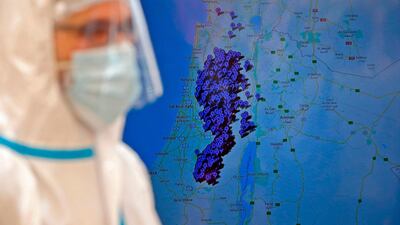
A doctor from the Palestinian ministry of health stands next to a map tracking the location of people infected with the coronavirus, in Hebron in the occupied West Bank. AFP -
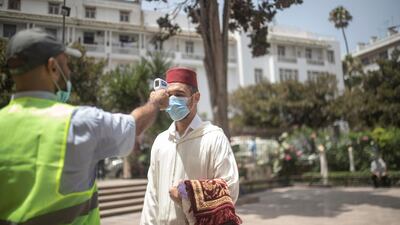
A worker checks the temperature of people who are going to pray at a mosque in Rabat, Morocco. With the exception of Friday prayer, mosques reopened for the first time since their closure in March following the coronavirus outbreak. AP Photo -

A Palestinian youth sells sweets by the beach in Gaza City as coronavirus restriction eases. AFP -

A health worker conducts a coronavirus test at a drive-through testing centre in the central Iraqi city of Najaf. AFP -
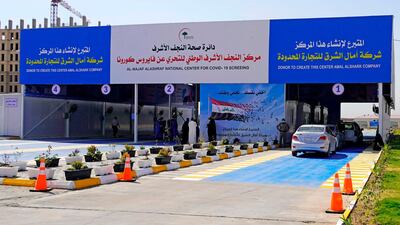
A drive-through testing facility for coronavirus in the central Iraqi city of Najaf. AFP -

An employee from the ministry of health during a radio broadcast that offers advice about the coronavirus precautionary measures at a radio station in Basra, Iraq. Reuters -

A doctor displays a blood sample taken from a person suspected of being infected with the coronavirus in Hebron in the occupied West Bank. AFP -
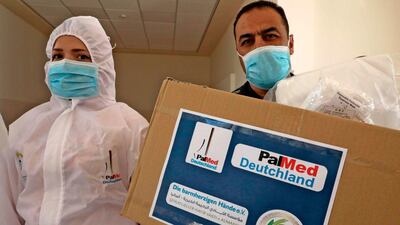
Dr Issam Mujahed, right, a member of the Pal-Med Europe, presents medical donations to doctors battling the coronavirus in Hebron in the occupied West Bank. AFP -

A Palestinian man rides a bicycle with his child in Gaza City as coronavirus lockdown eases. AFP -
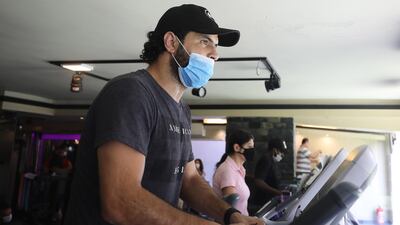
People training at a gym after its reopening in Cairo, Egypt. EPA -

People train at a gym after its reopening in Cairo, Egypt. EPA -

A policeman wears a face mask as he reviews the passport of a traveller at Mohammed V International Airport in Casablanca, Morocco. AP Photo


_______________
The Lebanese government has always been slow to pay contractors, but the delays used to be manageable because banks provided them loans to cover their expenses.
Banks refuse to do this now because the contractors are paid in Lebanese pounds despite their debts remaining in dollars, said Milad Moawad, chief executive of City Blu, which collects waste in Beirut’s southern suburbs and the neighbouring regions of Baabda, Aley and Chouf.
“Our debts increase day after day as long as operations continue,” he said. “We are currently spending three times more than we collect. That’s very dangerous. We can no longer survive like this.”
The freefall of the local currency also pushed City Blu’s 1,200 employees – 70 per cent of whom are migrant workers – to go on strike on Sunday.
Mr Moawad said that the company had increased the salary of its non-Lebanese employees by 40 per cent in February, but the crash of the Lebanese pound worsened after confinement measures were announced to curb the spread of the pandemic the following month. Today, the dollar is worth around 8,000 Lebanese pounds on the black market.
By Wednesday, City Blu had convinced 70 per cent of the company’s employees to return to work.
The company told them that the strike “will not help in getting a better result and asked them to give us more time to negotiate” with the government, said Mr Moawad.
Both Mr Moawad and Mr Bou Saad said that they suggested to the government to pay them in local dollar cheques that they could deposit in their bank accounts. They would not be able to cash the money since banks restrict access to dollars, but it would appear on their balance and enable them to cover their debts in the American currency. The government did not accept this solution, but more meetings are scheduled this week.
In a similar move to City Blu and Ramco, waste management company Lavajet reduced its operations by half on Wednesday in Lebanon’s second biggest city, Tripoli, for the second time in two weeks. Its chief executive, Sarkis Boulos, argued that it was not officially a strike.
“We wanted to be heard by authorities. We need to be paid as fast as possible,” he told The National. “Banks do not give us loans any more that would enable us to bear delayed payments from the Finance Ministry. We are in a very difficult situation.”
The Finance Ministry is 10 months late in payments to Lavajet, according to Mr Boulos, who declined to give a figure. He said that the company has been unable to pay its employees, who are all Lebanese and paid the minimum wage of 675,000 Lebanese pounds a month or more, for the month of June.
On Wednesday, 250 Lavajet employees received food aid from the Association for the Protection of Tripoli’s Heritage. An increasing number of Lebanese are reliant on food handouts as the price of basic products, which are mostly imported, have doubled, or sometimes tripled, in less than a year.
“I don’t know what the solution is,” said Mr Boulos. “The value of the Lebanese pounds paid by the ministry is divided by at least 6 or 7. But this is a business that cannot stop. It’s obvious as soon as we do,” he said, referring to rubbish piling up in the streets.
“We are in the middle of a real crisis. It’s a sanitary crisis, a hygiene crisis, and a health crisis. The implications of not addressing the rubbish problems are devastating to Tripoli and to the entire Lebanese population,” Tripoli MP Dima Jamali told The National.
“The responsibility is now on the government and the central bank to find solutions,” she said.

